



Survey overview
Employees across the Middle East are more optimistic about artificial intelligence and skills development than workers in many other regions, yet they are also reporting higher levels of fatigue and pressure in their day-to-day jobs, according to a new survey from PwC.
The Middle East Workforce Hopes and Fears Survey 2025 draws on responses from 1,286 people in both public and private sector roles. It examines attitudes toward technology, skills, leadership, well-being, and career plans over the next few years.
The findings suggest that national efforts to promote digital transformation are filtering down to the workplace. At the same time, they highlight a growing need for employers to balance rapid change with stronger support for employee well-being and clearer communication about the future of work.
Strong Embrace of Artificial Intelligence
According to the report, the use of artificial intelligence tools in daily work is already widespread in the region. About 75% of respondents said they had used artificial intelligence at work during the previous twelve months. That compares with around 67% of employees worldwide who reported the same.
Workers who already use artificial intelligence report clear benefits. Around 80% say it has made them more productive. Meanwhile, 87% say it has improved the quality of their work, with a similar proportion pointing to a lift in creativity, from help with new ideas to faster problem solving.
Looking ahead three years, nearly 80% of respondents think artificial intelligence will further lift their productivity, with more than 80% expecting it to improve the quality of their work, and almost the same share anticipating continued gains in creativity.
This optimism extends to job security and earnings. More than 50% already feel artificial intelligence has strengthened their position at work rather than threatened it, while about 50% believe it will have a positive effect on their pay in the coming years. Those figures are higher than the global averages in the wider PwC survey.

Skills and Training Move to The Center
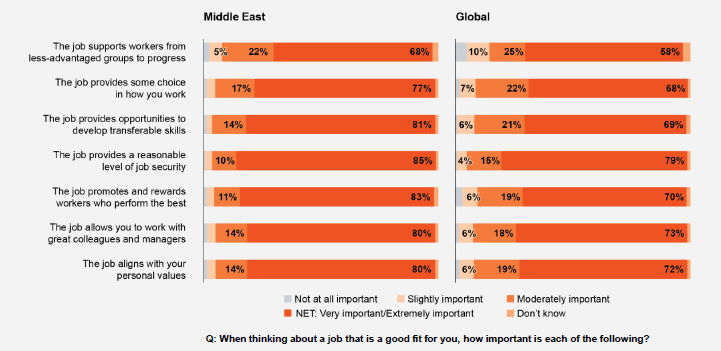
The report points to a marked shift toward a skills-first mindset, with more than 80% of employees saying they prefer roles that build transferable skills usable across different jobs and industries, a preference that is even stronger among younger workers at the start of their careers.
Nearly 70% of respondents say they have learned new skills over the past year. A similar proportion feel they have good access to training and development resources at work, noticeably more than the global comparison group.
Inside organizations, many employees report that their managers support them in developing new capabilities. More than 50% say they feel safe trying new approaches and that their teams treat mistakes as a source of learning rather than only as failure. This environment, the report argues, makes it easier for workers to experiment with emerging tools such as generative artificial intelligence.
High Motivation Mixed with Fatigue
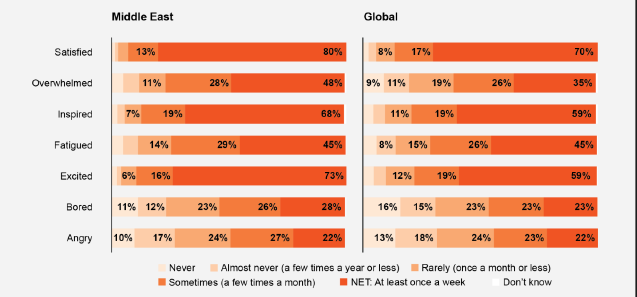
Middle East employees appear more engaged than their peers in many other regions. About 78% say they look forward to going to work. Around 84% express pride in the work they do. A similar share, 76%, say they are willing to go above and beyond their formal responsibilities.
These figures indicate a workforce that still sees meaning and opportunity in its roles. However, other answers point to rising strain. About 45% of respondents say they feel fatigued at least once a week, similar to the global average of 45%. Around 48% say they feel overwhelmed at work with the same frequency, compared with 35% globally, a noticeably higher level than the worldwide average.
Almost 49% report feeling anger at work at least a few times a month, compared with 45% globally. PwC notes that last year’s edition of the survey already showed a sharp increase in workloads. The new data suggests that pressure has remained high even as employees have become more experienced with new technology and ways of working.
Alignment fades, and Job Hopping Slows
Employees still feel broadly aligned with the direction set by their organizations, but this alignment has weakened compared with last year. Almost 75% say their day-to-day work connects to long-term organizational goals, down from close to 90% in the previous survey.
At the same time, attitudes to career moves are shifting. Job security now sits at the top of the priority list when workers in the region consider a new role. Around 85% rate security as critical, more than any other factor and above the global average. This percentage is true across different age groups, including Gen Z, millennials, and Gen X.
Fewer employees say they intend to ask for a promotion in the coming year compared with the previous survey, although the figure remains higher than the global average. The proportion planning to ask for a pay raise has dropped even more sharply from last year. Additionally, intentions to change employer have fallen from more than 40% of respondents in the earlier survey to less than 30% in 2025.
Taken together, these results point to a workforce that is more cautious about job moves than in recent years. PwC suggests that softer labor market conditions and economic uncertainty may be encouraging employees to stay put even as they continue to build skills and adopt new technology.
Flexibility and Autonomy Gain Ground
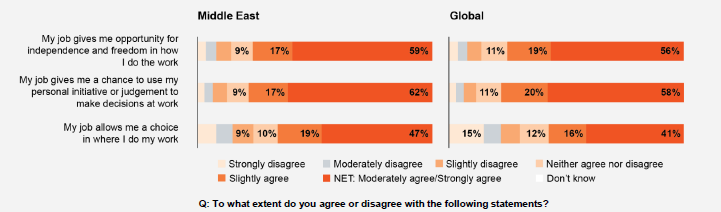
The survey also looks at how much control employees feel they have over their work. Around 60% say they have significant freedom to decide how they carry out their tasks, slightly more than the global average. A similar share say they can use their judgement and personal initiative in their roles.
On work locations, 47% say they have some choice over where they work, and among those whose roles can be done remotely, 59% follow a hybrid pattern that mixes office and home days, 23% work entirely in person, and 18% are fully remote.
What These Numbers Tell Us
The figures indicate a significant shift in the nature of working life. Artificial intelligence is moving from experiment to everyday tool, and that shift is rewriting what it means to be effective at work.
In the Middle East, most employees now use artificial intelligence, and many say it helps them deliver better work faster, with skills rather than job titles becoming the real currency of security and progress.
Workers are investing in learning because they believe that knowing how to work with intelligent systems will decide who stays relevant.
At the same time, the data on fatigue, feeling overwhelmed, and anger at work shows that this transition is stretching people. The same tools that lift output also raise expectations. Employees are expected to learn constantly, respond faster, and stay connected for longer. That pressure spills into home life, affecting energy, mood, and the sense of control over time.
Globally and in the region, the lesson is clear. Artificial intelligence can raise productivity and support higher quality jobs, but only if employers redesign work, protect rest time, and managers start to look after people as well as performance. Otherwise, gains in efficiency will come with a growing human cost.
Read More: AI to Guide Antibody Design as ImmunoMatch Predicts Sequence-Based Pairing


