




CIA Deputy Director Michael Ellis told Politico that the agency is planning to deploy AI in intelligence analysis after recently using the technology to produce its first autonomous report, as the U.S. agency moves to speed up assessments of foreign threats.
CIA Brings AI Into Core Analysis
Ellis said the Central Intelligence Agency plans to embed AI tools across its analytic platforms over the coming years, giving analysts classified generative AI systems to assist with core tasks, such as drafting judgments, testing conclusions, and spotting patterns in incoming intelligence.
He added that the agency expects AI to play a growing role in how it assesses the plans, intentions, and capabilities of foreign governments, while stressing that final decisions would remain in human hands.
The comments mark the beginning of the CIA’s push to integrate AI into one of its most closely guarded and central missions, turning fragments of information gathered by spies and surveillance tools into assessments for U.S. policymakers.
Agency Builds Wider AI Capabilities
Ellis said the agency had already tested 300 AI projects last year, including tools for processing large datasets and translating languages, and is also working to put AI and other advanced technologies in the hands of officers collecting intelligence overseas.
He said the CIA’s expanded Center for Cyber Intelligence, which oversees clandestine hacking operations, would be an important driver of that effort.
Ellis also suggested the agency would resist outside constraints on how it uses private-sector AI technology, saying the CIA would not allow companies to dictate its lawful use of those tools.
He framed the push as part of a broader effort to keep pace with fast-moving technological change and maintain an edge over China, which he described as the United States’ top strategic rival.
CIA’s Bet on Emerging Tech Goes Back to 1999
The CIA’s use of emerging technology stretches back decades. In 1999, the agency helped establish In-Q-Tel, a venture-backed firm created to connect U.S. intelligence agencies with fast-moving commercial innovation, an early sign that the CIA saw outside technology as essential to modern intelligence work.
That push became more institutional in October 2015, when the CIA created its Directorate of Digital Innovation, the first new directorate at the agency in more than 50 years.
The unit brought together cyber operations, open-source intelligence, data science, and digital capabilities under one roof, reflecting the agency’s effort to adapt to an environment increasingly shaped by online activity, connected devices, and digital communications.
The next step came in 2020, when the CIA launched CIA Labs as its in-house federal laboratory to work more closely with academia and private industry on frontier technologies, including artificial intelligence, biotechnology, and quantum computing.
The agency said the lab aimed to speed the transition of scientific advances into intelligence applications.
By 2023, CIA-published research was openly discussing AI’s growing role in analysis, arguing that the technology could assist analysts in handling large volumes of data rather than replace human judgment.
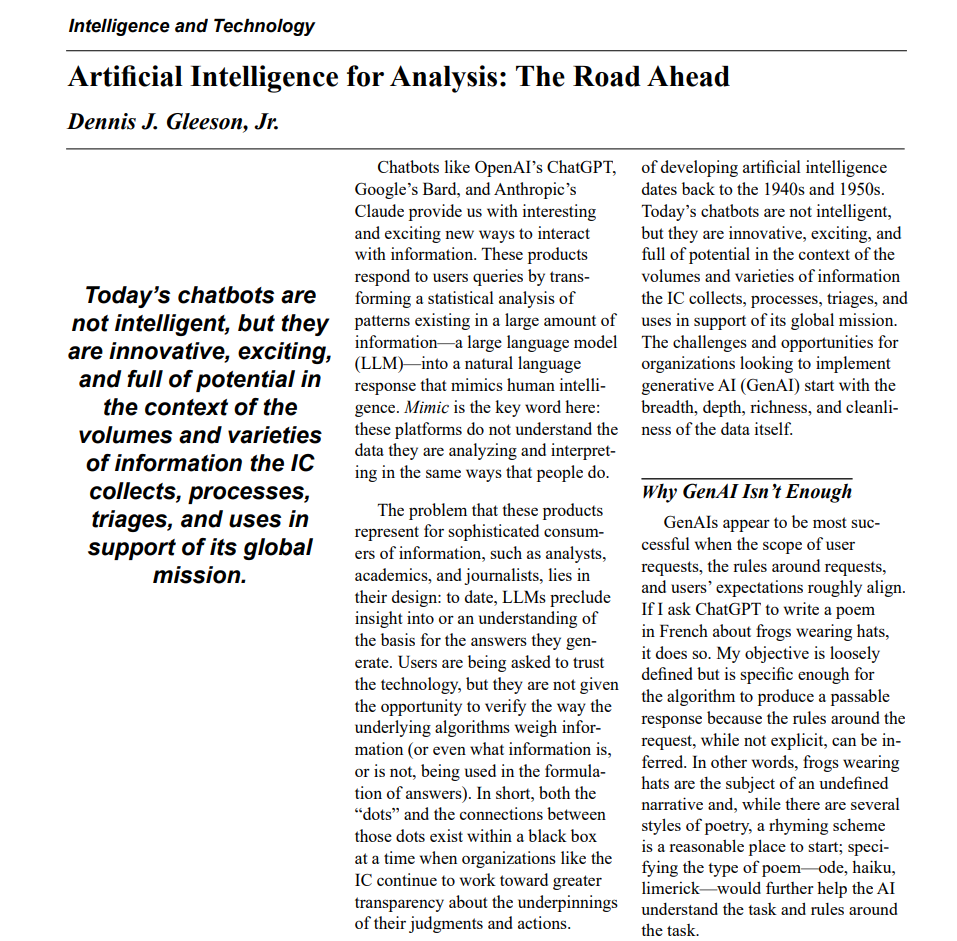
Ellis’s latest remarks suggest that the process is now moving from experimentation to deployment, with AI being embedded directly into the agency’s core analytic workflow.


