




David Sacks has completed his 130-day term as President Donald Trump’s crypto and artificial intelligence czar, ending the temporary White House role that allowed him to serve as a special government employee while opening the door to a wider role on technology policy.
Speaking to Bloomberg, Sacks said he had reached the legal time limit for that position but would remain involved in the administration as co-chair of the President’s Council of Advisors on Science and Technology, known as PCAST. In that role, he said, he expects to advise on a broader set of issues stretching beyond AI and digital assets into semiconductors, quantum computing, and nuclear energy.
A Larger Role in Tech Policy
Sacks described PCAST as a long-running federal advisory body designed to bring leading figures in science and industry together to make recommendations to the president and the White House. He said the newly formed group includes high-profile technology executives and researchers such as Nvidia’s Jensen Huang, AMD’s Lisa Su, Meta’s Mark Zuckerberg, and Dell Technologies’ Michael Dell.
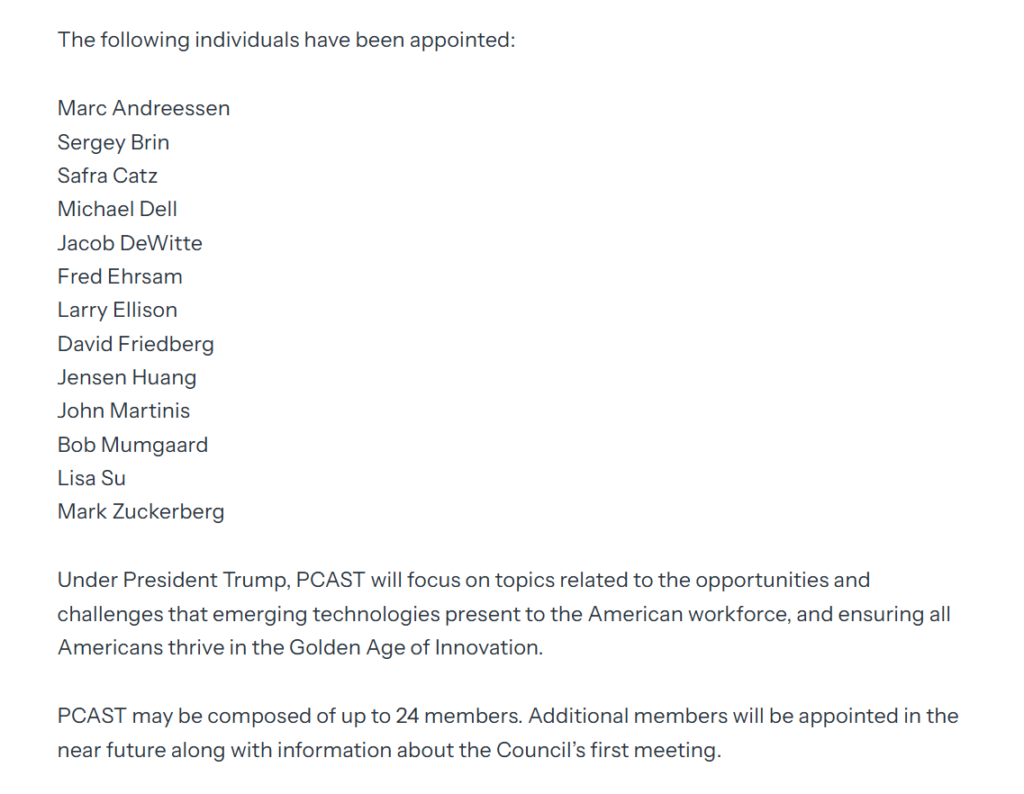
According to Sacks, the administration wants the council to draw on both research expertise and practical business experience, with an emphasis on people who have built companies around major technological breakthroughs. He said the panel would study issues, gather evidence, and publish reports that could later help shape policy.
Focus on AI Rules and Infrastructure
Sacks said artificial intelligence would remain an immediate priority for the administration, particularly after the release of what he called a national AI framework. He said the White House wants to replace what it sees as a fragmented patchwork of state-level rules with a single national standard, arguing that companies cannot easily navigate 50 different regulatory systems.
Sacks said that the framework focuses on child safety, protections for content creators, and measures to ensure that new data centers do not drive up electricity costs for households, while making it easier for AI companies to secure their own power supply and expand infrastructure.
Export Strategy and Political Outlook
On trade and technology exports, Sacks said the administration broadly favors expanding the global reach of American technology, arguing that market share helps cement both economic strength and strategic influence.
He added, however, that exports to countries such as China would still require a more careful and tailored approach.
Sacks also said he believed the AI framework had received a constructive response on Capitol Hill and suggested bipartisan legislation could emerge in the coming months.
Inside Sacks’ 130 Days in the White House
During his 130 days as crypto and AI czar, Sacks helped turn Trump’s crypto and AI agenda into policy.
On crypto, Sacks played a visible role in some of the administration’s biggest early moves. He was involved in the White House effort to set up a digital-assets working group, helped lead the March crypto summit, and backed the creation of a strategic bitcoin reserve made up of assets already seized by the government. He also chaired a White House report that supported dollar-backed stablecoins and called for clearer rules for the crypto industry.
On AI, Sacks helped shape the administration’s lighter regulatory approach, co-signed America’s AI Action Plan, and backed a federal framework aimed at replacing a patchwork of state laws. Reports also pointed to his role in easing some Biden-era limits on AI chip exports, while he remained a public advocate for expanding the global reach of U.S. technology.


