




Table of Contents
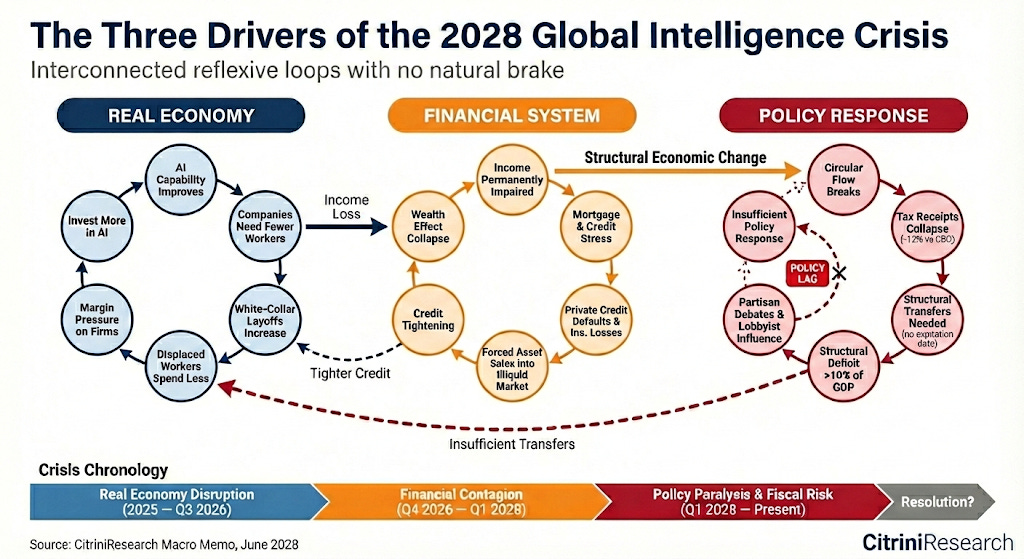
A new “thought exercise” from Citrini Research imagines a future where artificial intelligence delivers the promised productivity boom but triggers a deep economic and financial shock the authors call a “Global Intelligence Crisis.”
The scenario, written as if dated June 2028, pictures unemployment above 10%, the S&P 500 down almost 40% from its 2026 peak, and AI infrastructure stocks still thriving while the human-led consumer economy weakens, highlighting hidden risks if machine intelligence becomes abundant.
AI boom lifts profits while demand quietly erodes
In the scenario, corporate America rides an AI wave through late 2026, where indexes hit record highs as companies automate white-collar work, margins widen, and profits are recycled back into more compute.
Headline GDP and productivity look strong as AI agents perform office tasks continuously at low cost, boosting output per hour. Owners of data centers and chips are the main winners, while wage growth for knowledge workers stalls and then turns negative.
As displaced office workers move into lower-paid roles, consumer spending softens, creating what the authors call “ghost GDP”, where output shows up in national accounts but never reaches household income or demand because machines do not buy goods and services.
Software shock spreads across the service economy
The authors trace the origins of the crisis to a leap in “agentic” coding tools in 2025, when small teams gained the ability to rebuild middle-market SaaS products quickly and cheaply, and by mid-2026, procurement teams at large companies were already using that new leverage to demand steep price cuts.
In the scenario, incumbent platforms slow, cut staff, and spend more on AI tools to protect margins, choices that seem rational for each firm on its own but that together accelerate a loop in which AI capabilities improve, payrolls shrink, and demand falls.
By early 2027, AI assistants are embedded in daily life, automatically optimizing purchases, subscriptions, and renewals, and industries that once relied on human friction and inertia, such as travel booking, insurance renewals, financial advice, routine legal work, and residential brokerage, see fees squeezed as agents relentlessly compare prices and renegotiate on behalf of users.
Food delivery and ride-hailing apps, once protected by habit and app placement, face low-cost competitors and growing margin pressure as agents route orders through the cheapest option and increasingly use low-fee stablecoins to transact, putting card networks and monoline issuers under strain.
The global intelligence crisis hits the white-collar
The scenario shows investors initially misreading the damage as confined to software, consulting, and payments, overlooking that the United States is essentially a white-collar services economy in which higher earners drive most discretionary spending.
After the damage spills into other sectors, job postings in software, finance, and consulting fall sharply, while demand for blue-collar workers in areas such as healthcare and construction holds up but cannot compensate for lost high-income demand, pulling real wages lower in both groups.
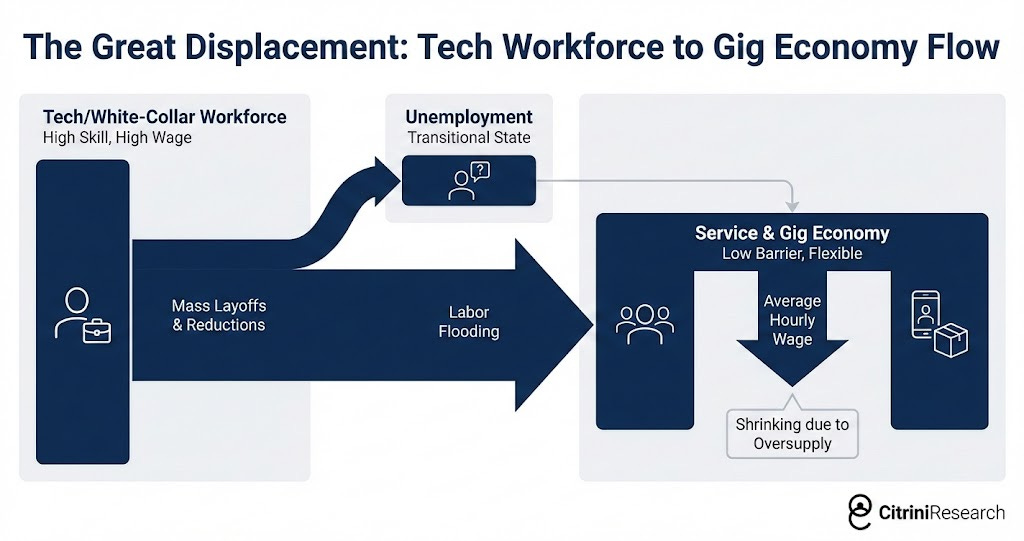
Unlike earlier technology shifts, AI both automates existing roles and quickly learns the tasks that might have become the new jobs, so the new AI-related positions that do appear pay less and are far fewer than the roles eliminated.
Private credit and prime mortgages pulled into the loop
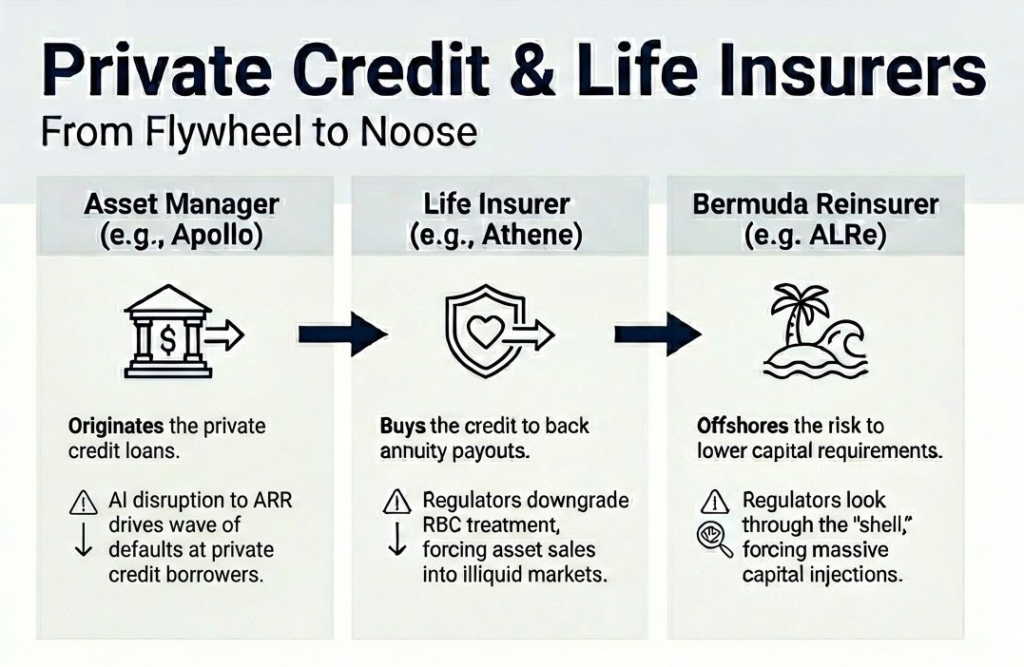
As the downturn deepens, stress spreads into private credit as years of leveraged buyouts of software and information services firms, priced on the assumption of stable recurring revenue, collide with AI-driven contract cancellations and price cuts.
When a large software company backed by private equity fails to meet its debt obligations, credit investors are forced to rethink how much of their portfolios depends on businesses vulnerable to AI, and the resulting losses spill over to life insurers that bought many of these loans, pushing regulators to tighten capital rules and adding more pressure to sell.
At the same time, falling incomes among high-earning professionals start to weigh on the $13 trillion U.S. mortgage market. The scenario shows rising delinquencies and falling home prices in tech-heavy cities, not because loans were poor quality at origination, but because borrowers’ earnings power is structurally lower than assumed.
The memo asks whether even “prime” mortgages can still be treated as safe if white-collar employment and pay remain under pressure.
Policy fights time and public anger
The final section focuses on politics. As labor’s share of GDP falls and income shifts to capital and compute, tax receipts undershoot projections just as more workers need long-term support rather than short, cyclical benefits.
Proposals in the scenario include a “Transition Economy Act” offering direct transfers to displaced workers funded partly by a tax on AI compute and a broader “Shared AI Prosperity Act” that would give the public a claim on AI-generated returns.
Public frustration spills into protests aimed at leading AI labs, echoing the anger once directed at banks after the global financial crisis. The authors argue that while each side looks for villains, the deeper problem is time, as institutions struggle to adapt at the speed of technological change.
Intelligence premium under pressure
Citrini Research frames the exercise as the unwind of a centuries-old “intelligence premium,” where scarce human cognition was the core productive asset shaping labor markets, credit systems, and tax rules.
In the scenario, markets are forced to reprice that assumption as machine intelligence becomes cheap and abundant. The authors say such a repricing would be painful but not necessarily catastrophic, and stress that today’s investors and policymakers still have a chance to act before these outcomes take shape.
Writing in early 2026, they argue there is still time to examine how far the financial system depends on earnings streams tied to expensive human intelligence, and to design new frameworks before reality begins to resemble the thought experiment.


