





Key Takeaways:
- Kinto Exchange is shutting down after a hack in July drained 577 ETH (worth around $2.4 million), making recovery impossible to this point.
- The exploit was a CPIMP attack, a sophisticated industry-wide vulnerability affecting proxy contracts.
- User assets on the Layer 2 (L2) remain safe and can be withdrawn until September 30th.
Table of Contents
The Fatal Blow: A CPIMP Exploit
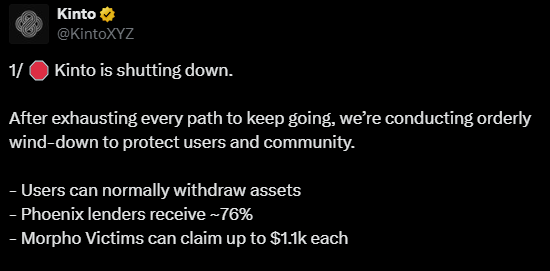
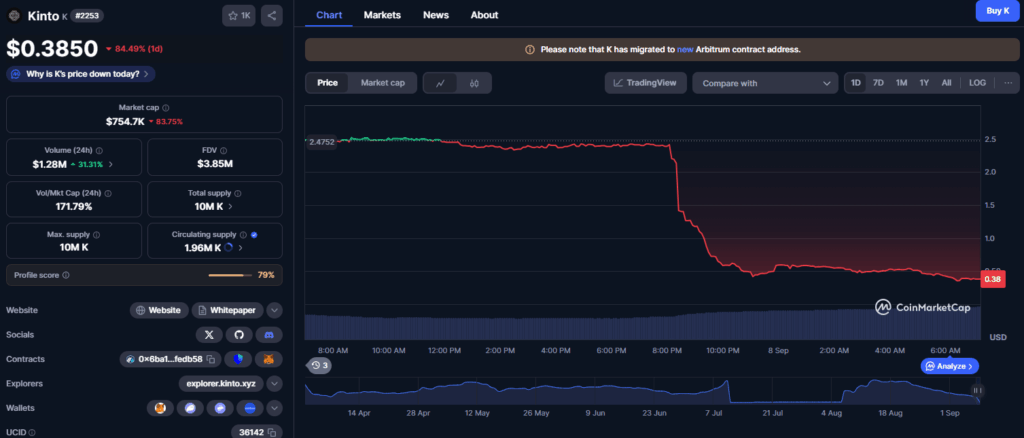
A sobering moment in the Ethereum Layer 2 (L2) landscape occurred when Kinto, an L2 modular exchange with a focus on security, announced it was shutting down just months after the exploit. Following the news that Kinto exchange was ceasing operations, the project’s native K token is down by over 84%, marking a tragic ending for a project praised for its style.
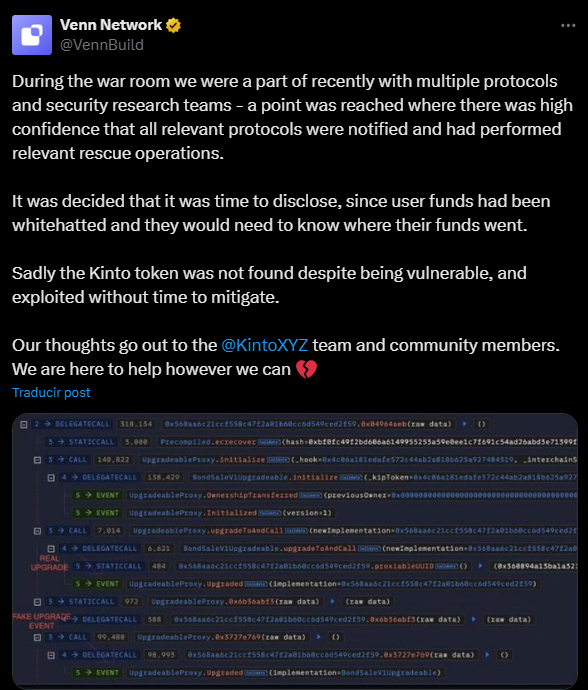
The rupture began with a CPIMP (Controlled Proxy Implementation Manipulation) exploit on the Foundation’s own Kinto minting agency. While not a breach of its core L2 or wallets, but an advanced and sophisticated exploit targeting the $K token proxy contract on Arbitrum. The hacker drained 577 ETH, which at the time was around $2.4 million, and financially destroyed the project beyond the point of recovery.
A Failed Rescue Attempt
In a last-ditch effort, the team attempted to survive and raised over $1 million in emergency debt from “Phoenix” lenders to reestablish trading and get going again. Unfortunately, with the theft of funds, the new debt raised, and the hard market conditions, it started to feel that it could not continue to fundraise and work on the project. The team that had not been paid since July was forced to initiate an orderly shutdown of the platform to take care of the users first.
Read also: BtcTurk Hit by $48M Hot Wallet Hack – Trading Active but Exchange Halts Withdrawals
The Orderly Wind-Down
Kinto’s response has been lauded for its transparency and user-first approach. All user assets on the Kinto exchange are still safeguarded and accessible for withdrawal until September 30th. The project is consolidating its remaining treasury of about $800,000 to make whole its Phoenix lenders, who will likely recoup about 76% of their principal. To add, the founder is donating $55,000 from his own pocket to make small hack victims whole.
Summing Up
The collapse of the Kinto exchange highlights the existential risks in decentralized finance (DeFi) and L2s, where a single, multi-faceted smart contract vulnerability can unravel years of work overnight. Its responsible shutting down of operations creates a great context for project accountability in failure.
Final Thought: Will Kinto’s transparent wind-down transition itself to a standard for failed crypto projects, or will the incident stamp out innovation in permissionless L2 development?
FAQs
What was the CPIMP attack?
It refers to a complex exploit that manipulated proxy contracts, a common coding pattern in DeFi, allowing hackers to drain funds from multiple projects.
Are users’ funds safe on Kinto exchange?
Yes, user assets on the Kinto L2 were never compromised. Users must withdraw them by September 30, 2025.
What happens to the $K token?
The K token is essentially worthless following the shutdown announcement, hence its 84% price crash.
For more crypto hack stories, read: Shocking LuBian Bitcoin Hack: How $3.5B Vanished in Crypto’s Biggest Heist


