




Key Takeaways
- MIT’s national scale model finds current AI tools can already perform tasks equal to nearly twelve percent of US wage value.
- Most exposure lies in administrative, financial and professional services rather than in software roles.
- States with limited tech sectors face hidden risk because white collar functions show far higher exposure than visible adoption suggests.
- Researchers say the Iceberg Index offers early warning, while traditional metrics like GDP and unemployment fail to capture emerging AI driven shifts.
Table of Contents
A new study from the Massachusetts Institute of Technology (MIT) shows that current artificial intelligence (AI) systems already demonstrate the technical capacity to take over nearly 12% of work performed across the United States labor market.
The research estimates that more than $1 trillion in annual wage value sits within reach of existing digital tools, far beyond the visible adoption taking place in technology companies.
Drawing on a national scale simulation involving more than 150 million workers, the researchers argue that AI exposure is not in software roles but in administrative, financial and professional service functions that appear stable to the public.
Their conclusion is blunt: the visible impact on coders and data specialists reflects only a small fraction of what present day AI systems can already perform.
Project Iceberg and Its Skills-Based Measure
The study relies on a framework called Project Iceberg, a model designed to evaluate where human work and machine capability intersect.
Rather than tracking job titles or employment trends after change occurs, the project focuses on the underlying skills that make up daily tasks.
The index aggregates thousands of software agents, automation systems and copilots, mapping them to more than 30,000 human skills used in occupations across the country.
The index offers an early view of where AI can already match human skills, regardless of whether companies have begun adopting the technology. It acts as a capability map, showing areas of potential impact well before changes appear in employment data.
Where Traditional Metrics Fall Short
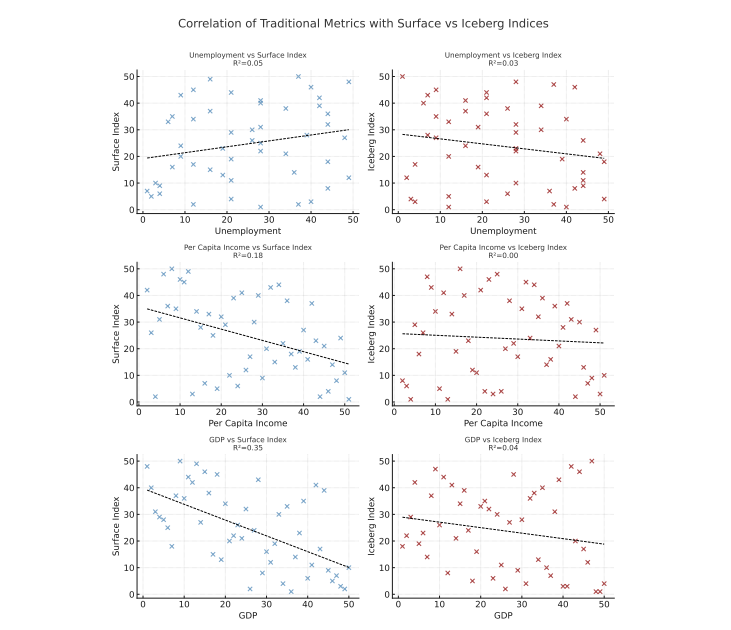
The researchers note that traditional economic measures were created for earlier eras with clear boundaries between human and machine roles. Gross domestic product, unemployment rates and income rankings are useful for measuring outcomes but offer little insight into how tasks and skills are shifting. AI platforms and gig-based digital work often fall outside official reporting, creating a large blind zone for policymakers.
MIT researchers argue that without a skill-centered approach, governments are likely to underestimate where disruption is building. By the time employment figures reveal the effects, the shift in tasks may already be far along.
Findings from the Iceberg Index
The Iceberg Index results reveal a much broader pattern beneath the visible shifts in the technology sector. The data shows that AI capability is not showing up in only a small sector of the working world but reaching into routine decision making, document handling, coordination and analytical work that supports everyday operations across industries.
The researchers note that this spread is driven by the nature of digital tools themselves, as systems originally designed for programming support are now showing competence in reading, transforming and generating information, allowing their use to influence finance departments, administrative teams and professional services.
The index therefore captures the scale of change not by tracing adoption in firms but by mapping where current tools already demonstrate capability across thousands of work activities.
According to the study, visible effects in software and computing roles account for only around 2% of national wage value. The researchers describe this portion as the surface layer, small in scale but highly visible to the public because it affects headline industries. Beneath that surface, the index shows that cognitive and administrative exposure is roughly five times larger.
Limits of the Analysis and What Comes Next
The researchers acknowledge that their index measures technical exposure, not job losses or timelines, meaning actual outcomes will depend on firm strategy, regulation and worker adaptation. The study also focuses on digital AI tools because reliable adoption data for physical robotics remains limited.
The researchers conclude that the United States is entering a moment when human skills and machine intelligence will work side by side in ways today’s metrics cannot quite follow. They note that governments and employers who plan ahead will navigate the transition smoothly, while those watching only the usual economic data may find themselves reacting too late.
Read More: Your Secrets May Not Be Safe With AI: Microsoft Warns of ‘Whisper Leak’ Attack


