





Morningstar Inc, an independent provider of investment insights, has launched an index that tracks 20 of the largest generative artificial intelligence specialists worldwide, aiming to give investors a clearer view of the companies building the core software layer of the technology.
The Morningstar PitchBook GenAI 20 Index tracks firms specialized in designing, training, or operating generative models and related tools. The benchmark is meant to follow those companies as they move from late-stage private funding into stock market trading and beyond, instead of focusing only on established listed names that sit in traditional equity indexes.
The index uses data and a classification framework from PitchBook, a Morningstar company, to identify businesses that advance key fields such as machine learning, natural language processing, computer vision, and agent-based systems.
According to the company, eligible firms must derive most of their value and revenue from the generative software layer that can serve many industries. Companies that mainly provide hardware, consulting, or narrow single-sector products are excluded so that the index reflects what Morningstar describes as pure-play exposure.
Valuation-based Selection and 20% Cap per Company
The index selects the 20 largest qualifying companies based on their latest valuation. It includes both private and public firms and applies a 20% cap on the weight of any single name to avoid excessive concentration.
Morningstar says the design allows the index to follow companies through their full life cycle as long as they continue to meet the rules, meaning a firm can in principle enter the index as a private company and remain in it after an initial public offering if it still fits the definition of a core generative AI provider.
The launch of the GenAI 20 Index builds directly on a joint report on the generative frontier by Morningstar and PitchBook. That study describes generative technology as a foundational software layer for the global economy, similar in importance to earlier shifts such as the rise of cloud computing.
Study Sees GenAI Bringing Trillions of Dollars in Yearly Activity
The research estimates that widespread adoption of generative systems could unlock between $3 trillion and $4 trillion of economic value each year. It attributes this mainly to higher productivity, lower operating costs, and faster innovation as companies use models to automate routine work, improve decision-making, and redesign software-based processes.
The research also projects a sharp acceleration in capital spending on advanced computing. It predicts that big cloud and infrastructure companies will spend about $1.8 trillion a year by 2030, up from about $300 billion in 2024. Meanwhile, revenue from companies that sell generative models and related services could rise to roughly $460 billion by 2032.
Taken together, the report suggests that close to $2 trillion of additional AI-related spending could be added to the world economy over a 5-year window, even before counting potential future investment in autonomous agents or physical AI systems.
AI Adoption shows 71% of Firms Use Generative Tools
The study also tracks how quickly organizations are adopting AI and generative tools. By 2025, 78% of organizations were using some form of AI in at least 1 business function, up from 55% in 2024. Use of generative systems grew even faster, from 33% of firms in 2023 to 71% in 2024, with most of those users interacting with the tools weekly or daily.
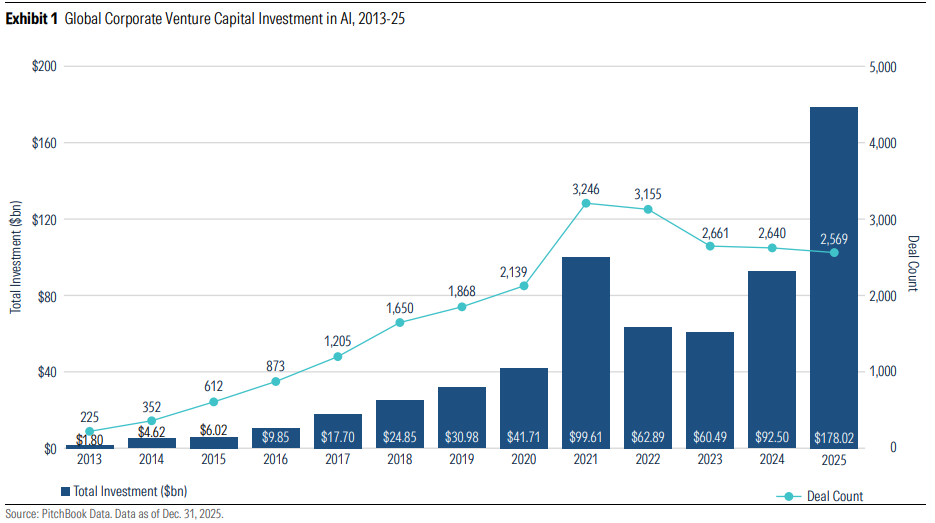
On the capital side, corporate venture investment in AI has expanded strongly over the past decade.
Global corporate-backed AI deals drew about $1.8 billion in 2013 and climbed to more than $178 billion by 2025, while the number of annual transactions stayed above 2,000. The report highlights that the United States continues to be the primary hub for private AI funding, as firms in this region attracted over $109 billion in private AI investment in 2024.
Increasing Computing Needs, Power Limits and Laws Seen as Main GenAI Risks
Alongside the growth projections, the report points to several risks. It describes a historic capital expenditure cycle that could reach $1 trillion in the near term as companies race to build computing power for training and inference but warns that productivity gains inside enterprises can lag large physical investment.
According to the study, if companies struggle to integrate generative tools into daily workflows or face internal resistance, economic benefits may appear more slowly than expected. In that scenario, valuations for some AI leaders could come under pressure even as spending on infrastructure remains high.
The report also flags constraints in power generation, grid capacity, and cooling for data centers that could slow deployment of new models, along with the risk that basic model capability becomes more of a commodity as open systems improve and squeeze margins unless providers move into more advanced agentic or physical applications. It also warns that diverging national rules on data, safety, and model oversight could raise compliance costs and curb the global reach of leading US groups.
Anthropic, OpenAI and Databricks Dominate the GenAI 20
The GenAI 20 Index is presented as a way to observe how the core software layer of the generative ecosystem is taking shape. As of the end of December 2025, the 10 largest constituents included Anthropic with a valuation of about $350 billion, OpenAI at $300 billion, and Databricks at $134 billion.

Other names in the top group were Safe Superintelligence at $32 billion, Anysphere at $29 billion, French model provider Mistral AI at $14 billion, Cognition at $10 billion, Sierra at $10 billion, and Canadian company Cohere at $7 billion. 8 of those 10 firms were from the United States, while 1 was based in France and 1 in Canada, underlining how concentrated leadership in the space currently is.
Index Extends Morningstar’s Push into Private Market Coverage
Morningstar positions the GenAI 20 Index as part of a broader push to help investors navigate the convergence of public and private capital markets.
By combining key private and public generative AI firms in this fast-evolving market, investors can follow the companies behind core generative models and platforms and stay up-to-date with changes in scale, strategy, and market share.


