




Jensen Huang, co-founder and chief executive of chip designer Nvidia, has warned against treating artificial intelligence as just another app or software feature, noting it has become “essential infrastructure” on par with electricity and the internet and will demand trillions of dollars in investment, vast amounts of energy, and a new wave of skilled labor.
In a new blog post published by Nvidia, Huang says every company will deploy AI, and every country will seek to build its own capabilities, reshaping how economies grow and how work is organized.
From Fixed Code to Real-Time Intelligence
For most of the PC and internet era, software followed prewritten rules, and databases returned results only when users issued precise, structured queries. Huang compares that model to modern AI systems, which can process images, text, and audio, infer intent and context, and then produce responses that did not exist beforehand.
That shift, from retrieving stored outputs to generating “on-demand intelligence,” means the hardware and infrastructure underneath also have to be redesigned for live, high-volume computation rather than static storage.
Huang’s “Five-Layer Cake” View of AI
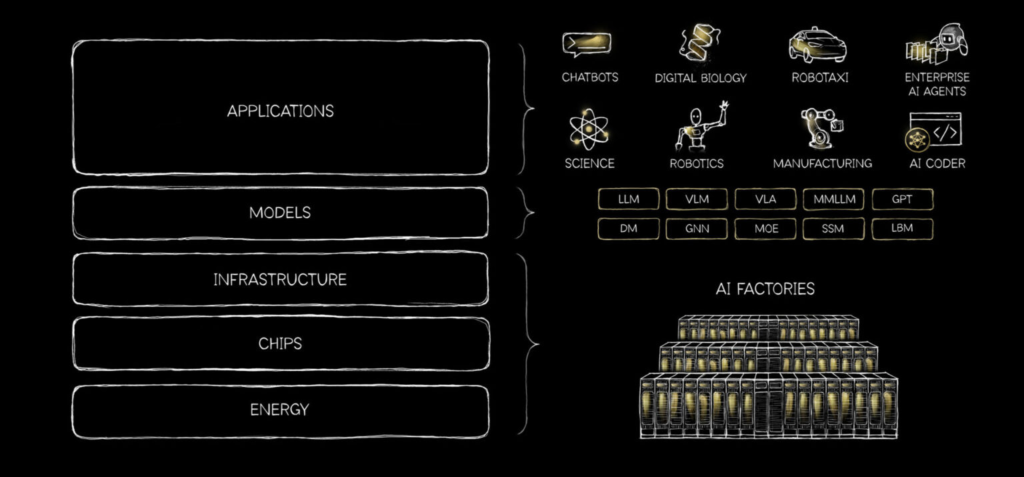
Huang describes AI as a five-layer industrial stack, stretching from power plants to end-user apps.
Energy at the Base
Real-time intelligence, he argues, starts with real-time electricity, as each token generated by a model is ultimately the result of electrons moving through chips and heat being removed from systems. Energy availability, efficiency, and cost set the upper limit on how much intelligence can be produced.
Chips Turn Power into Computation
On top of energy sit specialized processors built for parallel workloads, high-bandwidth memory, and fast interconnects. Progress in this layer determines how quickly AI capacity can grow and how cheap it becomes to run models at scale.
Infrastructure as AI Factories
Above the chips are data centers that Huang describes as “AI factories,” which are facilities designed not primarily to store information but to manufacture intelligence. They combine land, power delivery, cooling, networking, and orchestration software to bind tens of thousands of processors into a single computing system.
Models Beyond Language
Next come the models themselves, which Huang says increasingly extend well beyond general-purpose language systems. He highlights work in models for proteins, chemistry, physics, robotics, and autonomous machines, arguing that some of the biggest breakthroughs may come from these domain-specific systems.
Applications Where Value Shows Up
At the top of the stack are applications, from drug discovery engines and industrial robots to legal assistants and self-driving cars.
According to Huang, a self-driving vehicle, or humanoid robot, is simply an AI application embodied in hardware, drawing on every layer beneath it.
“Every successful application pulls on every layer beneath it, all the way down to the power plant that keeps it alive,” he writes.
“Largest Infrastructure Buildout in History”
Huang estimates that the world is only a few hundred billion dollars into what he calls the AI buildout, with “trillions of dollars of infrastructure” still to come, spanning chip creation plants, computer assembly lines, and AI-optimized data centers around the globe.
He argues this investment wave amounts to the largest infrastructure expansion in history and is already driving strong demand for skilled trades, including electricians, plumbers, pipefitters, steelworkers, and network technicians. These roles, he notes, do not require advanced degrees in computer science but are critical to keeping AI factories running.
Productivity Boost, Not a Jobless Future
Addressing fears that AI will eliminate work, Huang points to radiology as an example of how automation can raise productivity without reducing demand for specialists.
AI systems now help interpret medical scans, but hospitals still need more radiologists, he says. When machines handle routine pattern-recognition tasks, doctors can spend more time on judgment, communication, and patient care.
According to Huang, that pattern, in which productivity creates capacity and capacity drives growth, will play out across many knowledge-intensive fields.
Open Models and the DeepSeek Effect
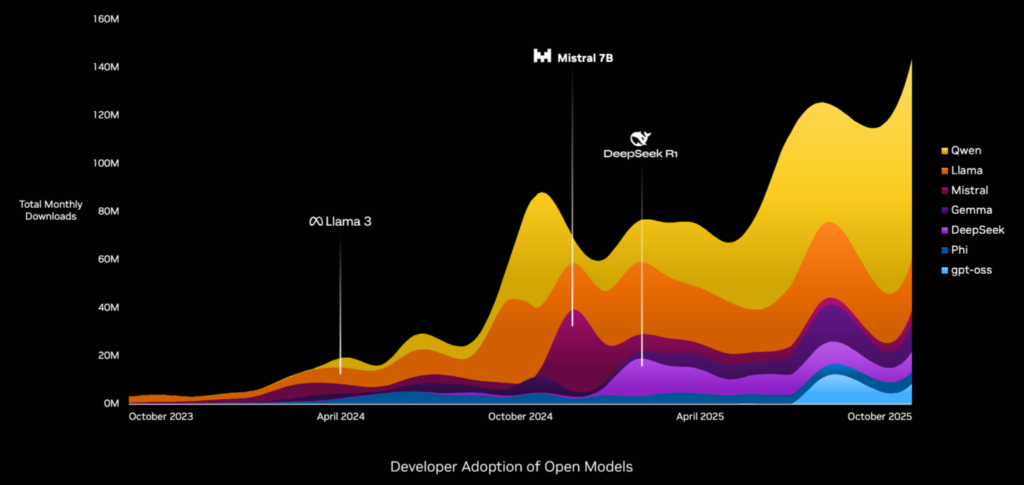
Huang credits open-source AI models with widening access to advanced systems, noting that many cutting-edge models are now freely available, allowing researchers, startups, enterprises, and even governments to experiment and build on them without having to start from scratch.
He highlights the release of the DeepSeek-R1 reasoning model as an example of how open models at the technological frontier can rapidly accelerate demand.
Once such a system is made widely available, Huang argues, it speeds adoption at the application layer and, in turn, increases the need for training runs, infrastructure, chips, and power across the whole stack.
AI Crosses a Commercial Threshold
Over the past year, Huang says, AI models have become reliable enough for large-scale deployment. He cites improvements in reasoning, reductions in hallucinations, and better grounding in factual information as key changes that allowed applications in areas such as drug discovery, logistics, customer service, software development, and manufacturing to demonstrate clear product-market fit.
These practical deployments, he argues, are now pulling the rest of the infrastructure forward, turning abstract enthusiasm for AI into concrete demand for power, chips, and data centers.
Choices Now Will Define AI’s Legacy
Huang concludes that AI has moved beyond being just a family of large language models and has become the backbone of a wider industrial shift that will influence energy systems, factory design, labor markets, and national competitiveness.
He stresses that the world is still in the early stages, since much of the necessary infrastructure has not been built yet, many workers still need training, and many economic opportunities remain untapped.
The key questions, in his view, are how quickly societies choose to build, how widely the benefits are shared, and how responsibly the technology is deployed.
Those decisions, he says, will determine how this era of AI-driven infrastructure ultimately reshapes the modern world.


