


Key Takeaways:
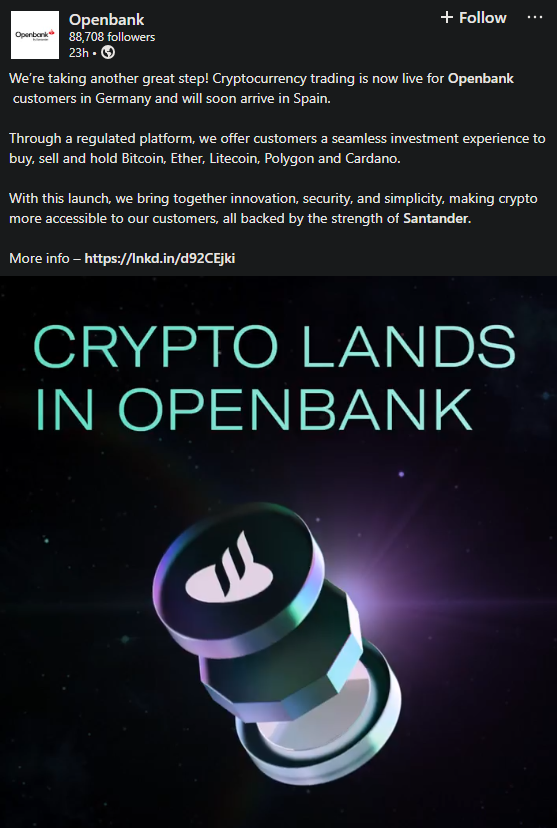
- Openbank Crypto Services, now available in Germany, offers trading functionality for Bitcoin (BTC), Ethereum (ETH), Litecoin (LTC), Polygon (POL), and Cardano (ADA).
- Crypto service will expand to Spain in the coming weeks, with more cryptos and features planned.
- This rollout, operating under the EU’s Markets in Crypto-Assets Regulation (MiCA), signals a major shift in traditional banking’s approach to digital assets.
Table of Contents
Openbank Crypto Services in a Regulated Environment
The new Openbank Crypto Services offer a fully integrated experience, allowing users to buy, sell, and hold digital assets directly within its existing banking app.
There’s no need to send funds to unregulated exchanges outside its banking app. The offering places trust in the safeguards and investor protections of the Santander group and is fully regulated under the European Union’s Markets in Crypto-Assets (MiCA), offering trust and credibility that crypto platforms often lack.
"By incorporating the main cryptocurrencies into our investment platform, we are responding to the demand of some of our customers and continue to strengthen a broad range of products and services through an agile, simple technology platform backed by one of the world’s leading financial groups." - Coty de Monteverde, Head of Crypto at Grupo SantanderStrategic Introduction and Competitively Priced Fees
Openbank is intentionally rolling out its service in Germany first, as a market that has strong demand for traditional and digital investments. The bank charges an attractive fee, with an effective transaction price of 1.49% (with a minimum of €1) and, importantly, no custody fees, which has appeal for retail investors. The strategy is to follow with a fast rollout in their home market of Spain and to continue to enhance the offering with more cryptocurrencies and features like crypto-to-crypto conversions in the near future.
Read also: Introducing P2P PayPal Links for Effortless Transfers
Banking’s Crypto Embrace
This is not an isolated test. It suggests a massive change in the strategy of large European banks. Openbank follows German giants Deutsche Bank and DZ Bank, which have also announced crypto services based on the predictability supplied by MiCA. Banks want to keep tech-savvy customers from moving to financial technology platforms and are looking to create a new revenue stream as digital assets become increasingly mainstream.
Accelerated Mainstream Adoption
Openbank’s decision is a strong endorsement for the long-term permanence of digital assets in the financial ecosystem. By simply packaging crypto along with stocks, ETFs, and funds, Santander is normalizing digital assets as a mere category of investable security. This is a very low barrier to entry for millions of potential investors. The crypto journey is now accelerating and moving from the fringe to the core of modern finance.
Final Thought: If traditional banks become the primary crypto on-ramp, does this ultimately validate or co-opt the original decentralized essence?
FAQs
What is the MiCA framework?
Markets in Crypto-Assets (MiCA) refers to an exhaustive regulatory framework for crypto in the European Union, designed to provide legal clarity and consumer protection.
Which crypto can be traded within the Openbank Crypto Services?
Initially, Openbank supports Bitcoin (BTC), Ethereum (ETH), Litecoin (LTC), Polygon (MATIC), and Cardano (ADA), with plans to add more cryptos on the way.
Is my crypto insured?
While held under MiCA’s investor protection rules, crypto assets are not covered by traditional deposit insurance schemes like the German Einlagensicherungsfonds. The security comes from Openbank’s regulated custody.
For more crypto banking services, read: RAKBANK Makes History as First UAE Bank to Offer Retail Crypto Trading


