





Key Takeaways
- Cocoon, Telegram’s confidential AI compute network on The Open Network blockchain, has started processing its first user tasks in a fully private environment, offering an alternative to dominant cloud providers.
- Pavel Durov announced the launch at Blockchain Life in Dubai, saying Cocoon is intended to protect digital freedoms and reduce reliance on centralized AI infrastructure that may compromise sensitive data.
- The system allows GPU owners to contribute computing power for AI inference and earn TON tokens, cutting out traditional intermediaries such as Amazon and Microsoft.
- Cocoon plans to add more GPU capacity and widen developer access, with the system offering hardware owners a way to earn from unused computing power.
Table of Contents
Cocoon, a confidential AI compute platform developed by Telegram on The Open Network blockchain, is now fully operational and processing its first user tasks, Pavel Durov said on X.
The announcement follows Pavel Durov’s keynote at the Blockchain Life event in Dubai, where he said that the new initiative is meant to counter the growing concentration of AI infrastructure and give users greater control over how their information is handled.

The new system allows GPU owners to contribute processing power for AI inference and receive TON tokens in return, creating an alternative supply route that does not rely on major cloud operators such as Amazon and Microsoft, whose centralized services are frequently criticized for high costs and their role as intermediaries in AI compute.
Developers of the project believe that processing tasks through a decentralized architecture can increase trust in the system. They add that the prospect of earning returns while contributing to a wider pool of computing power is likely to appeal to hardware owners.
Cocoon’s team plans to broaden capacity in the coming weeks by bringing additional GPU resources onto the network and by opening the platform to more developers. Telegram users are expected to see new AI features built on the system’s framework, extending the platform’s wider push into privacy-oriented digital tools.
The network’s launch introduces one of the first publicly available confidential compute layers designed for large-scale AI, placing it at the center of an industry-wide debate over how AI infrastructure should be governed and who should control the data that flows through it.
How GPU Owners Can Join Cocoon Network
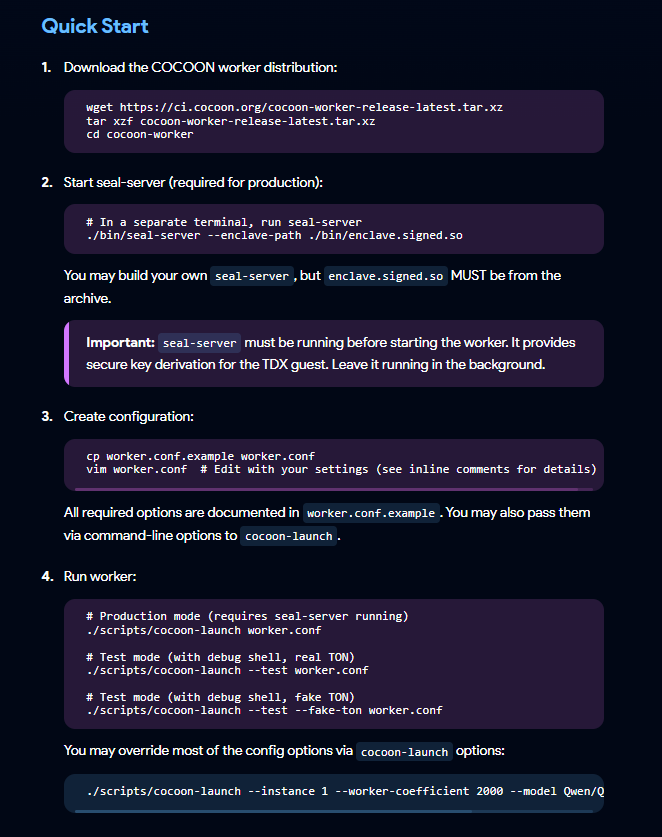
GPU owners can join Cocoon by running the project’s worker software on a Linux server that has an Intel processor with TDX support and an NVIDIA GPU that can run confidential computing.
The setup involves three main steps: preparing the hardware, running Cocoon’s seal-server, and filling in a configuration file with a TON wallet address, the GPU being used, and the model the worker will serve.
After the worker is launched, the server begins receiving AI inference jobs from the network, and TON payments are issued automatically for each completed task.
According to Cocoon, owners with more than one GPU can run additional workers to increase earnings.
Read More: Anthropic’s Opus 4.5 Sets New Benchmark in AI Engineering and Coding Performance


