




For most crypto participants, the choice between a centralized exchange and a decentralized one gets framed as a simple binary: convenience versus control. That framing, while not entirely wrong, skips over the mechanics that actually determine where risk concentrates, who profits from your trades, and what happens to your funds when something goes wrong. Understanding the structural differences between the two models is not optional knowledge for anyone trading with meaningful capital.
Working of a Centralized Exchange
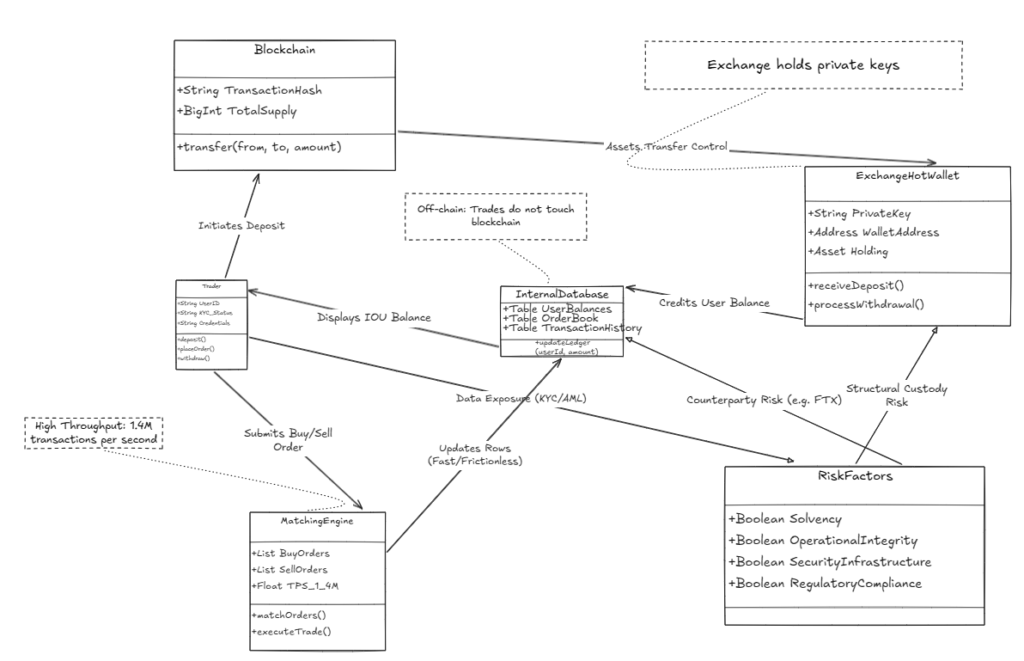
When a trader deposits funds directly to a centralized exchange like Binance, Coinbase, or OKX, the digital assets leave the blockchain and move into a wallet the exchange controls. What the trader holds from that point is not the asset itself but a balance entry in the exchange’s internal records, a number in a database that acts as proof of the real asset sitting in the exchange’s custody. Trades that happen on the platform do not touch the blockchain at all. A buy order matched against a sell order is resolved by updating two rows in the exchange’s ledger, fast and frictionless, but entirely dependent on the exchange remaining solvent and operational for that balance to ever be redeemable.
The order book is utilized for matching the trades. The matching engine works to pair the bids of the buyer side and the asks of the seller. side. This form of structure helps with delivering liquidity depth, tight spreads, and execution speeds that decentralized protocols cannot currently match. Binance alone processes over 1.4 million transactions per second on its matching engine, a throughput figure that remains out of reach for any on-chain settlement model available today.
The tradeoff is structural custody risk. Because the exchange holds the private keys to user funds, the user’s asset security is entirely dependent on the exchange’s operational integrity, security infrastructure, and solvency. The collapse of FTX in November 2022, which resulted in an estimated $8 billion shortfall in customer funds, demonstrated that this counterparty risk is not theoretical. Regulatory compliance obligations, including mandatory KYC and AML verification, add an additional layer of friction and data exposure that some participants consider a meaningful concern.
How a DEX Routes the Same Trade
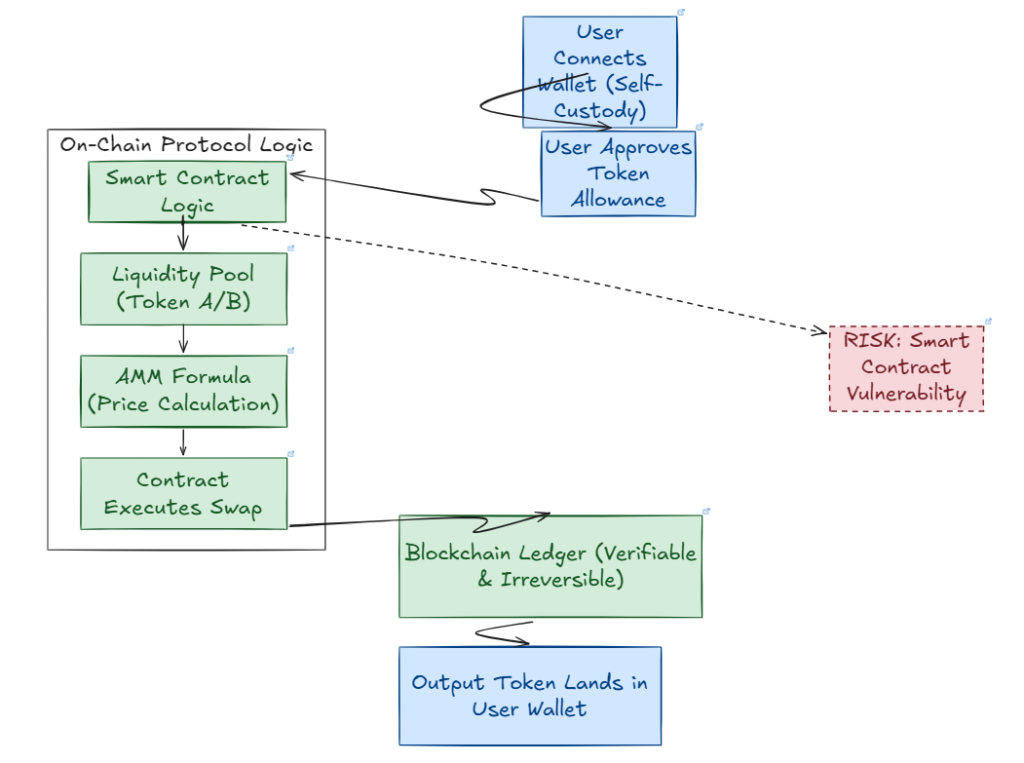
A decentralized exchange works differently from the ground up. In the case when a market participant makes use of Uniswap, Curve, or dYdX, their funds don’t ever leave their wallet. Instead of depositing assets and trusting a platform to hold them, the individual simply connects a wallet and approves a smart contract to move a specific token amount on their behalf. The contract executes the swap, the settlement happens directly on the blockchain, and the output token lands back in the same wallet, all without a company, team, or intermediary touching the funds at any point in that process. The trade either happens exactly as the code specifies, or it does not happen at all.
Most DEXs skip the order book entirely and price assets through a formula instead. Two tokens sit in a liquidity pool, and their ratio to each other determines the price at any given moment. Uniswap v3 sharpened this model in May 2021 by letting liquidity providers concentrate capital within specific price ranges rather than distributing it across the entire curve, which meant deeper liquidity where trading activity was actually concentrated and measurably less slippage on high-volume pairs.
The architectural advantage here is the elimination of counterparty risk. A trader using a DEX cannot lose funds to an exchange insolvency because no exchange ever holds those funds. The trade settles on the base layer blockchain, meaning it is verifiable and irreversible in a way that no CEX trade is. However, this same architecture introduces a different category of risk: smart contract vulnerability.
The Liquidity Reality
The volume gap between centralized and decentralized exchanges remains substantial, though the picture is more nuanced than a single headline number suggests. The centralized exchanges collectively process the dominant share of global spot activity, operating at a scale that DEX infrastructure has not approached in aggregate. Decentralized venues have captured a growing but still minority slice of that total, with Uniswap maintaining its position as the highest-volume DEX by a considerable margin over its closest competitors. Where the narrative shifts is in the long tail of the market. Tokens that have not yet secured listings on major centralized platforms often carry their only meaningful liquidity inside DEX pools, meaning that for early-stage assets or newly launched projects, a DEX is not the secondary option but the only functioning market available.
Slippage is the practical consequence of this liquidity differential. A $50,000 trade on ETH/USDT will execute with near-zero slippage on Binance due to the depth of its order book. The same trade on a mid-tier DEX pool with limited liquidity could experience 0.5 to 2 percent slippage depending on pool depth, which on large trades translates to a measurable execution cost. Gas fees on Ethereum mainnet add a further fixed cost that is irrelevant for small trades on CEXs but becomes material for frequent DEX activity.
Matching the Tool to the Use Case
The choice between a CEX and a DEX is ultimately a question of what the trader needs from the infrastructure, not which platform carries a better reputation. Traders executing high volumes in major pairs, running arbitrage strategies, or requiring sub-second execution will find that centralized exchanges remain the only environment where order book depth and matching speed meet that standard. On the other side of the spectrum, participants holding assets across multi-week or multi-month time horizons, where the daily friction of gas fees is irrelevant but the sustained exposure to custodial failure is not, are structurally better served by retaining self-custody and interacting with on-chain protocols directly.
DeFi-native strategies, including liquidity provision, yield farming, and access to tokens not yet listed on major exchanges, require DEX access by definition. Conversely, fiat on-ramps and off-ramps, margin trading, and regulated financial products currently exist almost exclusively on centralized platforms.
In practice, the more sophisticated approach is not a permanent commitment to one model but a deliberate allocation between both. Assets that are not actively being traded stay in self-custody, off any exchange and out of any counterparty’s reach. When a specific trading opportunity requires the liquidity depth or execution speed that only a CEX can provide, funds move there for that window and return to self-custody afterward. DeFi positions, yield strategies, and access to early-stage assets are handled directly on-chain. The result is a setup where custodial exposure exists only when there is a concrete reason for it, rather than as a permanent default.
The Forward Picture
The gap between the two models is narrowing on multiple dimensions. Layer 2 networks have substantially reduced gas costs for DEX transactions, with average swap fees on Arbitrum and Base frequently falling below $0.10 as of mid-2024. DEX aggregators such as 1inch and Paraswap now route orders across multiple pools to minimize slippage, partially closing the execution quality gap. Order book DEXs built on faster chains are beginning to offer trading experiences that more closely resemble CEX performance.
The more useful framework is not about which one is better but about under what conditions each one is the appropriate tool and whether the risk architecture of each one is clearly understood before capital is committed.


