




Liquidity pools are the fundamental components that enable decentralized exchange trading operations. The system replaces standard order books through its mechanism. It leverages the collective on-chain reserves to allow the market participants to conduct immediate, wide-ranging swaps for the tokens.
Decentralized exchanges (DEXs) operate with automated market makers (AMMs) to build trading connections that involve buyers and sellers. Traders swap tokens for assets stored in smart contracts, eliminating the need for manual intervention. Liquidity providers (LPs) contribute equal quantities of two different tokens to liquidity pools. This results in them receiving LP tokens that represent their ownership share while they also earn a portion of the trading fees generated from each swap.
The core framework serves as the foundation for Uniswap and Curve and all other major DeFi platforms. The introduction of concentrated liquidity and programmable “hooks” has brought operational improvements to the pools because these innovations enable better capital management and operational flexibility while maintaining the basic AMM framework.
How centralized and decentralized trading works
Centralized exchanges use order books to match bids and asks through their own systems. Trade execution depends on how much liquidity there is at certain price levels. If there aren’t many counterparties, big orders can cause slippage, partial fills, or delays.
Decentralized exchanges fix this problem in a different way. Trades don’t match participants; instead, they happen directly against the reserves of a liquidity pool through smart contracts. Swaps settle almost right away as long as there is enough liquidity and no direct counterparty is needed.
The result is that people can participate without permission, control their own assets (users keep their private keys), and trade with each other without a centralized intermediary managing funds.
Liquidity Pools Mechanism
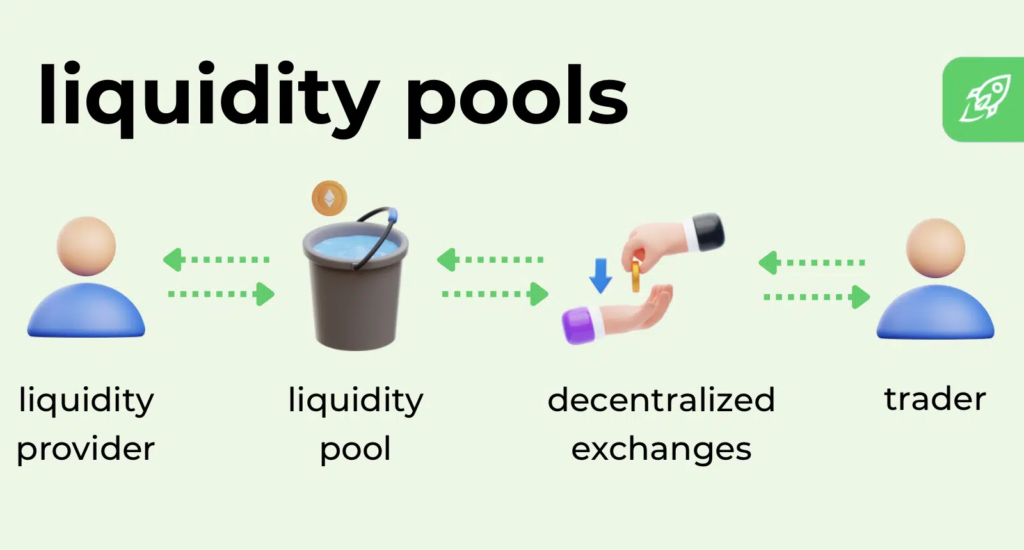
Liquidity providers put paired assets into a smart contract. The assets are usually worth the same amount of money, based on the current price of the pool. For instance, putting money into an ETH/USDC pool might mean giving $1,000 worth of ETH and $1,000 worth of USDC.
Liquidity providers get LP tokens in return, which show how much of the pool they own. People who hold these tokens are entitled to a share of the trading fees that swaps make.
When an individual buys ETH through USDC, ETH is taken away from the pool and USDC is added to it. This happens to match the LP logic; the pool must maintain the same value of k; the reduction in ETH supply consequently drives its quantity to rise inside the pool. This price adjustment happens algorithmically, without any central party setting it.
Arbitrage traders then make sure that pool prices are in line with prices in the rest of the market, which keeps things running smoothly without having to set prices centrally.
The launch of Uniswap v3 changed the way liquidity is provided in a big way. LPs can now provide assets in certain price ranges (concentrated liquidity) instead of across the whole pricing curve. Putting liquidity where trading volume is most likely to happen makes capital much more efficient.
Uniswap v4 added programmable “hooks” in the beginning of 2025. This helped the developers to work with the custom logic for the pools. These elements made it accessible to incorporate dynamic fees, automated rebalancing, and custom incentive frameworks, all while preserving the concentrated liquidity framework as the foundation.
Maximizing the Returns
Liquidity providers receive trading fees as their main source of income, and the percentage varies between 0.05% and 1% based on the pool’s volatility and design features. The fees increase according to each provider’s ownership portion and they typically get reinvested into the pool’s reserve.
Yield farming is a way to get more yield by staking LP tokens in other protocols for rewards. But this adds more risks that are specific to smart contracts and platforms.
The liquidity providers can effectively target limited price ranges by means of concentrated liquidity. Stablecoin pairs like USDC/USDT commonly function in tiny ranges. For example, providing liquidity in narrow bands allows for better use of capital, which potentially leads to higher effective returns than distribution of the liquidity over a wide range.
Important Risks to Know
The most common structural risk is impermanent loss. It happens when the prices of two tokens that are paired with each other change after a deposit.
For instance, if you deposit $2,000 in ETH and USDC and the price goes up to $4,000, the AMM will automatically sell some ETH to keep the balance. When they take their money out, the LP ends up with less ETH and more USDC than if they had just kept the original assets.
The loss stays “impermanent” until you withdraw it. If prices go back to normal, the gap closes. However, volatile pairs have more risk, while stablecoin pairs have very little impermanent loss because their prices are linked.
Rug pulls mostly happen to projects that are new or not well-known. Developers may bring liquidity to a token pair, then take out valuable assets, leaving LPs with tokens that are almost worthless. This risk is especially high in ecosystems with low-cap or meme tokens.
How to Use a Liquidity Pool Step by Step
- Choose a DEX platform that carries high liquidity. Uniswap is the most popular platform in the Ethereum and L2 ecosystems. Other platforms, like PancakeSwap and SushiSwap, have different fee structures and incentives.
- This step includes the connection of the wallet to the DEX platform. Popular software wallets like Phantom and MetaMask can be used for this purpose. To avoid phishing attacks, always check URLs.
- Pick a token pair and check the required deposit ratios for the same.
- Provide. the go-ahead for token spending and confirm the deposit transaction (gas fees apply).
- The individuals can now monitor the performance of the token and take further action on it.
Why DeFi Needs Liquidity Pools
Without centralized intermediaries, liquidity pools make it possible to trade openly and around the clock. They align incentives by giving rewards to people who put up money and take on risk.
As more individuals trade, it creates deeper liquidity, which ultimately helps to deal with high slippage issues during the swap process. This also brings in more users and makes network effects stronger. Innovations such as programmable hooks and cross-chain integrations suggest that users can customize and enhance the efficiency of market infrastructure.


