




Most conversations about blockchain begin and end with price. What gets less attention is the programmable infrastructure that has made the technology useful beyond speculation. Smart contracts are that infrastructure, and they are the reason decentralized finance functions without a clearing house, the reason NFT ownership is enforceable without a registry, and the reason two parties who have never met can execute a binding financial agreement without a lawyer, a bank, or any intermediary standing between them. The concept predates Ethereum by two decades.
Computer scientist Nick Szabo outlined the logic in 1994, describing digital contracts capable of executing automatically when predefined conditions were met, including complex instruments like derivatives and synthetic assets. At the time, the technology to implement his framework did not exist. When Ethereum launched in 2015, it did.
Understanding Smart Contracts in Blockchain
Smart contracts eliminate intermediaries and enable secure and trustless arrangements between two parties. Whereas blockchain technology gained attention through Bitcoin as the technology that enabled it, it has expanded to decentralized finance (DeFi), trading digital assets, supply chains, etc.
The agreement is centered on programmed logic that determines how and when a contract executes. Nick Szabo, a computer scientist, first published on the topic in 1994, mentioning digital contracts could work even when two parties are not present, including advanced financial instruments called derivatives or synthetic assets.
Smart contracts behave differently than legal agreements, in that they are wholly reliant on code. The agreement is enforced automatically through functions, variables, and modules.
For example, consider a consumer who buys an item online. The smart contract notifies the sender to transfer cryptocurrency to the seller while also triggering the notification to ship the item. Beyond this simple use case, smart contracts are now responsibly lending an asset, liquidating an asset because of a price drop from collateral, or documenting interest owed by a borrower without human intervention.
Real-World Applications
- Finance: The use of smart contracts facilitates the automation for payments, loans, and trading. It results in cutting out the need for banks or middlemen.
- Business Operations: The usage of smart contracts allows the execution of agreements and creation of workflow when predefined conditions are met. All of these smart codes ensure that task processing happens error-free and securely.
- Digital Assets: One of the major uses of these smart codes is the creation, ownership, and transfer of digital assets. The leading example involves NFTs (non-fungible tokens).
Components of Smart Contracts
Every component ensures the automation function remains reliable and secure and therefore supports the integration of blockchain logic with real-world operations. The smart contract is composed of code and it becomes crucial to understand these underlined components.
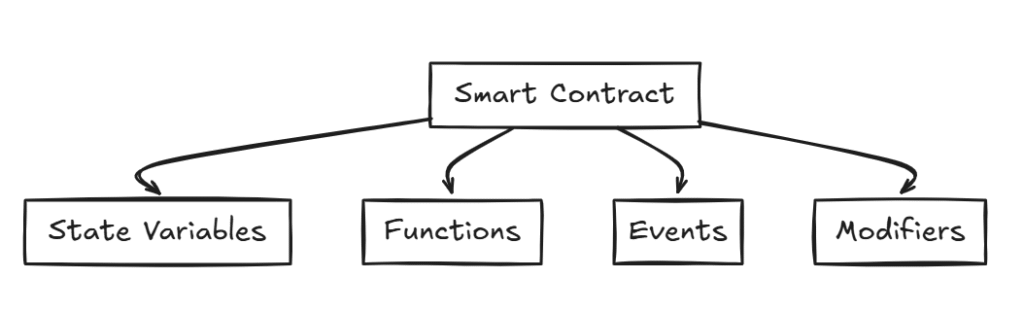
- State variables serve as the contract’s long-term memory. Every balance, every ownership record, every shipment status is written directly to the blockchain and stays there. Anyone with a wallet or an application can query that data at any time, and what they read is the same for everyone. There is no private database sitting behind it.
- Functions are what the contract actually does when you interact with it. Every time a user deposits collateral, claims a reward, or initiates a swap, a function runs in the background, checks whether the conditions are satisfied, and either executes the outcome or rejects the transaction. The user sees a confirmation or an error. The function is what determined which one.
- Events are how the contract talks to the outside world. When something happens inside the contract, an event fires a log that external applications can pick up and display. Most DeFi dashboards showing transaction histories and live balance updates are not reading raw contract storage. They are listening to these event logs, which is a faster and more practical way to surface on-chain activity to end users.
- Modifiers function as the contract’s permission system. Every function that carries financial or administrative weight has a modifier sitting in front of it, running a defined set of checks before any execution begins. A function restricted to the contract owner will not proceed until the modifier has confirmed the caller’s wallet address matches. A lending function that requires minimum collateral will not clear until the modifier has verified that threshold is satisfied. The check either passes or the transaction stops, with no partial execution and no exceptions.
Benefits of Smart Contracts
- Efficiency: Smart contracts help with transactions being carried out promptly without any manual intervention. It eventually allows you to save time and operational costs.
- Trustless Execution: Contracts operate without middlemen or third parties, which provides the transaction security to allow anonymous parties. It additionally reduces dependency on banks, lawyers, or brokers.
- Accuracy and Immutability: Once deployed, contracts cannot be altered, preventing fraud or manipulation. With the automation advantage from the code, the chances of error become negligible.
Limitations of Smart Contracts
- Permanent Code: Once the deployment process is done, if there are errors in the code, they cannot be reversed. All of this may lead to financial losses if not carefully implemented.
- Coding Risk: The developers need to work with precise logic, as loopholes could be exploited; that makes security audits mandatory.
Conclusion
Smart contracts update digital agreements by accounting for transactions and eliminate intermediaries. The self-executing code ensures trustless and transparent operations. They support DeFi, supply chains, and digital commerce, which makes the processes more effective and secure as blockchain adoption grows.


