

Solana is a public infrastructure for developing crypto applications that can scale up. The structure is censorship-resistant, rapid, and safe, and it is targeted for worldwide acceptance. To track time on the chain, Solana uses a creative method called Proof of History. PoH is not a mechanism for consensus, but it is still a very crucial part of Solana’s proof-of-stake consensus process.
Solana’s hardware-software combination of a novel cryptographic clock with parallel transaction processing and an architecture optimized for the best performance allows it to have instant transaction finality and make fees minimal. This has made Solana one of the favored platforms for DeFi, NFTs, Web3 gaming, RWA tokenization, and applications targeting consumers.
Why Solana Is Important
It delivers a performance level that is very similar to that of the centralized web infrastructure, yet it still has the characteristics of being completely decentralized and permissionless.
Key Advantages
- Transaction Speed: The actual and sustained throughput of Solana in the real world ranges from 1,500 to 3,000 TPS, with a peak that can even exceed 5,000 TPS in times of high activity.
- Ultra-Low Fees: The fee for each transaction is on average about $0.0002-$0.0005 (this figure applies even during peak times when the cost is still under $0.01).
- Hardware-Driven Scaling: Solana’s performance goes hand-in-hand with the development of hardware, and it is following a trajectory like that of Moore’s Law.
With such characteristics, developers are able to create applications that are truly consumer-grade on the blockchain without the limitations of congestion or high costs.
How It Works (Simply)
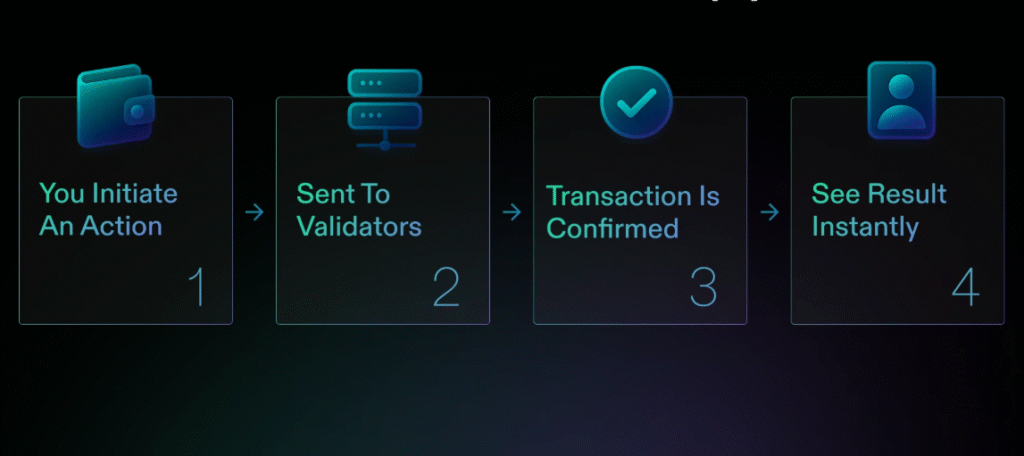
From a user’s perspective, each transaction and interaction seems to be instantaneous:
- Your wallet can be used to carry out actions like SOL token transfer, swapping tokens, or minting an NFT.
- The network receives your transactions right away.
- Validators authenticate it and reach agreement in under a second (often 400–800 ms).
- Your transaction gets confirmed and written permanently on-chain.
- The recipient, whether an individual or an application, sees the result immediately without having to wait for slow blocks or incur high fees.
Technical Working of Solana
The phenomenal speed and scalability of Solana owe their origin to the combination of eight tightly integrated innovations that work together flawlessly.
Proof of History (PoH): The Cryptographic Clock
Proof of History acts as a verifiable and decentralized time source that provides the timestamps for the events without the need for constant node-to-node communication. This, in turn, cuts down the coordination overhead immensely, reflected across the entire network.
Tower BFT: Proof-of-Stake Variant
In return for staking their SOL, validators are the ones primarily responsible for the security of the network. The selection and consequently the rewards depend on the size of the stake, the uptime of the server, and the performance of the validator. Tower BFT consumes little energy and thus it is very eco-friendly and also allows for delegated staking support.
Turbine: Block Propagation
To speed up block propagation, Solana splits the blocks into smaller packets and then applies a distribution method similar to that of the BitTorrent protocol for efficient and swift block propagation.
Gulf Stream: Mempool-less Transaction Forwarding
Transactions are sent to the next expected leaders, mempool delays and traditional bottlenecks, resulting in faster transaction confirmation.
Sealevel: Parallel Smart Contract Runtime
Thanks to Sealevel’s parallel processing capabilities, Solana is the only major blockchain able to run thousands of smart contracts at the same time.
Pipelining & Transaction Processing Unit (TPU)
The transactions execute at the same time across the optimized pipelines, which lets different steps of execution occur together for the highest possible efficiency.
Concurrent Accounts Database (formerly Cloudbreak)
The storage system that horizontally scales is built in such a way that it can handle thousands of accounts that perform reads and writes at the same time. All of these factors result in efficient data management for large-scale operations.
What Is $SOL?
SOL, the token of the Solana network, is the most important asset for the ecosystem. It is the one used to pay fees for transactions, secure the blockchain by means of staking, and reward validators for their work in ensuring the network runs smoothly. In addition to this, SOL also participates in governance through SIMD (Solana Improvement Documents) proposals, Realms, etc., and it drives the whole ecosystem’s activities like DeFi, NFTs, gaming, and even digital payments.
Core Use Cases
- DeFi: Fastest-growing DEXs, perps, and lending platforms
- NFTs & Digital Collectibles: One of the largest and lowest-cost ecosystems
- Real-World Assets (RWAs): Chain for tokenized treasuries and institutional assets (Ondo, BlackRock BUIDL fragments, etc.)
- Payments & Micropayments: Ideal for paying for tips, memberships, and, remittances
- Consumer & Mobile Apps: Powered by Solana Mobile (Saga Chapter 2) and optimized NFTs
Strengths and Limitations
Strengths
- One of the fastest and least costly blockchains.
- Sub-second finality and true parallel execution
- Massive DeFi, NFT, and RWA ecosystem
- Zero full-network outages since September 2023.
- The network continues to grow as hardware becomes better.
Limitations
- Top-tier validator hardware is still expensive (1–2 TB RAM is common).
- Solana faces strong competition from Ethereum Layer 2 solutions, Sui, Aptos, Monad, TON, and others.
- Past reputation for outages (2021–early 2023), now largely resolved.