




Delaware lawmakers are proposing to bring payment stablecoin issuers under the state’s banking laws, setting up a licensing regime that would also cover digital-asset service providers and align the state more closely with the federal GENIUS Act framework.
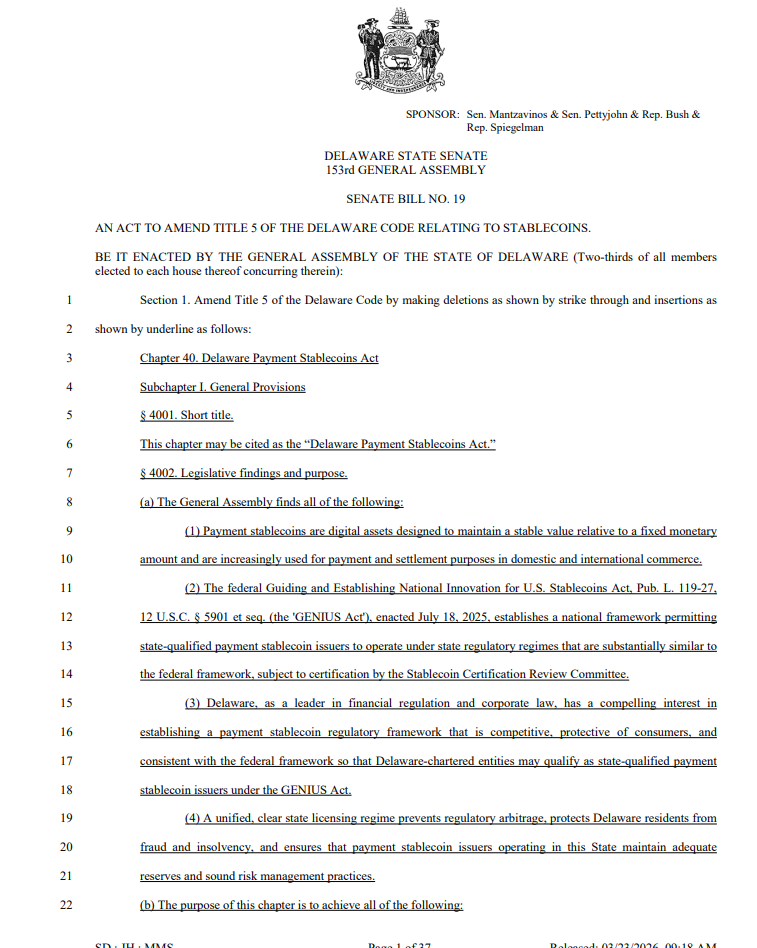
State Framework Targets Stablecoin Firms
Delaware Senate Bill 19, backed by bipartisan sponsors, would create a state licensing framework for payment stablecoin issuers and digital-asset service providers under Delaware banking law. The measure is intended to align Delaware’s regime with the federal GENIUS Act and would give the state bank commissioner authority over covered issuers and service providers operating in the state.
Under Senate Bill 19, firms would need approval from the State Bank Commissioner before issuing a payment stablecoin to Delaware residents or acting as a digital-asset service provider for them, unless they qualify for an exemption. The bill creates three license categories: one for stablecoin issuers, one for digital-asset service providers, and one for firms that do both.
Delaware Offers a Path for Smaller Issuers
The bill does not require federally supervised stablecoin issuers or bank subsidiaries to obtain a Delaware license for activities already subject to federal oversight, though they would still have to register with the state bank commissioner before operating in Delaware.
It also gives certain federally supervised nonbank issuers a route to switch into Delaware’s regime, but that option would only be open to issuers with no more than $10 billion in outstanding stablecoins and no major unresolved enforcement issues. Once a state-qualified issuer grows above that threshold, it would have 360 days either to move into the federal framework or to cut issuance back below the cap.
Full Reserve Backing and Redemption Requirements
The bill would require issuers to fully back their coins with reserve assets that satisfy the statute’s standards, part of a broader effort to make Delaware-chartered issuers look substantially similar to federally regulated ones.
Issuers would also have to explain how customers can redeem their tokens and meet those requests under rules set out in the bill, with notice to the commissioner if redemption demand surges.
The bill would also bar issuers from paying interest or yield on stablecoins unless federal rules later allow permitted issuers to do the same.
Oversight Requirements Grow
Applicants would have to disclose ownership, criminal history, reserve structure, custody arrangements, cybersecurity controls, AML procedures, and redemption practices. The bill also calls for independent cybersecurity and smart-contract audits.
Licensed issuers would need the ability to block, freeze, or burn tokens when required by lawful orders, maintain sanctions controls, and report suspected breaches of customer data to the commissioner within 72 hours.
Strong Preemption and Penalties
The legislation would make the new regime Delaware’s sole state-level framework for stablecoin issuers and covered digital-asset firms, barring local governments from imposing separate licensing, reserve, or AML rules.
The bill would impose criminal penalties for some violations, including operating without a required license, making false statements in an application, or submitting false certifications, with the measure taking effect immediately, while implementation of its main provisions set to begin within a year or upon issuance of final regulations, whichever comes first.


