





Oceanus Group and HashKey Group partner on a new approach to enhance global trade finance via a regulated stablecoin settlement infrastructure. The Memorandum of Understanding (MOU) was signed by Oceanus Group’s Technology Division, ODIN, and HashKey Technology Services to close the USD 2.5 trillion trade finance gap that has historically excluded small/medium-sized enterprises (SMEs) from access to working capital.
How Stablecoin Settlement Infrastructure Transforms Global Trade Finance
Traditional trade finance has been cumbersome, with lengthy delays and extensive paperwork, making it harder for most smaller businesses to access financing. Oceanus Group and HashKey Group are developing an ecosystem for the Asian trade corridors that they refer to as the “operation system.” Using an AI-based platform to standardize trade receivable portfolios, ODIN provides an overview of funding levels available to businesses by industry. Stablecoin transaction systems in place through Hashkey provide a method for traditional commodity businesses (e.g., salmon, beef, wine) to settle cross-border payments faster, safer, and more efficiently, without jeopardising regulatory compliance due to the volume of digital asset transactions.
Measuring Utility: Why is it Important
This partnership is an example of how stablecoins can be utilized for capital deployment to real-world assets (RWAs) through the onchain settlement of multi-million dollar commodity trades. Oceanus’s transformation from being a premier abalone farming company to a well-rounded platform for food security and support for SMEs was made possible by leveraging Web3 technology and democratic principles.
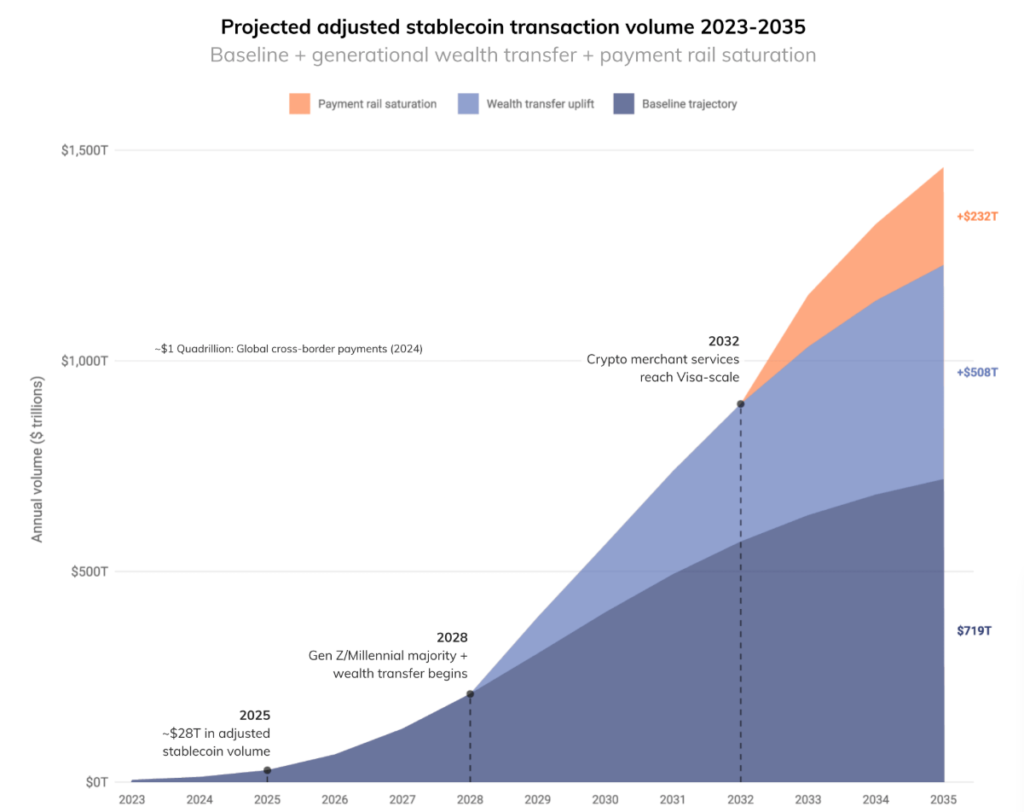
Adjusted stablecoin volume projections: According to a recent Chanalysis research publication, stablecoin volume is often inflated by non-economic activities like bot trading; therefore, in their analysis, they used “adjusted stablecoin volume” to measure genuine utility like payments and remittances. So far, this adjusted volume has shown a 133% compound annual growth rate (CAGR) since 2023, reaching USD 28 trillion by 2025.
Moreover, the baseline projection anticipates USD 719 trillion in volume by 2035. However, the analysis projects a much higher figure due to two major catalysts: a Generational Wealth Transfer of USD 80-100 trillion to crypto-friendly younger generations, and Point-of-Sale Saturation as stablecoins become a default payment method. Factoring in these drivers, the high-end projection for 2035 stablecoin volume is USD 1.5 quadrillion, which would surpass the current estimated value of global cross-border payments. A very interesting future for the sector.
ODIN and the Revolutionary Trade Finance System: Crossing the Line with Regulated Stablecoins
For the crypto ecosystem, stablecoins are meant to be used as enterprise-level settlement tools and not just for speculative means. The Oceanus-Hashkey model demonstrates how stablecoins can serve as a solid instrument for transferring huge amounts of trade value. If the Oceanus-Hashkey model works, it can be used across industry sectors such as agriculture and manufacturing and exponentially increase onchain RWAs trading volume.


