





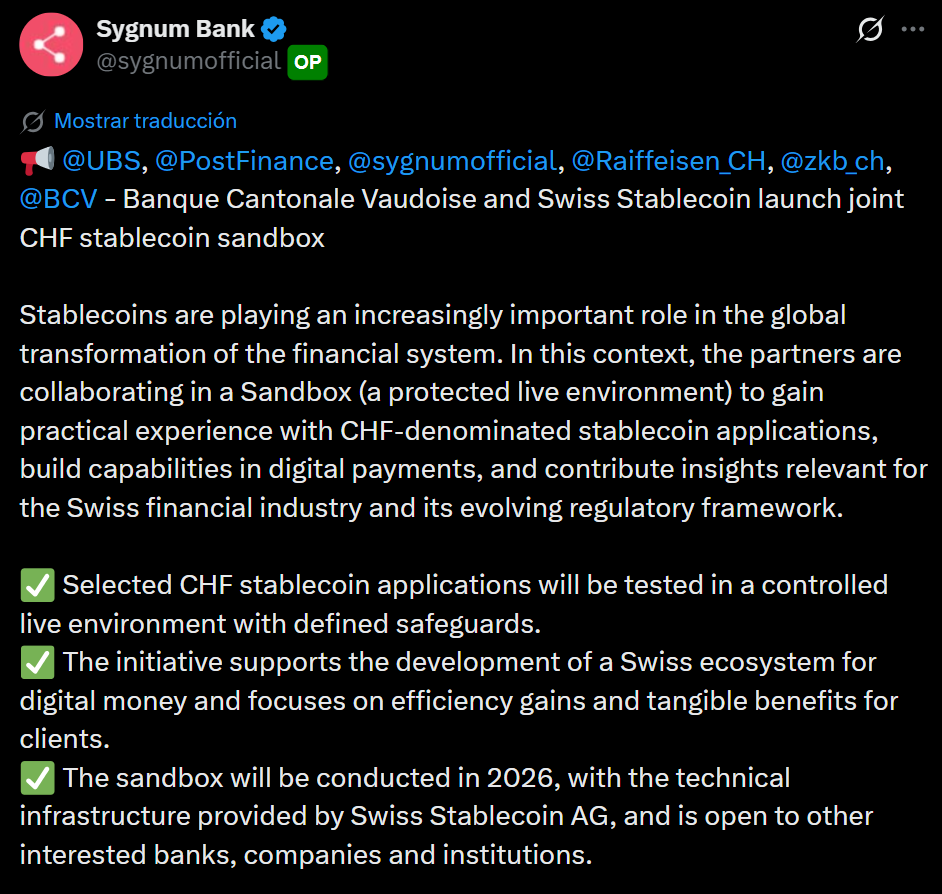
UBS announced that six major Swiss banks have joined forces to test potential use cases for a Swiss Franc stablecoin (CHF stablecoin). The banking consortium consists of UBS, PostFinance, Sygnum, Raiffeisen, Zürcher Kantonalbank (ZKB), and Banque Cantonale Vaudoise (BCV) and is collaborating with Swiss Stablecoin AG to create a regulated digital sandbox to test potential use cases that tie blockchain applications with the CHF.

Why the CHF Stablecoin is Important to Switzerland
UBS states that there is currently no broad-based regulated Swiss Franc stablecoin in Switzerland, thus putting the country at a competitive disadvantage to the Eurozone, which has many regulated Euro (EUR) stablecoins (such as EURC, EURCV), and the USA, where the GENIUS Act has established a federal framework for USD stablecoins. A CHF stablecoin would allow Swiss banks to offer onchain settlement, trade tokenized assets, and perform payments without needing to rely on a foreign currency stablecoin, thereby minimizing currency risk as well as regulatory friction.
The regulatory sandbox will operate through 2026 and is open for new banks to join. Participating banks will test functional applications such as interbank settlement, trading of securities, and cross-border payments. This initiative helps Switzerland establish its digital currency ecosystem while keeping the country an international leader in crypto finance.
Comparison to Other Jurisdictions
A comparison between Switzerland’s new payment system and other jurisdictions (eurozone, USA) shows that the eurozone has competitors in the form of various private issuers (fragmented), while in the USA, there is only one source of federally regulated stablecoins (i.e., GENIUS Act). Switzerland’s consortium of banks is working together as a group to create a new payment system that brings together traditional banks (UBS, PostFinance, Raiffeisen, ZKB, BCV) and crypto-native banks (Sygnum), allowing interoperability. This mirrors the structure of Switzerland’s existing “Crypto Valley” system in Zug, successfully incubating blockchain innovation through public-private cooperation.
What Comes Next
If the consortium’s sandbox activities are successful, they will be able to issue a regulated CHF stablecoin, backed by the member banks. This would create a domestic digital currency alternative to the European and U.S. governments’ digital stablecoins and would allow Swiss companies and investors who currently use foreign stablecoins to use a local one alternative. In addition, it will likely influence the policy decisions made by the Swiss National Bank related to the potential issuance of a retail central bank digital currency (CBDC).


