





Decentralized lending protocol Aave has exceeded USD 1 trillion in total cumulative lending, thus achieving a new debt milestone for the decentralized finance (DeFi) industry. CEO Stani Kulechov shared the news, calling Aave the “backbone of onchain lending, powering a new financial system that is open, global, and unstoppable.”
Aave Debt Milestone Reflects Institution Frenzy
The Aave debt milestone represents a continuation of Aave’s multi-year leadership in this sector, as the protocol is secured by USD 27.2 billion in total value locked (TVL) and has generated USD 83 million of fees during the last 30 days, or close to four times that of the next largest competitor, Morpho. The size of Aave’s business places it on a similar level with the largest banks in the U.S. by deposit volume.
More and more institutions are using Aave to further their efforts through Aave Horizon, an Ethereum-based marketplace, launched in August for traditional finance (TradFi) institutions to borrow stablecoins using real-world assets (RWAs) as collateral. To date, major participants include Vaskeck, WisdomTree, and Securitize.
Tension in Governance Due to Growth
This outstanding achievement comes at a time when protocol’s community members are debating on funding Aave Labs through a USD 42.5 million stablecoin and a 75,000 AAVE funding package, which will redirect all revenue from products to the Decentralized Autonomous Organization (DAO) treasury. Some members are worried about the concentration of votes, and others see this as creating an aligned incentive structure for long term growth and expansion, since it is predicted that the tokenization of “abundance assets” (i.e., solar, energy storage, robotics) will reach a value of USD 50 trillion by 2050.
What’s with the AAVE Token Price?
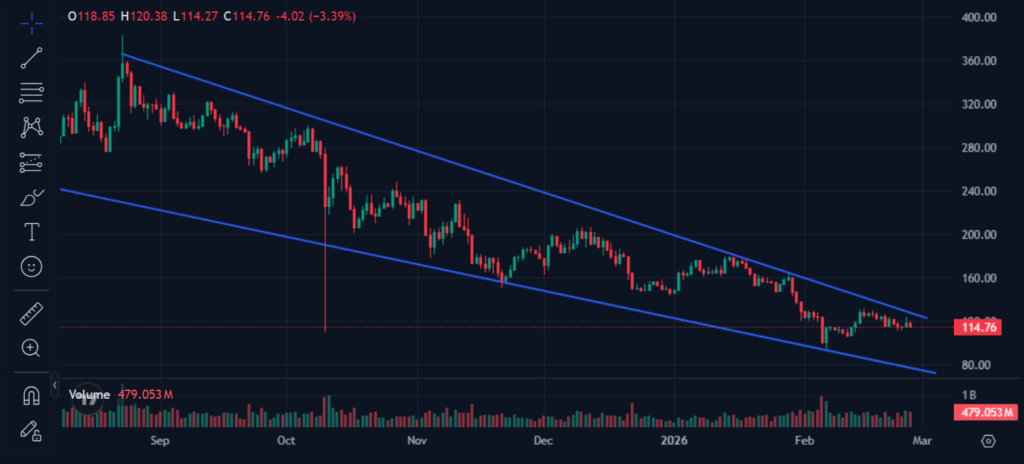
Currently, AAVE is trading at levels that coincide with the upper boundary of its long term descending channel since last August, approximately, as it approaches resistance of around the USD 130. While lower highs continue to develop structurally, there is continued compression against overhead resistance; this indicates that pressure is rising, and not an ongoing breakdown. The level of USD 100 continues to be considered a macro-based support zone for demand.


