





Chainlink has spent the better part of 2026 grinding along the lower boundary of what has become a well-defined range, and the daily chart reflects a market that has absorbed a prolonged downtrend from the October 2025 highs and is now sitting in a narrow band directly above a level that has so far refused to break. At $9.06 in the current session with a high of $9.21 and a 0.22% daily gain, LINK is not making a bold directional statement. It is consolidating in a range that will eventually resolve, and the fundamental and technical picture together suggests three clearly defined scenarios for how that resolution plays out over the next three months.
What the Chart Structure Shows
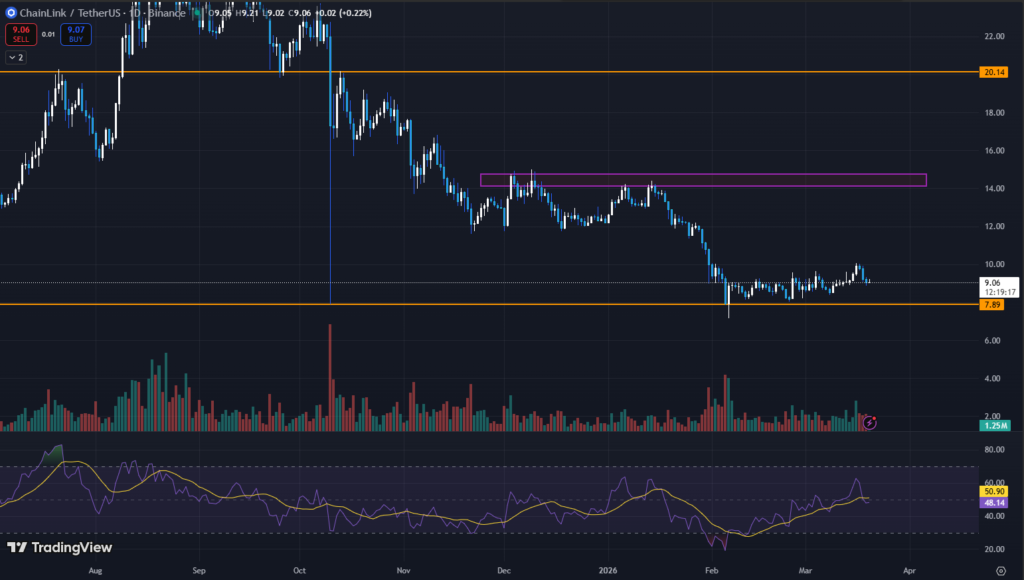
The daily chart tells a clear picture of distribution followed by compression. LINK peaked near the $20 area in October 2025 before entering a sustained sell-off that carried it through the purple supply zone between approximately $13.50 and $14.50, a band where the price consolidated for several weeks in November and December before breaking down further. That zone is now overhead resistance, not support, and any rally attempting to reclaim it will encounter the same sellers who defended it during the initial distribution phase.
The more immediate structure is defined by two orange horizontal levels that bracket the current price. The lower orange line at $7.89 is the critical support level, having been tested sharply in early February 2026 when the price briefly undercut it before recovering back above and consolidating in the $8.20 to $9.23 range that has held through March. That wick below $7.89 and the subsequent recovery are technically significant because it confirms that buyers are present at that level and were willing to absorb the spike-down aggressively enough to push the price back above support within the same session. The upper orange line at $20.14 represents the major overhead resistance from the October 2025 peak, which is more of a long-term reference than a near-term target given the distance from the current price.
RSI and Momentum
The two oscillator lines in the lower panel are sitting at 48.14 on the faster purple line (RSI) and 50.90 on the slower yellow line (signal line), readings that are as close to the midpoint as a momentum indicator can get without being precisely neutral. The purple line is below the yellow line by a narrow margin, which in a Stochastic RSI context indicates a mild bearish lean in the short-term momentum picture, though at these readings the signal carries less conviction than it would at extreme levels. The indicators are not overbought, they are not oversold, and they are not trending meaningfully in either direction, which is the oscillator equivalent of the price action: a market in wait-and-see mode rather than one building toward a directional move.
What is worth noting is the trajectory from the February lows. Both oscillator lines hit their lowest readings of the visible chart period around February, aligning with the price wick below $7.89, and have since recovered toward the midpoint. That recovery in momentum without a corresponding recovery in price back toward the $13 to $14 zone means the RSI reset has happened, but the price has not yet followed, which is a setup that can go either way depending on what catalyst arrives first.
The Fundamental Picture Behind the Chart
Chainlink’s market cap sits at $6.44 billion with an implied circulating supply of approximately 707.69 million LINK derived from the live market data. The 24-hour volume of $672.44 million against that market cap produces a volume-to-cap ratio of approximately 10.4%, confirming active two-way trading rather than a dormant market. The 30-day price range of $8.20 to $9.23 from the sampled data points aligns precisely with what the chart shows, a tight band that has seen regular volume spikes in the $600 million to $750 million range without producing a sustained directional move.
The fundamental case for LINK rests on three pillars that are each real but each conditional in terms of when they translate to price. The first is oracle demand, where Chainlink’s price feeds, CCIP cross-chain settlement infrastructure, and Proof of Reserve services sit at the center of the tokenization and real-world asset narrative that institutional participants are building around. That demand for oracle services is genuine and growing, but it is priced into the protocol’s usage metrics before it is priced into LINK itself, and the conversion pathway from oracle revenue to token appreciation runs through the Chainlink Reserve and staking mechanics rather than directly. The second pillar is the Reserve, an on-chain structure that accumulates LINK from enterprise revenue and was announced in 2025, where sizable purchases reduce circulating sell pressure in a measurable way. The third is staking, where increasing participation locks supply and shifts the token economics toward a more sustainable yield structure as fee revenue grows relative to reserve emissions.
Three Scenarios and What Validates Each
The bear scenario puts LINK in the $5 to $7 range and requires a combination of macro risk-off driving Bitcoin dominance sharply higher alongside a Reserve sell event or weak staking uptake that increases circulating supply pressure. The $7.89 support level on the chart is the technical trigger point for this scenario. A daily close below $7.89 with volume confirmation would shift the structure from range-bound to downtrending and open a path toward the $5 to $7 zone that has not been visited since the earlier stages of this cycle. The invalidation condition is straightforward: sustained on-chain Reserve purchases or a major enterprise integration announcement that demonstrates the protocol revenue pathway is accelerating faster than the bear case assumes.
The base scenario keeps LINK in the $7 to $13 range, which is essentially the current structure continuing. Chainlink maintains steady oracle revenue, staking adoption grows incrementally, no material reserve sales occur, and the macro environment does not deliver a sharp risk-off event. In this scenario the chart stays range-bound between $7.89 and approximately $13, with the purple supply zone between $13.50 and $14.50 acting as the ceiling that caps any rally attempting to break above the base scenario range. This is the most probable outcome absent a specific catalyst in either direction, and the current RSI readings near 48 and 50 are entirely consistent with it.
The bull scenario requires multiple positive triggers arriving in proximity: large TradFi adoption announcements that demonstrate CCIP and Proof of Reserve utility at institutional scale, reserve accumulation that visibly reduces sell-side pressure, a shift in staking yield toward fee dominance rather than reserve emissions, and an improvement in the broader altcoin appetite that brings capital back into the oracle narrative. If those conditions align, the path runs through the purple supply zone at $13.50 to $14.50 first, and a clean break above that zone with volume would open the measured target toward $20 and potentially beyond. The chart invalidation for the bull scenario is a failure to hold $7.89 on a closing basis.


