





Chainlink (LINK) declined another 3.50%, marking its second consecutive price drop, and has now reached the $13.62 level. The downward momentum in the asset appears to be taking advantage of by market participants, as LINK reserves on exchanges have been falling significantly and have now reached a yearly low.
An on-chain analytics platform, CryptoQuant, discloses that LINK Exchanges Reserve has declined sharply over the past year, falling from 171.269 million LINK to 128.051 million LINK — a decrease of 43.218 million tokens.

In crypto, the exchange reserve is an on-chain metric that highlights the overall market outlook for a particular asset. When an asset’s exchange reserve falls, it indicates that investors are withdrawing the asset from exchanges, which generally signals accumulation and can add buying pressure.
Whereas a rise in exchange reserves suggests that investors may be preparing to sell, as they are moving their assets onto exchanges. It typically has a bearish impact on the asset’s price, as it indicates weakening demand.
Despite reserves continuing to decline for the last year, the LINK price has fallen notably. CryptoQuant exchange reserve metric shows that during this period, instead of the price experiencing an upside move, it declined from $24.80 to $13.60.
Meanwhile, in the current scenario, it appears that market participants are seizing the ongoing volatility as an opportunity to add LINK to their portfolios at lower prices. Sometimes, investors also use such situations to average out their long-term holdings.
As of press, LINK is trading at $13.60, down 3.50% according to the advanced charting tool TradingView. However, investors and traders have shown strong interest in the asset, which is reflected in the trading volume, up 19% to $847 million.
Also Read: Bitcoin Exchange Reserves Drop to Year Low, Are Investors Missing Bullish Signal?
Why is Chainlink (LINK) Price Not Gaining Momentum?
The key catalysts that failed to lift the upward momentum seem to be weak market sentiment, declining trader interest, and a growing focus on short positions.
Despite today’s 25-basis-point rate cut, the overall market capitalization has declined by 2.51% to $3.08 trillion, according to Coinmarketcap data. The data further discloses that over the past 30 days, it has fallen from $3.55 trillion to $3.08 trillion.

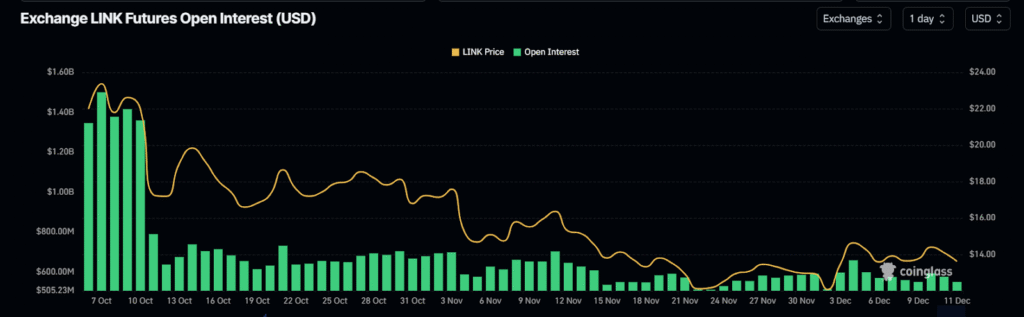
The decline in the overall market has weakened the market sentiment, as it is also reflected in the LINK Future Open Interest (OI). According to the derivative platform Coinglass, since October 7, 2025, LINK OI has dropped sharply from $1.50 billion to the current $549.26 million, as of press time, indicating fading trader interest.
In addition, falling OI points to a lack of conviction, weakening momentum, and traders exiting their positions.
Another factor failing to lift LINK’s upside momentum is traders’ positioning. According to Coinglass’s Exchange Liquidation Map, which highlights traders’ bets, their leveraged long/short value, and the levels at which these positions may get liquidated.
As per the latest update, traders’ interest has shifted notably toward the bearish side over the past 30 days, with strong bets placed around the $12.78 level on the downside and the $15.87 level on the upside. At these levels, traders hold $24.66 million worth of long leveraged positions and $45.06 million worth of short leveraged positions.

Conclusion
When combining all these metrics, it appears that short-term market sentiment is quite bearish, as the overall crypto market and open interest continue to decline. Additionally, traders’ interest, now heavily tilted toward the bearish side, seems to be following the current market trend.
However, the declining LINK exchange reserve points to consistent accumulation. Not only that, but it also highlights the asset’s long-term potential and suggests an ideal level at which investors may consider adding LINK.
Besides these long-term and short-term market signals, traders and investors should be clear about what they are planning in the current volatile market, as crypto is considered one of the riskiest asset classes.


