





Bitcoin (BTC) opens the week inching closer to $70,000 with a market structure that looks calm on the outside but is unstable on the inside. Trading volumes have gone down, volatility is still low, and directional conviction is still weak across most major venues.
But leverage keeps rising in important derivatives markets, which could lead to quick and messy price changes. That tension is now at the heart of the Bitcoin story. On one side, traders keep adding new exposure as prices go back up. On the other hand, thin liquidity makes the market open to sudden reversals, failed breakouts, and liquidations that happen without much warning.
Thin Volume Raises the Risk of Sudden Price Shocks
The latest concern comes from 10x Research, which warned that crypto trading activity has dropped sharply. At the same time, market positioning has stayed broadly neutral. That combination matters because low volume often weakens the market’s ability to absorb sudden bursts of buying or selling.
Consequently, even modest flows can move Bitcoin harder than usual. A rally can accelerate quickly, squeeze shorts, and then lose momentum just as fast. Likewise, a decline can trigger long liquidations before spot demand steps in. In both cases, price action becomes disorderly because the order book lacks depth.
Besides, quiet markets often create a false sense of stability. When volatility stays low for too long, traders may become more comfortable with leverage. That behavior can work for a while. However, it often breaks down once the price reaches a crowded level and forces weak positions out.
James Wynn’s Liquidations Show How Fragile the Market has Become
Recent activity involving leveraged trader James Wynn highlights that risk in real time. On-chain data reviewed by Lookonchain shows that Wynn has faced six separate liquidations on BTC-USD perpetual futures over the past two weeks on Hyperliquid.
The latest event came around two hours before the report, when Bitcoin hit $67,955. That move wiped out a position worth $64,620. Earlier liquidations occurred at prices between $70,425 and $71,952. Those positions ranged from roughly $42,000 to more than $208,000.
Taken together, the six losses exceed half a million dollars. Significantly, the damage did not come from one extreme market collapse. Instead, it came from repeated moves in a choppy environment that punished leveraged exposure again and again.
That pattern tells an important story about Bitcoin right now. The market does not need a dramatic trend to inflict damage. It only needs enough imbalance to trigger a squeeze, reverse direction, and catch traders leaning too hard one way. Wynn’s losses reflect that exact environment.
Options and Positioning Add Another Layer of Risk
10x Research also pointed to another concern developing beneath the surface. Both implied and realized volatility remain subdued, which keeps options relatively cheap. That pricing can encourage traders to cluster around similar views because protection does not look especially expensive.
Moreover, the firm noted that options flow has become increasingly one-sided. When too many participants lean in the same direction, the market can react violently once a catalyst appears. In low-volume conditions, that reaction can become even more severe because fewer orders stand ready to absorb pressure.
Hence, the issue does not revolve around sentiment alone. It revolves around structure. A market can look balanced in headlines while still holding dangerous asymmetries in leverage, options flow, and liquidity. Bitcoin seems to fit that description now.
The same report also highlighted a widening divergence between Bitcoin and Ethereum flows this year. That split has not yet forced a decisive break. Even so, it suggests that demand inside crypto has become less uniform. That fragmentation could matter if the market approaches a key event later this month.
Profit-taking Data Clouds the Short-term Bullish Case
Santiment added another warning sign over the weekend. According to its on-chain data, Bitcoin closed the prior week with a profit-to-loss transaction ratio of 2.95. In simple terms, nearly three profitable transactions occurred for every one transaction moved at a loss.
That reading stands as the highest level in 12 weeks. Historically, such a high ratio has often appeared near short-term tops rather than at the start of sustained rallies. The logic remains straightforward. When holders move coins in profit at a high rate, some level of distribution likely enters the market.
Additionally, it doesn’t mean that there will be a sudden drop. But it does suggest that more supply may come out as Bitcoin gains strength. That extra supply can slow down upward momentum, especially when spot demand isn’t very strong.
This change is important because Bitcoin already trades in a weak market. If holders who are making money sell into rallies and derivatives traders add leverage, the market may have a hard time making a clean upside continuation. Instead, it could swing back and forth between hope and forced unwinds.
Binance Derivatives Activity Points to Growing Speculative Appetite
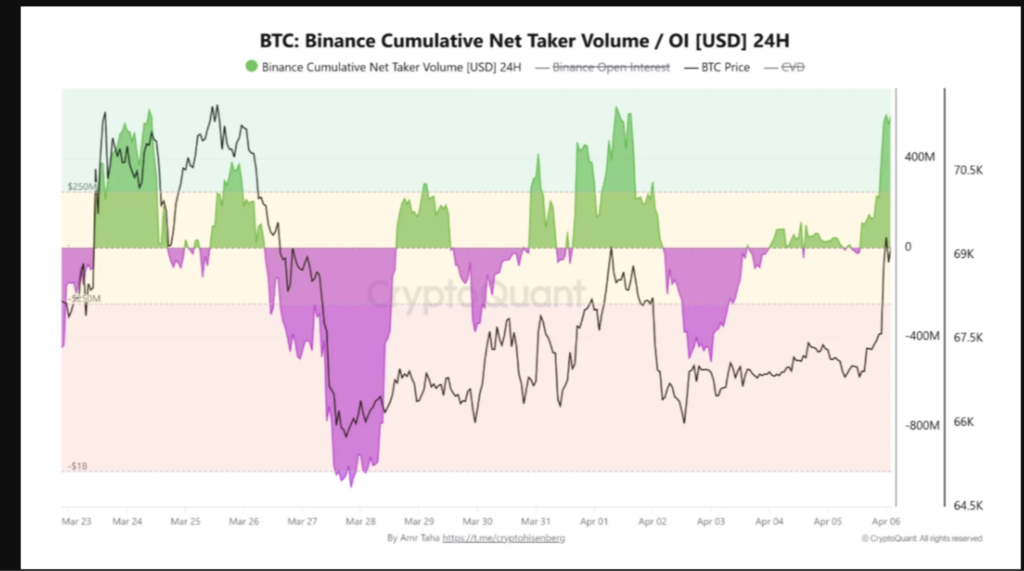
While some indicators call for caution, others show that traders still expect more upside. CryptoQuant analyst Amr Taha reported a notable rise in speculative activity among Bitcoin holders on Binance, especially across derivatives metrics.
Source: CryptoQuant
Taha found that Bitcoin’s cumulative net taker volume on Binance posted strong spikes in recent sessions. The measure climbed above $500 million on March 24 and again on April 1. It then rose to $595 million on April 6.
Net taker volume tracks the difference between aggressive buy and sell orders. When that figure rises sharply, buyers show greater urgency. More importantly, it suggests traders open fresh positions instead of simply maintaining older ones.
Open interest tells a similar story. Bitcoin’s daily open interest change on Binance increased from $53 million on March 27 to $67 million on April 1. By April 6, it had surged to $136 million.
Interestingly, Bitcoin’s spot price rose only 2% between April 1 and April 6. That mismatch matters. Price moved higher, but leverage expanded much faster. Therefore, traders appear to be building exposure in anticipation of a larger move rather than responding to one already underway.
Bitcoin Holds Support, but Resistance Still Limits the Move
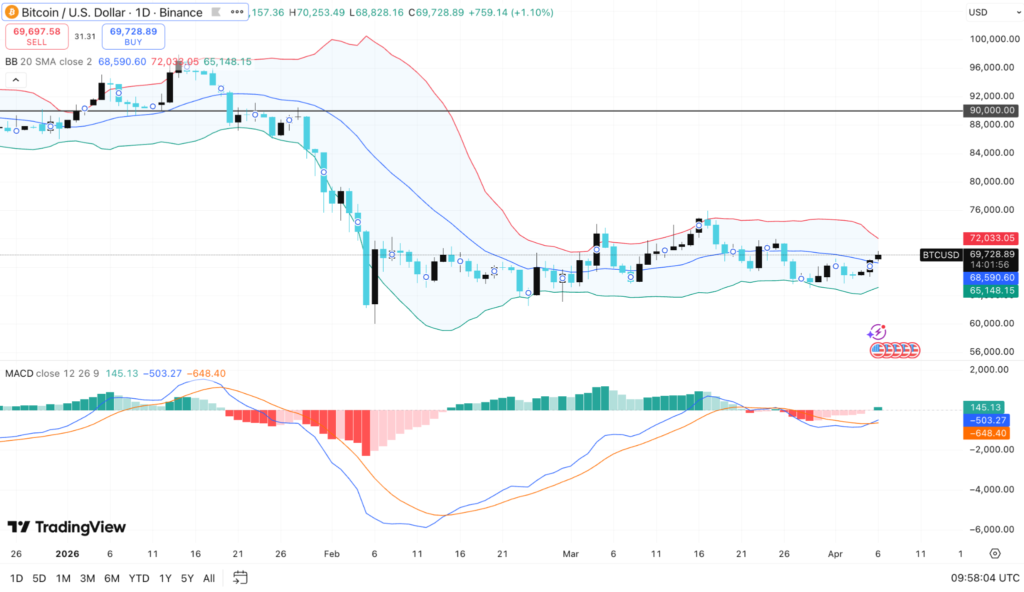
From a technical perspective, Bitcoin still shows improving short-term momentum. It is now floating above the 20-day Bollinger Band basis around $68,590 that is now a dynamic support. Bulls have an advantage in the short run as long as their price remains above that level.
The upper Bollinger Band sits near $72,033. That level marks the first major resistance zone. A daily close above it would strengthen the case for a move into the $74,000 to $76,000 region.
Source: TradingView
However, downside risk remains very real. The lower Bollinger Band near $65,148 marks the next important support area. If Bitcoin loses the $68,500 region decisively, sellers could push BTC price back toward the mid-$65,000s. That outcome would keep the broader sideways structure intact.
Momentum indicators can provide incentive encouragement, but not confirmation. The MACD histogram has gone positive, and the MACD line is near the bullish crossover. That turn indicates that selling pressure is beginning to wane. Nevertheless, the signal is yet to confirm a major breakout.
Final Take
Bitcoin heads into the week with improving momentum, but the rally still rests on fragile ground as leverage rises faster than liquidity returns. Unless spot demand strengthens enough to absorb profit-taking and crowded derivatives positioning, Bitcoin may stay vulnerable to abrupt swings that punish both late buyers and overconfident longs.


