



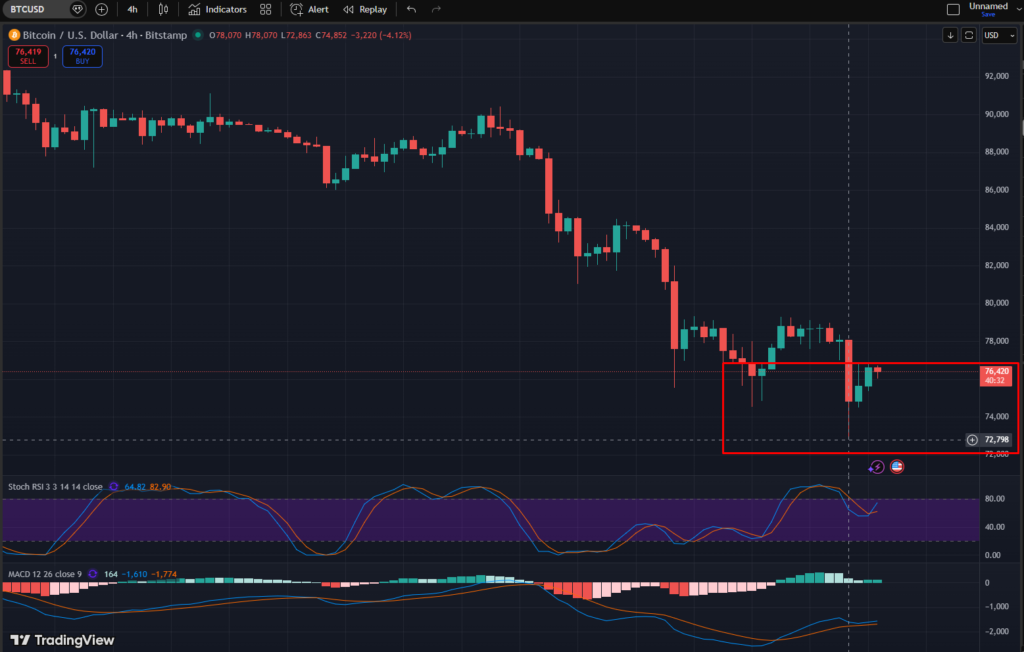
Bitcoin crashes again, hitting levels not seen since Donald Trump’s last election win in 2024, following a sharp downturn that started fading on Feb 4th 2026, where, after dropping below USD 73,000 briefly before regaining some of its losses, Bitcoin has lost all of its gains since the crypto-friendly politician/business man return to the White House and has now experienced a nasty 4-month decrease.
The Scale of the Bitcoin Sell-Off
In September 2025, Bitcoin was approaching USD 110,000. After reaching a high of USD 126,000 in October 2025, it fell to USD 76,000 by February 4, 2026, representing about a 39% correction and not a minor one, with months of ongoing volatility. This selloff was further intensified by continued selling pressure on long-term margins due to the massive liquidation of some leveraged long traders aiming to “buy the dip” and being forced out of their positions.
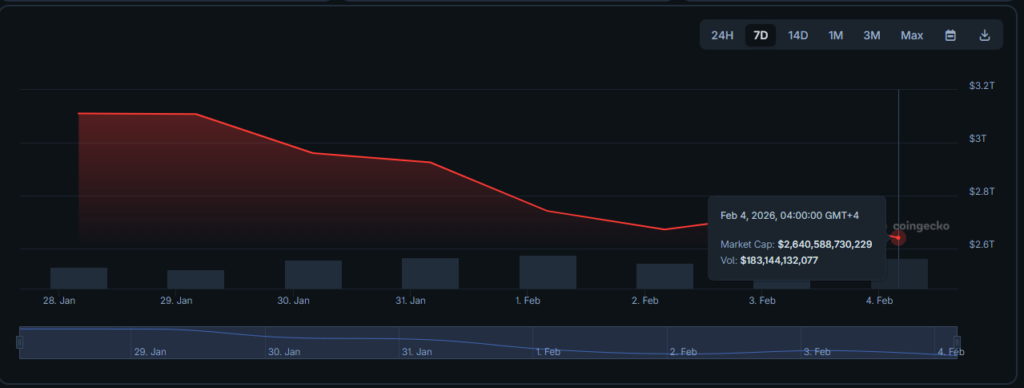
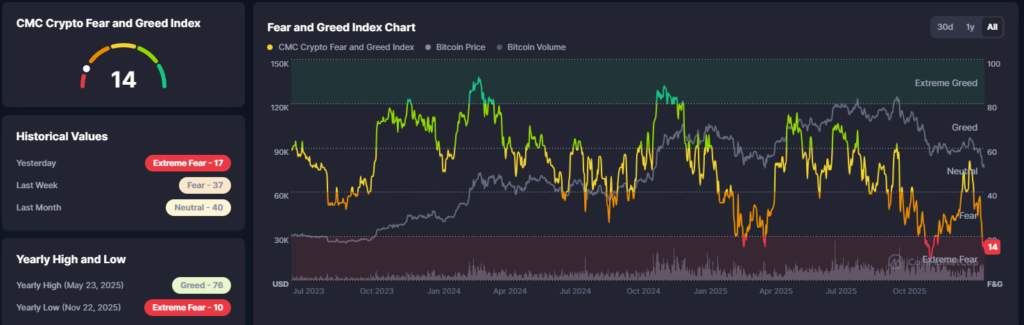
Overall, the total crypto market capitalization (marketcap) has collapsed to USD 2.66 trillion (a -2.44% change in the last 24 hours and -19.66% change in one year), according to Coingecko. Consequently, the market confidence has dropped to “extreme fear.” The general trend in options and derivatives market data clearly leans toward bearish bets and a rush for downside protection.
Why Trump’s Return Hasn’t Been a Sustained Catalyst
The irony here is that Trump’s vocal support for crypto has coincided with Bitcoin’s continued decline, highlighting BTC’s ongoing sensitivity to the macroeconomic risks. For instance, Bitcoin has not been performing as a secure investment like “digital gold” during recent geopolitical and market upheavals, instead trading in lockstep with other high-risk tech assets.
To this point, the initial post-election optimism linked to Trump has faded amid macroeconomic challenges, recent tensions with Iran, fears of an AI bubble, and a record shift of capital into physical precious metals; this has also drained liquidity for speculative digital assets.
A Harsh Reality Check for the Narrative
Dramatic declines are sending a clear message: strong political winds blow through any world’s largest economies; therefore, strong winds will do very little to prevent the negative effects of economic downturns or investor psychology on financial assets. This is evidenced by continuous Bitcoin crashes again and again, showing that it is still highly volatile and carries a significantly higher level of risk than traditional investments.
In addition to the Bitcoin decline, a fundamental repricing of risk throughout the financial markets has been occurring; moreover, Bitcoin crashes again demonstrate that, for the moment, it remains a high-beta risk asset, not a decoupled store of value. On these terms, the market is clearly re-classifying and redirecting risk; the “Trump bump” has been entirely erased, forcing a reevaluation of the digital gold narrative.