





The crypto market is highly volatile right now after a period of relative stability that followed Bitcoin’s peak in late 2025. Bitcoin is currently trading near $66,970, slightly up by 1% in the past 24 hours. The daily chart for the largest cryptocurrency is still showing the downtrend.
Technical Analysis Highlights Bearish Scenario
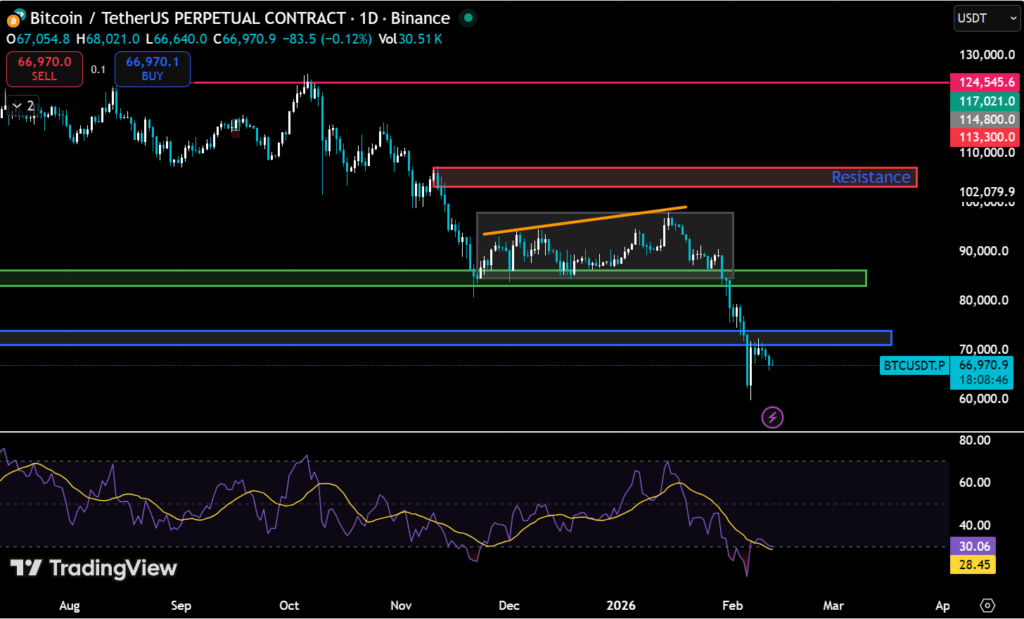
The daily chart for Bitcoin has shown a classic bearish pattern for the last six months. The price kept going up, and by October 2025 it was almost $126,000. But after this rally, there was a sharp correction, which was defined by a downward trendline connecting the peak in October to the lower highs. This trendline acts as dynamic resistance, stopping upward moves and giving sellers the upper hand. It also shows that there is a lot of sell-side liquidity that the market may eventually work through.
There are clear markings showing the key support and resistance levels. A green horizontal support level is at $90,000 USD, which was a psychological barrier during the November 2025 consolidation. Below that, a more important blue support line at $73,200 that is now acting as resistance. The most recent price movement shows a breakdown below the $90,000 level, which sped up the drop to the current $66,970 level. This breach suggests that buyers are losing faith, which could lead to a further drop toward $60,000, as marked by the blue zone on the chart.
The current market situation could mean that sellers are now experiencing a cooldown. At the time of writing, the daily Relative Strength Index (RSI) is standing at 30 and highlights that the largest cryptocurrency is now entering oversold territory. In the past, readings like this type have come before rebounds. For example, in September 2025, the RSI hit similar lows before a 20% recovery. The oscillator line shows momentum and diverges from price lows. If higher highs confirm this, it could mean a bullish reversal.
In simple terms, the technical structure still indicates a bearish short-term bias, with immediate resistance at $73,000. Sustaining these levels with substantial volume could drive the price higher to the $93000 region. On the other hand, if the price structure doesn’t hold $66,000, it could slide to $60,000 or lower, testing the 50% Fibonacci retracement from the lows of 2025.
ETF Flows and Institutional Sentiment
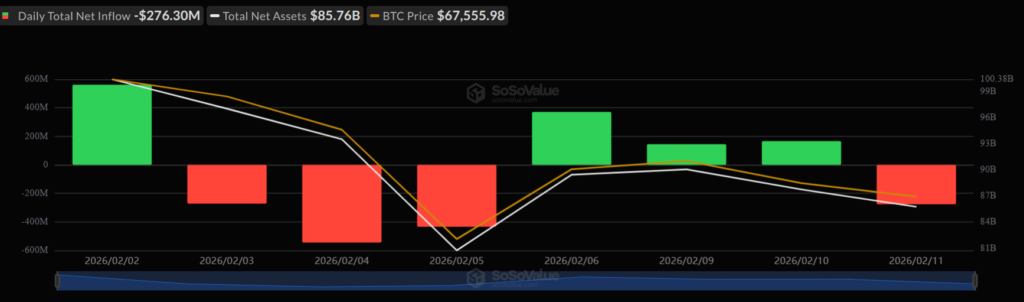
Bitcoin spot ETFs show how interested institutions are in the market. SoSoValue data states that yesterday the U.S. spot Bitcoin ETFs saw an outflow of a total of $276.30 million, which is a continuation of the sporadic withdrawals that have been happening since January. The metric stands with the cumulative total net inflow of $54.72B.
WisdomTree’s BTCW received a $6.78 million inflow and marked its total assets at $66.26 million, while value-focused investors bought the scale-in as they found the current prices to be appealing. Fidelity’s FBTC suffered its biggest outflow when investors withdrew $92.60 million, which brought its total net assets down to $11.07 billion from previous levels. The two investment patterns demonstrate distinct investment patterns since investors buy smaller ETFs during price declines, while larger ETFs experience investor withdrawals when the individuals decide to book their profits or decrease their investment risks.
The total net asset value of all ETFs is $85.76 billion, which represents 6.35 percent of Bitcoin’s total market capitalization. The ratio has remained constant since the 2024 ETF approvals and current outflows demonstrate that investor interest is decreasing. The reasons for this situation include high interest rates, which have existed since the Federal Reserve implemented its 2025 policies, current geopolitical conflicts, and the market competition from AI-driven stocks.
The Intersection of ETFs and Technical Structure
The blend of technical vulnerabilities and ETF withdrawals intensifies the downward pressure. Outflows complicate purchases, intensifying situations like the one below $90,000. The decline yesterday coincided with the reported $276 million outflow, likely resulting in additional liquidations in perpetual contracts.
On the other hand, positive inflows into some ETFs could help keep prices stable. If BTCW’s trend grows stronger, it would be in line with technical oversold conditions for a relief rally. But if heavyweights like FBTC keep leaving, it could be negative for prices and make them more volatile by pushing them toward lower supports.
Possible Future Outcomes and Scenarios
Numerous factors could influence the future trend of Bitcoin. If the economy is growing strongly, supported by the relaxing monetary policy, by mid-2026, it might prevent capital flight and encourage prices to rise above the downward trendline towards $100,000. To confirm technically, the RSI needs to rise above 50, and there should be an increase in volume. ETF inflows are returning to levels observed in 2025, likely due to more transparent regulations on staking or derivatives, which could introduce an additional $10 billion to $15 billion in new capital, increasing the net asset ratio to 8%.
A neutral outlook sees trading staying between $60,000 and $80,000, with ETFs staying stable at their current levels. This could happen if macroeconomic data shows moderate growth, which would lower expectations for rate cuts. Technical indicators like the RSI divergence could back the trend up and stop a big drop.
In the bearish case, continued outflows in response to fears of a recession could push Bitcoin below $60,000; that could open a door to the levels near $50,000, a level last seen in 2024. This would make oversold signals useless, and the descending trendline would make resistance stronger. ETF redemptions reaching $500 million per day could shrink the total net assets by 20 percent, signaling a significant pullback by institutional investors.
The supply shock from the 2024 halving has passed, but the next one in 2028 is still a long way off. Positive wildcards include adoption milestones like nation-state reserves or DeFi integrations, which could make up for outflows. Based on historical correlations, modeling suggests a 0.7 coefficient between weekly ETF flows and price changes.


