





Bitcoin’s recent rally has started to lose momentum just as quickly as it formed. After pushing toward the $73,000 region multiple times, the price has struggled to hold above it, leaving the market stuck in a tight and uneasy range. What once looked like the start of a clean breakout is now turning into a battle between strong institutional demand and equally strong selling pressure.
At the time of writing, Bitcoin was hovering around $71,554 after repeatedly failing to break above $73,000. Each push upward is being met with profit-taking, making a dip towards $70,000 very likely, especially if the US-Iran ceasefire collapses.
US-Iran Cease-Fire Uncertainty Triggers Risk-Off Behavior
A key driver behind the recent volatility has been shifting sentiment around the Middle East conflict, particularly the fragile US–Iran cease-fire narrative. Early optimism around easing tensions helped fuel a risk-on rally across markets, pushing Bitcoin from around $68,000 to over $72,000 within hours.
However, as doubts around the durability of that cease-fire re-emerged, the momentum has begun to fade.
Eyes are especially on Iran’s response to the Israel-Hezbollah after Israel launched the heaviest Lebanon strikes on Wednesday, as the Iran-aligned group fired rockets into northern Israel after a short-lived pause under the US-Iran ceasefire.
This shift matters because Bitcoin has increasingly traded like a macro-sensitive asset. When risk appetite improves, liquidity flows into crypto quickly. But when uncertainty returns, the same leverage that drives rallies can also amplify pullbacks.
And that dynamic is evident in the latest BTC price action. After the initial surge, Bitcoin failed to sustain its breakout attempts and was rejected near the $73,000 region for the third time.
At the same time, altcoins such as Ethereum (ETH), Solana (SOL), and Bittensor (TAO) have started to weaken, signaling a rotation away from higher-beta assets. Bitcoin dominance has also climbed, suggesting that traders are consolidating into the largest and most liquid asset rather than expanding risk exposure.
Aggressive Positioning Rather Than Demand Drove The Recent Surge
While macro sentiment is playing a role, market structure tells an even clearer story. The recent rally was not purely driven by spot demand. Instead, a large portion of the upward move came from aggressive positioning in perpetual futures markets. New long positions expanded rapidly, adding fuel to the rally and forcing a wave of short liquidations worth over $100 million in a short period.
That kind of positioning can push prices quickly, but it also makes the market more fragile. When leverage builds up too fast, even small shifts in sentiment can trigger sharp reversals or extended consolidation phases.
On the other hand, institutional flows have provided a stabilizing force. Spot Bitcoin ETFs have recorded strong inflows, including nearly half a billion dollars in a single day, along with additional demand from newly launched institutional products. This steady buying pressure has helped establish the $69,000–$70,000 region as a strong support base for now.
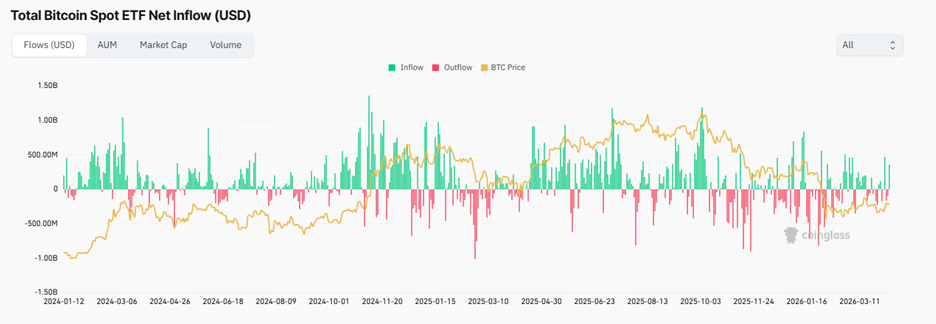
In addition, while Bitcoin is still holding above its short-term moving averages, which keeps the broader trend tilted upward, it remains below longer-term resistance zones near $75,000, suggesting the market is still in transition rather than a confirmed breakout phase.
From a technical analysis perspective, the immediate support sits at approximately $69,400, with a deeper cushion near $67,000.
Why $70K Is Critical For The Next Phase
For now, the market is trapped between two forces. Institutional demand is building a floor, while leverage and macro uncertainty are capping upside momentum. Until one side breaks, Bitcoin is likely to continue trading in a tight range, reacting sharply to both geopolitical headlines and technical pressure points.
The coming sessions will be critical. A decisive break above $73,600 would reopen the path toward $75,000 and beyond. But repeated rejection, combined with weakening sentiment, increases the risk that $70,000 will eventually be tested, and it could give way.
If $70,000 fails to hold, analysts highlight that the next major support levels to watch could be $69,423 and $67,167, where liquidity is likely to be tested more aggressively. A move into that region would not necessarily break the longer-term uptrend, but it would signal that the recent rally has fully cooled off and that leverage is unwinding.


