


Stablecoin issuer Tether has introduced MiningOS, an open-source operating system for bitcoin mining that is meant to break the sector’s dependence on closed, proprietary management software and replace it with a transparent, self-hosted software stack.
The company presents the new system as a common base layer for the industry, capable of running anything from a few machines in a garage to industrial-scale sites.
From Closed Systems to a Shared Codebase
In a post on X on Monday, Tether announced the launch of MiningOS and introduced the software as a new operating system designed to simplify how Bitcoin mining operations are managed.
The system is framed as a response to miners’ reliance on “black box” tools, offering a transparent, openly licensed codebase that operators and developers can inspect, adapt, and extend to fit their own needs and facilities.
Peer-to-Peer Structure Replaces Central Servers
According to MiningOS documentation, the system is built in JavaScript and runs on Windows, macOS, and Linux, and it uses a peer-to-peer networking layer that allows miners, sensors, and other devices to communicate directly with one another instead of routing traffic through central servers. This self-hosted approach is intended to remove single points of failure, cut latency, and keep operational data inside the operator’s own infrastructure instead of external cloud services.
Lightweight Base with Plug-In Functionality
At the center of MiningOS sits a slim core that is surrounded by modular applications, with functions such as site monitoring, performance reporting, and analytics, delivered as separate components that plug into a shared API layer.
Additionally, operators can switch on only the pieces they need, remove others, or build their own modules on the same framework, with Tether presenting the stack as something users can shape rather than a fixed bundle of features.
Full Control From a Single Dashboard
Beyond handling ASICs and containers, MiningOS is designed to structure how energy is used across a site or portfolio of sites and can be used to coordinate power draw from multiple sources in real time, helping operators shift loads, respond to grid constraints, and adjust mining intensity to protect margins.

The new system supports a wide range of equipment, including mining rigs, cooling systems, power meters, containers, and other infrastructure from multiple vendors, allowing users to view, track, and manage everything from a single dashboard.
Built for Both Small Setups and Industrial Operations
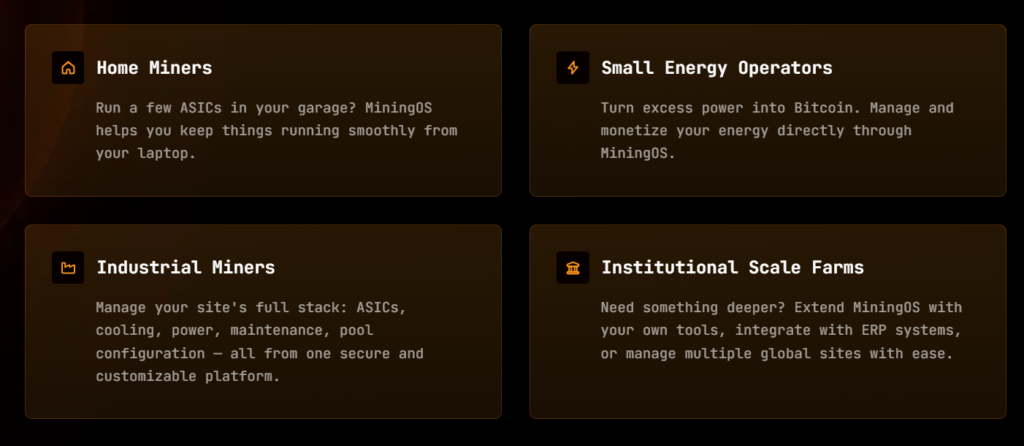
According to Tether, MiningOS is intended for a broad range of users, from new miners running a few devices to large commercial operators.
According to the company, home miners can manage small setups through a straightforward interface, while smaller energy operators can route surplus power into mining under their own control.
At the same time, industrial sites can coordinate thousands of ASICs, cooling systems, and maintenance tasks from one platform, and institutional-scale farms can extend the software with in-house tools or connect it to existing enterprise systems through its modular design.
With the code released as open source and external contributions invited, Tether presents MiningOS as infrastructure that the wider mining community can modify and build on, rather than as a closed product tied to a single vendor.


