





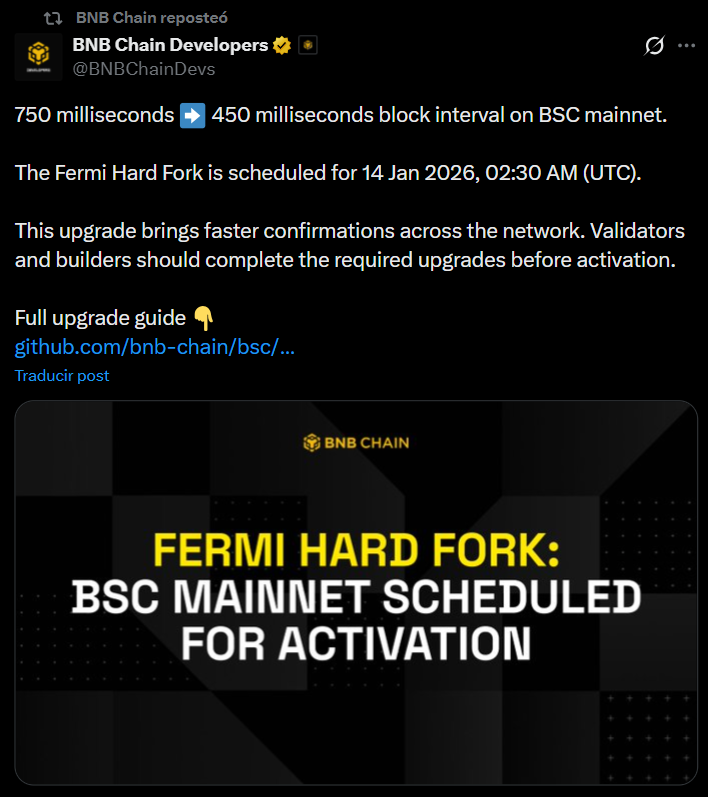
The BNB Smart Chain will get an important boost with the Fermi Hard Fork. The team announced the upgrade is set to be launched in January 2026 to drastically decrease block production time from 750 milliseconds to 450 milliseconds.
A Leap Toward Sub-Second Finality
The BNB Smart Chain’s next major upgrade will occur on January 14th, 2026. Following extensive testing, the Fermi Hard Fork has two main goals: to dramatically reducing the time it takes to produce new blocks and improve the efficiency of the Blockchain, improving the overall performance of the network, and allow for faster failure/resolution on Blockchain transactions.
This will provide the BNB Smart Chain with a large speed advantage over other chains, allowing it to compete for time-sensitive applications (e.g., high-frequency trading, real-time online gaming, and advanced DeFi applications) that rely on instant verification.
Read also: Uniswap Governance Passes Historic ‘UNIfication’ Proposal, Triggers 100M Token Burn
Improving the Stability and Accessibility
The Fermi hard fork enhances the stability of the network through the introduction of a new extended voting parameter to manage validator coordination and to provide network stability within the new speeds.
The Fermi hard fork is also creating a mechanism to partially index the ledger so that nodes can synchronise only with the relevant historical data instead of the entire historical ledger; reducing the storage and compute burden for running a node, and enabling potentially greater decentralisation and access for developers.
Read also: Coinbase 2026 Outlook: Crypto’s Future Hinges on Derivatives, Prediction Markets, and Stablecoins
Strengthening Position for Future Adoption
The Fermi hard fork is a strategic infrastructure investment on behalf of one of the most active crypto networks.
The BNB Chain is improving its value proposition as a cost-effective and high-speed environment for decentralised applications (dApps) through this upgrade.
To this point, the Fermi hard fork is likely to be critical in retaining and attracting developers and even investors in a highly competitive Layer 1 environment, where there will be performance battles between the various networks for the next wave of user adoption.
FAQs
What is the definition of the term Hard Fork?
A hard fork is an update of a blockchain protocol that is permanent and incompatible with older versions of the protocol. A user or node operator must update their software to the new version to participate in the network going forward.
How will users be affected by the upcoming Fermi Hard Fork?
End-users should experience noticeably faster transaction confirmations. DApp developers may want to optimize their applications for the new block time. In addition, all Node operators and Validators will need to upgrade their client software before the activation of the fork.
Do I need to transfer my BNB tokens during the Hard Fork?
No. A hard fork is a network upgrade, not a token migration. All tokens, including BNB, will remain safe in the user’s wallet. Token holders do not need to do anything, but users of wallets or services that are connected to the BSC should be sure to verify that their wallet or service provider supports the upgrade prior to the activation of the fork.
Read also: Isolated Turkmenistan Legalizes Crypto Mining and Exchanges


