




Key Takeaways
- El Salvador begins securing official records on Bitcoin, starting with CUBO+ graduation certificates.
- The project was developed with U.S.-based Simple Proof, using the OpenTimestamps protocol to verify documents through cryptographic hashes.
- The system is efficient and scalable, requiring minimal blockchain space while allowing independent verification.
- The government plans to expand the program, aiming to create a tamper-proof and transparent public record system.
- El Salvador broadens its Bitcoin strategy with new laws and plans for a national Bitcoin bank.
Table of Contents
El Salvador has begun recording official documents on the Bitcoin blockchain in a bid to protect public records from tampering, highlighting the growing global recognition of blockchain technology as a tool for transparency and security.
According to Diario El Salvador, the first chosen files to be timestamped were graduation certificates from CUBO+, a government-backed education program focused on Bitcoin and digital finance.
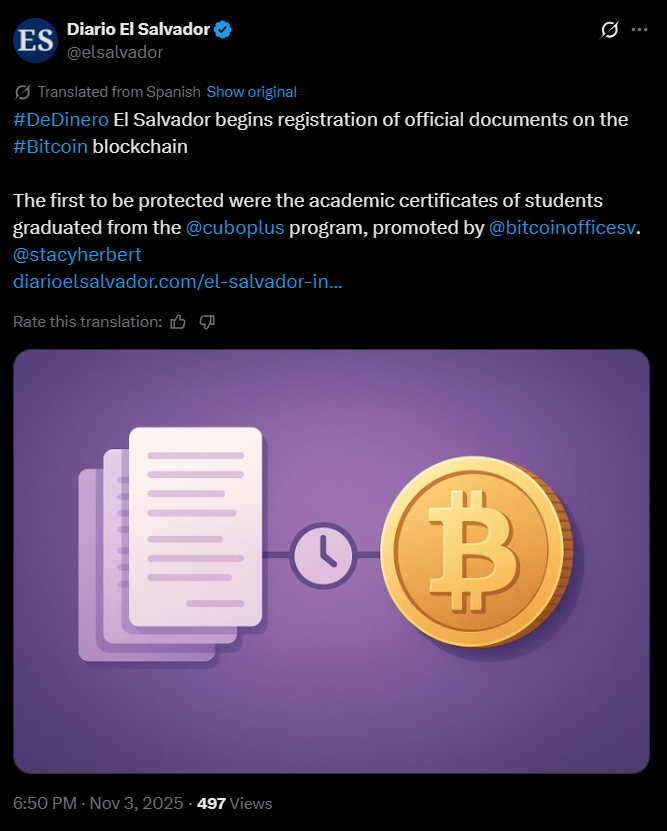
The initiative was developed in partnership with U.S.-based startup Simple Proof, which uses the OpenTimestamps protocol to secure data through cryptographic hashing. “This is the first time in El Salvador’s history that public documents are being secured directly on Bitcoin,” said Carlos Toriello, CEO of Simple Proof.
Bitcoin isn’t just money that no one controls—it’s also a clock no one can manipulate,” Toriello added. “That makes it ideal for proving exactly when a document existed.
El Salvador’s Blockchain Method Cuts Data Use Sharply
Instead of uploading full files, the system generates a cryptographic hash, which is a digital fingerprint, and embeds it in a Bitcoin transaction. Each hash is linked to a specific block on the network, and since the Bitcoin blockchain produces a new decentralized timestamp approximately every 10 minutes, the result is a permanent and verifiable record anchored in time.
Using just 32 bytes of space, or less than 0.01% of a block, this method enables millions of documents to be securely certified without affecting blockchain performance. It also allows individuals to verify the authenticity of their documents independently, without needing intermediaries.
El Salvador Aims to Bring Blockchain to All Government Records
El Salvador is now piloting the same system with other government ministries to apply it to administrative and legal documents. According to Toriello, the broader goal is to build a public record system that is both tamper-proof and universally accessible.
“El Salvador is laying the groundwork for a future where national records can be permanently verified—by anyone, at any time,” Toriello added.
Government Deepens Crypto Strategy With Banking and Policy Reforms
El Salvador has accelerated its crypto strategy with several bold moves in recent months.
In August 2025, it passed a law allowing investment banks with at least US $50 million in capital to obtain digital-asset licenses, signaling a shift from retail adoption to institutional crypto activity.
It also announced plans to establish what it calls the world’s first dedicated “Bitcoin bank,” designed to handle deposits, payments, and lending in Bitcoin alongside traditional financial services.
Meanwhile, the government began moving its Bitcoin reserves to multiple new wallet addresses to bolster security and decentralize its holdings.
Furthermore, El Salvador’s International partnerships have also expanded. In July 2025, the country struck a knowledge-sharing agreement with Pakistan’s crypto-blockchain agency, extending its influence beyond regional borders.
These developments come as part of a broader agenda to embed blockchain and Bitcoin more deeply into the national financial and regulatory framework, rather than treating them merely as alternative assets.
At the same time, external pressure from the International Monetary Fund has led El Salvador to moderate parts of its crypto ambitions, particularly around Bitcoin accumulation and mandatory use.
If executed smoothly, these initiatives could position El Salvador as a global ground for national-level crypto integration, though challenges around market volatility, regulation, and public adoption remain.
Read More: Animoca Brands Eyes Nasdaq Listing via 95–5 Reverse Merger With Currenc Group


