




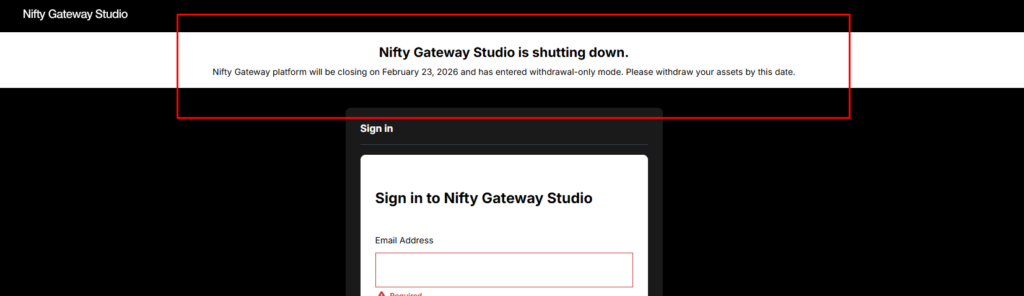
In what is likely another indicator of an overall trend toward consolidation in the non-fungible token (NFT) market, Nifty Gateway Studio has announced it will no longer operate. Nifty Gateway, owned by the Gemini exchange, posted an announcement stating that the last day of operations is 23 February 2026, followed by a “withdrawal only” period during which users can secure any remaining funds or digital collectibles.
The Strategic Reasoning for the Shutdown
This is not a random collapse, but a future-focused, strategic decision made by the parent company, Gemini. Closing the Nifty Gateway platform allows the exchange to reallocate resources towards building a “comprehensive customer platform.” In other words, NFT functionality will now be included in the overall Gemini Wallet offering rather than as a separate, expensive product line.
This move is a reflection of the challenging reality now facing many of the pure-play NFT marketplaces that were created during the 2021 boom, as they can no longer justify their existence as standalone businesses due to the inability to maintain high-volume trading and the continued financial pressure on the larger Gemini organization.
Nifty Gateway’s Legacy and the State of the NFT Market
During its newly opened virtual marketplace, Nifty Gateway has changed the NFT segment run by many online stores selling art in addition to selling physical assets. Shortly after the NFT platform came out in 2020, it became known for enabling many buyers to acquire assets by allowing them to pay with credit cards. Additionally, the company frequently featured significant drops from well-known artists such as Beeple and Grimes, resulting in Nifty Gateway processing an unprecedented total of approximately U$D 300 million in sales at its peak around May 2021. The closing of Nifty marks the end of a chapter of an era characterized by the intense, speculative trading of collectible NFTs by retail investors.
Overall, while the NFT segment experienced a low level of overall performance early in 2026 (approximately $3.2 billion market cap), the overall level of activity had not improved enough to support all of the services and infrastructure established during the boom.


