





Key Takeaways
- TIS Inc., which handles about half of Japan’s credit card transactions and supports over 80% of branded debit accounts, has launched a Multi-Token Platform to digitize its payments infrastructure.
- The platform is built on AvaCloud, a managed blockchain service by Ava Labs that runs on the Avalanche blockchain, enabling the issuance and management of stablecoins, tokenized deposits, and digital securities.
- Processing roughly $1.96 trillion a year via its PAYCIERGE system, TIS is expanding its payment infrastructure into real-time, programmable finance while upholding Japan’s regulatory standards.
Table of Contents
Japan’s payments technology giant TIS Inc. has launched a new Multi-Token Platform on AvaCloud, bringing one of the country’s biggest financial infrastructure on-chain.
The platform, developed with blockchain service provider AvaCloud and built on the Avalanche network, enables TIS to manage and distribute stablecoins, tokenized deposits, and digital securities within a single interoperable framework.
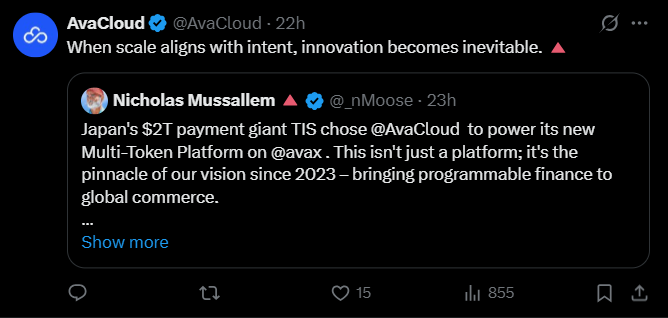
The Tokyo-based firm manages roughly half of Japan’s domestic credit card processing and supports more than 80% of branded debit accounts. Its PAYCIERGE platform processes over ¥300 trillion in annual consumer transactions, and the company works with 11 of Japan’s top 25 credit card issuers.
By integrating AvaCloud’s infrastructure, TIS is expected to extend its payment capabilities into real-time, programmable settlement while maintaining existing systems.
Additionally, AvaCloud enables the company to launch and manage production-ready blockchains without internal development teams, with automated scaling, governance, and performance monitoring built in.
This service is a new platform that safely and efficiently enables the issuance, management, and distribution of diverse digital assets such as stablecoins and security tokens, accelerating the social implementation of tokenization and its business deployment,” said Isao Otokita, Managing Executive Director at TIS.
AvaCloud CEO Nick Mussallem described the collaboration as “a watershed moment that moves beyond pilot projects and directly into production-ready infrastructure,” highlighting more than two years of joint development between the two firms.
Inside Japan’s DeFi Revolution
TIS’s move comes amid a nationwide push to modernize Japan’s financial system through regulated digital assets.
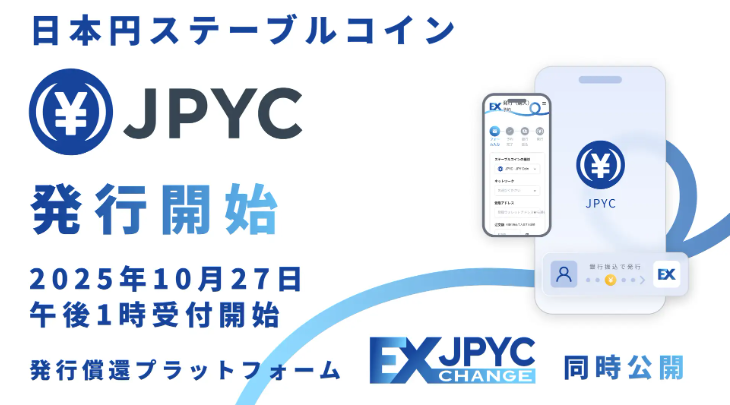
Earlier this month, JPYC Co. Ltd. launched Japan’s first fully compliant yen-pegged stablecoin, backed 1:1 by cash deposits and government bonds across multiple blockchains, including Avalanche and Ethereum.
Around the same time, Japan’s three megabanks, MUFG, SMBC, and Mizuho, announced plans to issue their own bank-backed stablecoin under a shared framework for corporate settlements.
Meanwhile, industrial player Ikuyo Corp. is forming a Stablecoin Association to streamline B2B trade finance and develop common standards for digital payments.
These initiatives highlight Japan’s coordinated effort to bring its financial infrastructure on-chain, reflecting a broader convergence between traditional institutions and emerging blockchain platforms as the country positions itself as a leader in regulated digital finance.
Read More: Circle Launches Arc Testnet with Backing from BlackRock, Goldman Sachs, Visa, and Mastercard


