





JPMorgan Chase has warned that stablecoins, smart contracts, and tokenized finance are no longer marginal and are becoming serious competitors to banks’ core business of moving and safeguarding money.
In its annual shareholder letter, Chief Executive Jamie Dimon said the bank faces pressure not only from traditional lenders and fintech firms, but also from a “whole new set of competitors” emerging from blockchain technology, including stablecoins, smart contracts, and tokenization.
JPMorgan Races to Keep Pace
Dimon said JPMorgan’s rivals already span payments, digital banking, investing, and market-making, adding that new technologies could alter how customers “hold money, move money, invest money, raise money, and manage their investments.” He also said the bank would need to move faster on product development, use its data better, and roll out its own blockchain technology more aggressively.
JPMorgan said it is expanding in global payments and digital assets as part of broader growth plans, betting that its scale and client relationships can help it defend market share even as newer entrants attack the underlying rails of finance.
Scale Remains JPMorgan’s Main Answer
The letter said that JPMorgan’s size remains one of its biggest advantages as new technology reshapes payments. While blockchain-based rivals may be moving quickly, the bank is arguing that reach, customer ties, and the ability to move money at a global scale still matter.
JPMorgan said it extended credit and raised capital totaling $3.3 trillion for consumer and institutional clients in 2025. It also said it moves nearly $12 trillion a day across more than 120 currencies and in over 160 countries, highlighting the size of the network it is trying to adapt to a more digital financial system.
Its consumer bank also showed how much activity is already shifting online. JPMorgan said total payments volume in consumer and community banking rose to $7.0 trillion in 2025, while digital non-card payments accounted for 82% of those transactions. The bank also said it had 75 million active digital customers, including about 62 million active mobile users.
Those figures indicate that JPMorgan already has a large digital customer base as it prepares for an intense battle over payments infrastructure and tries to keep clients within its network as digital money gains ground.
Record Profit Gives Bank Room to Invest
The warning on blockchain came alongside another year of record earnings, giving JPMorgan room to invest as competition intensifies.
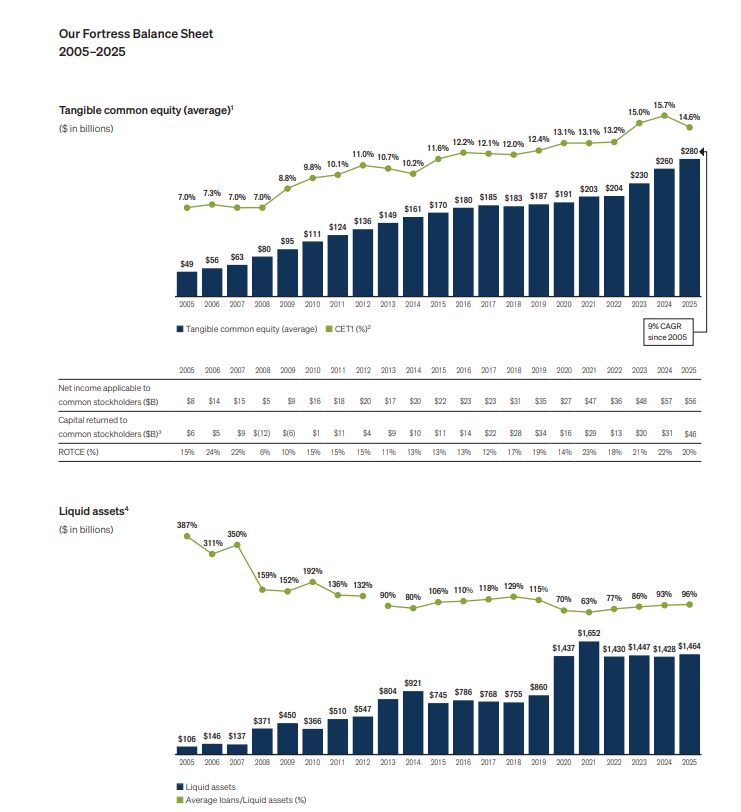
JPMorgan said 2025 revenue rose to $185.6 billion, its eighth straight annual record, while net income reached $57.0 billion. Return on tangible common equity was 20%, and the bank raised its quarterly common dividend twice during the year, first to $1.40 a share and later to $1.50.
The bank said its balance sheet gives it room to keep investing, with average tangible common equity standing at $280 billion in 2025 and liquid assets totaling $1.464 trillion, according to charts in the annual report.
Dimon’s broader message was that JPMorgan is entering the next phase of competition from a position of financial strength, even as the battle over payments is changing shape. The bank is seeking to show that it is not coming to digital assets and blockchain as an outsider, but from within one of the world’s largest existing payments franchises, with deep ties to companies, governments, and consumers.


