




Midas, a blockchain-based platform providing investment solutions, announced the launch of its Instant Liquidity Layer, dubbed Midas Staked Liquidity (MSL), via a USD 50 million Series A fundraising round. The goal of the MSL facility is to address one fundamental challenge that has existed in the trading and holding of tokenized assets: the ability to instantly redeem or exit positions without having to navigate through lengthy settlement periods and/or fragmented liquidity pools.
How the Instant Liquidity Layer Will Work
The Instant Liquidity Layer operates on an open architecture model, allowing liquidity providers to compete against one another for the execution of redemptions, thereby lowering execution costs. MSL transaction settlements are made free of counterparty and settlement risk, which restructures the capital cost associated with investing in tokenized funds, vaults, and real world assets (RWAs). The initial capacity of MSL is set at USD 40 million.
Midas also introduced the Midas Attestation Engine, which provides continuous onchain proof of reserve holdings, net asset value (NAV), and price updates for every mToken. This functionality permits investors, protocols, or integrators to independently verify the assets backing their mTokens at any time.
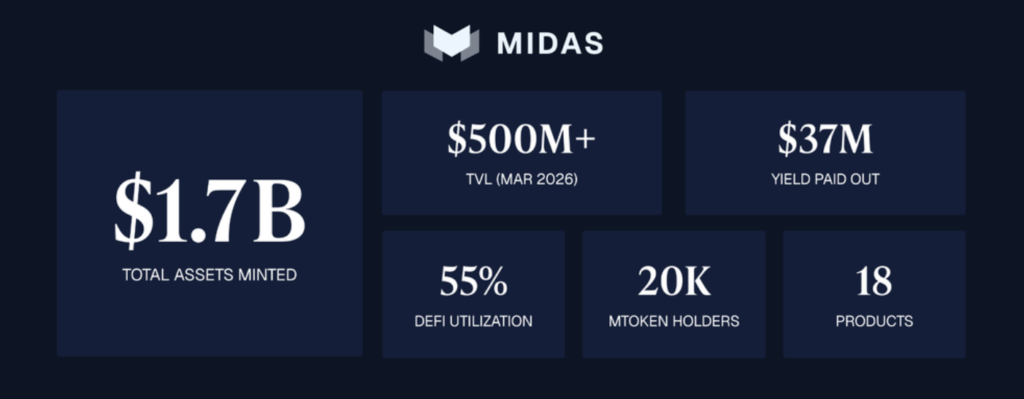
The existing mTokens have been very well received by investors. To date, over USD 1.7 billion in total net assets of mTokens have been minted, over USD 37 million in yield has been paid to over 20,000 holders, and numerous leading decentralized finance (DeFi) protocols (e.g., Morpho, Curve, Pendle) are currently integrated with Midas. Additionally, an increasing number of institutional asset managers are implementing their own strategies via Midas.
Why It Matters for the Tokenization Sector
The development of tokenized real-world assets has happened quickly, but the number of uses on a day-to-day basis has been limited due to the lack of redemption latency and composability. Midas’ Instant Liquidity Layer will eliminate these points of friction and allow tokenized goods (products) to act more like native primitives across DeFi and Centralized Finance (CeFi), whether for retail investors who want to be able to exit their positions daily or for large institutions that need to manage a significant allocation of funds.


