





Ethereum has regained its footing after dipping to an intraday low near $2,160, showing renewed strength as bulls take control after the short pullback from the $2,257 high set on April 8.
The recovery has been steady rather than explosive, with ETH trading around $2,217 at the time of writing, marking a 1.7% gain over the past 24 hours. Price action has remained within a relatively tight intraday range of $2,160 to $2,234, suggesting that volatility is building beneath the surface.
The rebound now brings fresh attention to whether the asset can build enough momentum to break through the $2,257 resistance zone.
Technical Analysis Points to More Gains
The pullback has found strong demand near the $2,160 level, which now stands out as a short-term support zone. More importantly, the altcoin has reclaimed the $2,145 level, a former resistance that has now flipped into support.
This shift is critical from a technical standpoint. Holding above $2,145 keeps the current bullish structure intact and suggests that buyers are willing to defend higher lows. In addition, the 20-day exponential moving average (EMA), currently positioned near $2,125, reinforces this support zone.
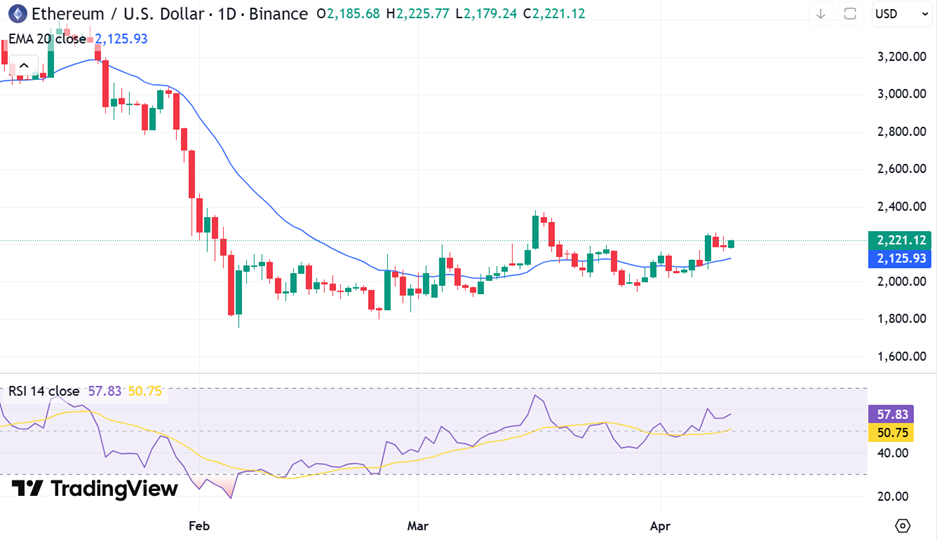
The longer timeframes also reflect improving conditions. Over the past seven days, Ethereum has gained approximately 7.7%, while extending its 30-day increase to over 9%. On a yearly basis, the asset remains up nearly 40%, highlighting a broader upward trend despite recent consolidation.
For traders, the key takeaway is clear: as long as ETH holds above the $2,145–$2,160 region, the path of least resistance remains to the upside.
Market Momentum and Derivatives Signal Growing Confidence
Ethereum’s rebound is not occurring in isolation. The broader crypto market has also turned positive, with overall market gains hovering around 1.2%–1.3% in the same period. This has positioned Ethereum as a high-beta asset, meaning it has amplified the broader crypto market moves.
At the same time, derivatives markets data points to increasing bullish positioning, with open interest in Ethereum perpetual futures rising by roughly $2.2 billion within 24 hours. The Taker Buy/Sell Ratio also remains above 1.0, further confirming that buyers are currently in control.
Institutional developments are also contributing to the backdrop. Increased participation in Ethereum staking infrastructure, including involvement from major financial players like BlackRock, which named Galaxy as one of the approved validators to power ETH staking for its new iShares Staked Ethereum Trust ETF (ETHB), continues to strengthen long-term confidence.
While these factors may not trigger immediate price spikes, they provide underlying support for sustained upward movement.
On-chain activity signals strong underlying demand
Beyond price action, Ethereum’s network fundamentals remain robust. Daily transactions have climbed to approximately 1.3 million on a seven-day average, matching previous peak levels. At the same time, daily active wallet interactions have approached the 2 million mark.
This surge in activity reflects growing usage across decentralized finance platforms and layer-2 scaling solutions. It also contributes to increased fee generation, which in turn supports Ethereum’s deflationary mechanics through token burning.
For traders, this is an important context. Strong on-chain activity often precedes sustained price appreciation, even if the market initially lags in response.
Can Ethereum break above $2,257?
For now, the Ethereum price outlook remains cautiously bullish.
The immediate focus now shifts to the $2,257 resistance level, which marks the recent swing high and represents a key barrier for further upside.
A confirmed breakout above $2,257 could open the door toward the $2,300–$2,380 range, where the next cluster of resistance is likely to emerge. Given the current momentum and improving sentiment, such a move remains plausible if buying pressure continues.
However, the absence of a clear, singular catalyst means the rally is still dependent on broader market conditions. Ethereum’s correlation with the wider crypto market remains high, and any reversal in sentiment could quickly impact price action.
If a bearish reversal happens and Ethereum falls below $2,145, the current bullish structure would be weakened, exposing the price to a retest of the $2,100 level.
A deeper pullback could extend toward $2,000, which remains a strong psychological and technical support zone.


