





In order to mitigate the fragmentation of the rollup-centric roadmap, Ethereum developers have proposed the concept of the Ethereum Economic Zone (EEZ). This initiative is being led by Gnosis and Zisk with funding from the Ethereum Foundation. The goal of the EEZ is to unify the ecosystem by allowing Layer-2 (L2) solutions to be synchronously composable with mainnet, and also with one another.
The Main Feature of the Ethereum Economic Zone
At its core, the Ethereum Economic Zone uses atomic execution across all chains. For example, a smart contract on an EEZ rollup can call another smart contract on either the mainnet or another EEZ rollup, get a response back, and complete the transaction, and this can all be done in a single atomic operation. This eliminates the use of bridges, wrapped assets, or worries about fragmented liquidity (which is a major problem in the current multi-chain experience).
The EEZ also greatly reduces complexity for many protocols, which otherwise would need to deploy and maintain five different deployments on five different chains, along with associated tooling. Deploying to the EEZ allows protocols to deploy once and take advantage of synchronous composability to reach users everywhere. This allows users to follow one process on Ethereum where assets, positions, and identity are handled without needing to specifically use bridges (as expected).
What’s at Stake
Ethereum’s Economic Zone (EEZ) will fundamentally change L2 solutions from being a set of competing “silo” solutions with unconnected liquidity, multiple custom bridges, and many different infrastructures into a single unified solution connecting all L2s. The EEZ aims to provide a solution to this by constructing rollups that add to the current Ethereum Layer-1, rather than isolating from it.
The EEZ is built on many years of foundational work. Gnosis has been building out the infrastructure necessary for Ethereum’s execution layer since 2015. Gnosis has been responsible for the development of Ethereum’s constant product Automated Market Maker (AMM) model, creating the Conditional Token Framework, which is used by Polymarket, as well as the Coincidence of Wants Protocol (CoW Protocol) and Safe (Wallet).
The lead architect for the EEZ is Jordi Baylina, who is the creator of Circom, has been a contributor to many zero-knowledge proof (ZKP) systems, and has extensive experience developing zkEVMs and zk-EVM provers, and was requested to build an EEZ trial.
The Role of the Ethereum Foundation
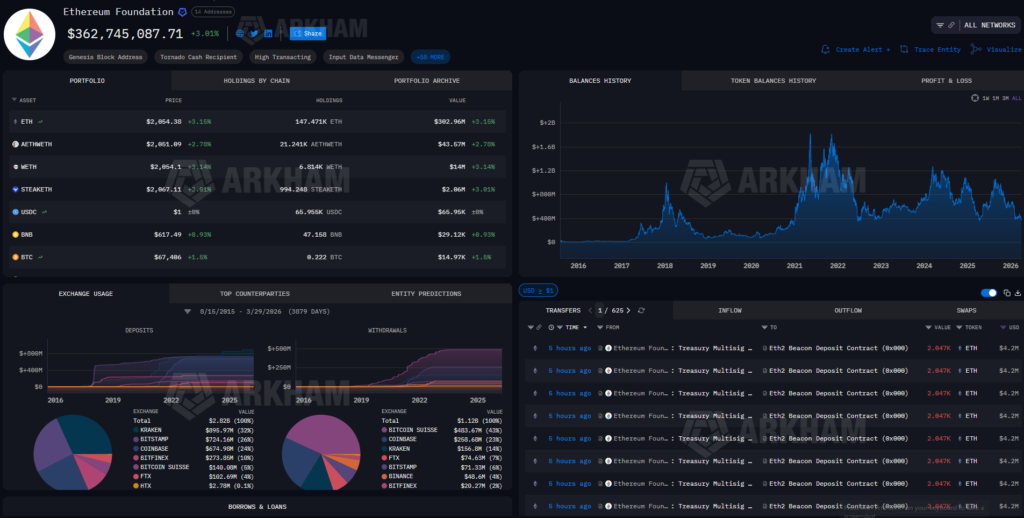
Recently, the Ethereum Foundation deposited 22,517 ETH (worth over USD 46 million) into the Ethereum Beacon Deposit Contract, marking its biggest single staking transaction so far, as part of its treasury strategy introduced in 2025.
ETH Price
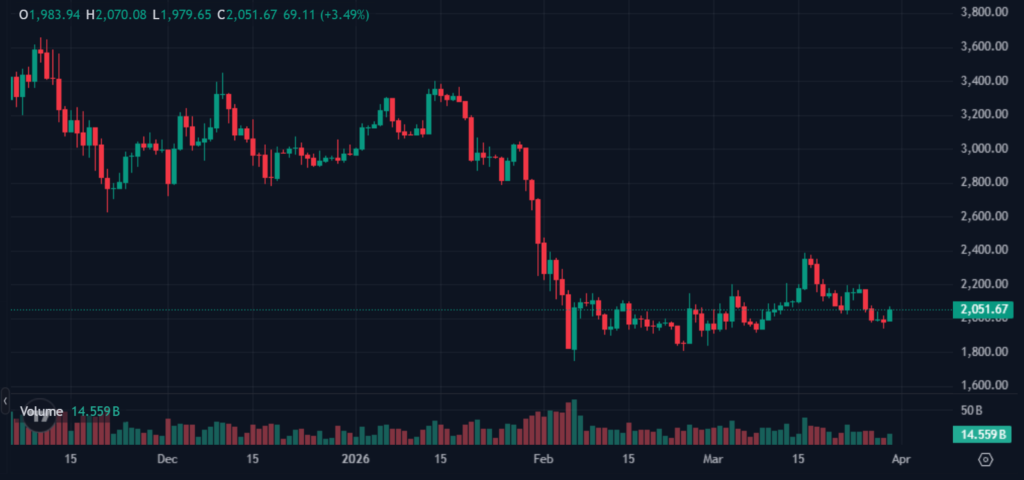
In the meantime, ETH is still down around 60% from its high, raging betweeen USD 1,800 and USD 2,700 since early February. ETH is trading at USD 2,051 at the time of writing, having broken its repetitive USD 2,000 resistance, almost 3% up in the 24 hours.


