





Ethereum co-founder Vitalik Buterin has outlined a detailed plan for how the Ethereum network could steadily cut the time between blocks and bring final confirmation of transactions down from minutes to just a few seconds, while preparing protections against future quantum computers and keeping the existing roadmap largely intact.
Shorter Slots, Same Roadmap
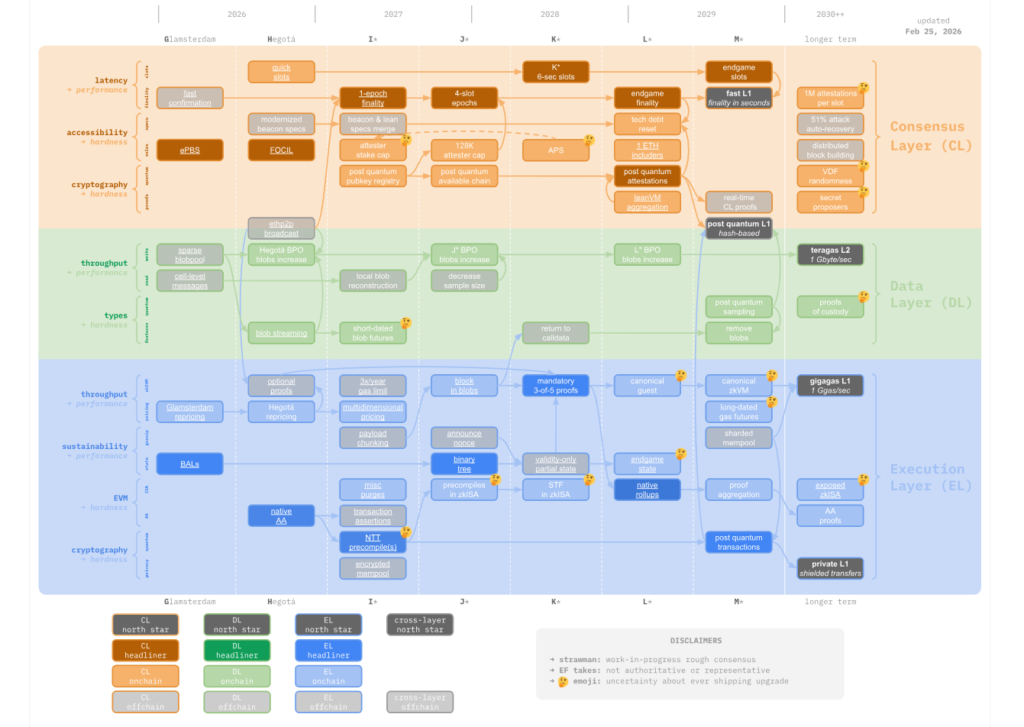
In a Feb. 26 post on X, Buterin said the goal is to push Ethereum toward this “endgame” design in many small steps rather than through one disruptive overhaul.
Today a new Ethereum block appears roughly every 12 seconds, yet Buterin suggests lowering this in stages, for example, from 12 to 8 seconds, then to 6 and 4, with the most ambitious steps, such as 3 or 2 seconds, left to future research.
He wants slot time to be treated as a dial that can be turned down whenever data show the network can safely handle more speed, instead of a rigid constant that would force a redesign of the whole system each time it changes, stressing that most pieces of the long-term roadmap look almost the same whether blocks arrive every 2 seconds or every 32 seconds.
To make shorter slots workable, developers are rethinking how blocks travel across the network. Rather than every node downloading the same full block from several peers, the new design splits a block into multiple pieces and lets a node rebuild it once it has collected enough of them, which keeps redundancy while cutting wasted bandwidth and, crucially, reduces how long it takes for the slowest nodes to see new data.
At the same time, more complex features, such as separating block builders from proposers and adding a “fast confirmation” rule, leave less room in the timing budget, so researchers are exploring a model where only a randomly selected subset of validators signs each block; with hundreds of signatures instead of tens of thousands, the protocol can skip an aggregation step and further shorten slot times.
From 16-Minute Finality to Seconds, With Quantum in Mind
“Finality” on Ethereum, the point where a transaction is extremely unlikely to be rolled back, currently averages about 16 minutes, and Buterin wants to decouple this process from block production and replace today’s scheme with a one-round algorithm, known as a Minimmit variant, that could eventually bring finality into the 6–16 second range.
The roadmap he sketches moves through partial milestones such as faster slots, one-epoch finality, and shorter epochs before relying fully on the new algorithm, making confirmation times progressively shorter while allowing the network to adapt at each stage.
Because these changes reach deep into Ethereum’s core, Buterin argues that the largest steps should coincide with a shift to post-quantum cryptography, using hash-based signatures and hash functions that are friendlier to modern zero-knowledge proofs.
Some components, such as the signatures used for each slot, could become quantum-resistant earlier than the finality gadget itself, he added, which means that in a world where powerful quantum computers arrive suddenly, Ethereum might temporarily lose strong finality guarantees yet still continue producing blocks and processing transactions.
Buterin compares the process of upgrading Ethereum’s consensus to a “ship of Theseus,” where parts are replaced step by step instead of all at once.


