




In a significant development, Grayscale has announced its first quarterly Ethereum staking reward to investors holding shares of Grayscale’s exchange-traded fund (ETHE). This is a exciting because it represents an important shift in the way that ETFs can generate income.

Grayscale’s Launch of Ethereum-based Income Generating Products
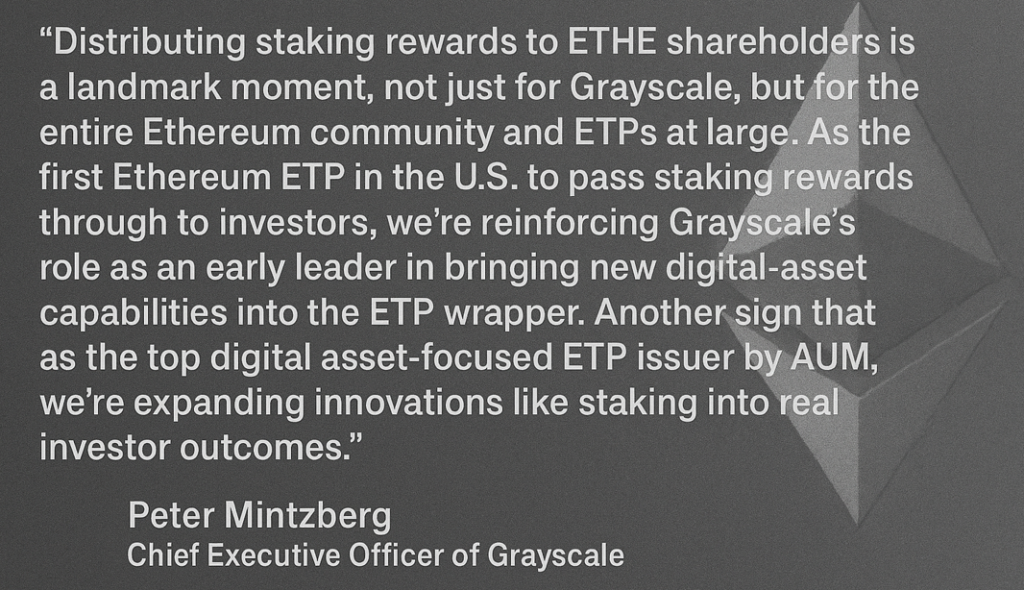
In an industry first, Grayscale has begun distributing staking income earned by its Spot Ethereum ETF to its investors. The fund made a payout of $0.083178 for each share in the fourth quarter of 2025.
This new offering changes the nature of the ETF from one that merely tracks the price of Ether ($ETH) to one that provides passive income to its investors, which is generated via the Ethereum Network’s Proof of Stake consensus algorithm.
Read also: Grayscale Files for Landmark U.S. Bittensor ETP (GTAO) with SEC
Unlocking Institutional-Grade Staking Access
Grayscale is creating an avenue for Traditional Investors to access Ethereum staking rewards with a compliant and hassle free manner; allowing investors to earn rewards from the ETH network without the burden of knowing how to run a Validator, manage their own Keys, or deal directly with decentralized finance (DeFi) Protocols.
This provides a significantly lower barrier to entry for institutions and financial advisors who are looking for crypto yield but do not wish to have to deal with any of the complications associated with running a Validator. Thus, creating new long-term demand for ETH.
Read also: Bitwise ETFs Expansion: Firm Files for 11 New Altcoin Strategy Funds
A New Benchmark for Crypto ETPs
Grayscale has established a new standard in the crypto exchange-traded product (ETP) market through its recent successful distribution of earnings. As a result, this creates pressure on competing issuers of crypto ETPs to adopt this approach, while confirming the inclusion of staking as an essential component of ETFs whose assets are proof-of-stake-based.
The success that Grayscale has experienced in its recent earning distribution will indicate the increase in sophistication of the product offerings in the marketplace. These products will be evaluated based on their differentiation factors independent of just fees and the level of liquidity; one should now expect to evaluate how effectively these products provide investors with the ability to receive and earn yield from the native yield of the underlying blockchain. This connects the economic characteristics of digital assets with the anticipated return characteristics of traditional asset classes.
FAQs
How does an ETF pay staking rewards?
The exchange-traded fund (ETF) issuer (Grayscale, in this case), stakes a portion of the Ethereum (ETH) held by the fund. To this point, the rewards earned from the network are collected, converted to cash (or additional $ETH, depending on the fund’s policy), and then distributed to shareholders as a periodic payment, similar to a stock dividend.
Do I earn more yield with an ETF or by staking myself directly?
Typically, you earn less with an ETF. The fund charges a management fee for operating the staking infrastructure and often retains a portion of the rewards. For instance, you pay for convenience, regulatory safety, and not having to manage the technical process yourself.
Are the staking rewards guaranteed?
No. Staking rewards vary based on network participation and are not guaranteed. Furthermore, staking involves some risks like slashing penalties (for validator misbehavior, for example) and smart contract risk, which the fund manages on behalf of shareholders. The ETF’s value also remains subject to Ethereum’s price volatility.
Read also: Coinbase 2026 Outlook: Crypto’s Future Hinges on Derivatives, Prediction Markets, and Stablecoins


