





Australia’s corporate regulator has urged young adults to think twice and verify financial tips circulating online before making decisions, after new research showed social media and AI are playing a bigger role in how Gen Z approaches saving, investing, and cryptocurrency.
A survey released by ASIC’s Moneysmart on March 16 found that nearly two-thirds of Australians aged 18 to 28 use social media for financial information, while 30% use YouTube and 18% rely on AI platforms when thinking about their financial future.
Scrolling for Answers, Finding Mixed Signals
ASIC said the problem is not a lack of interest in responsible money management. Instead, young Australians are navigating an online environment where visibility and engagement often matter more than accuracy.
More than half of Gen Z respondents said they somewhat or completely trust financial information shared on social media, while 52% said they trust finfluencers, and 64% said they trust AI platforms.
At the same time, 60% said they also use formal or professional sources, and half seek input from family and friends. Even so, the survey suggests social media remains a central influence among users who are aware that not everything they see online is reliable.
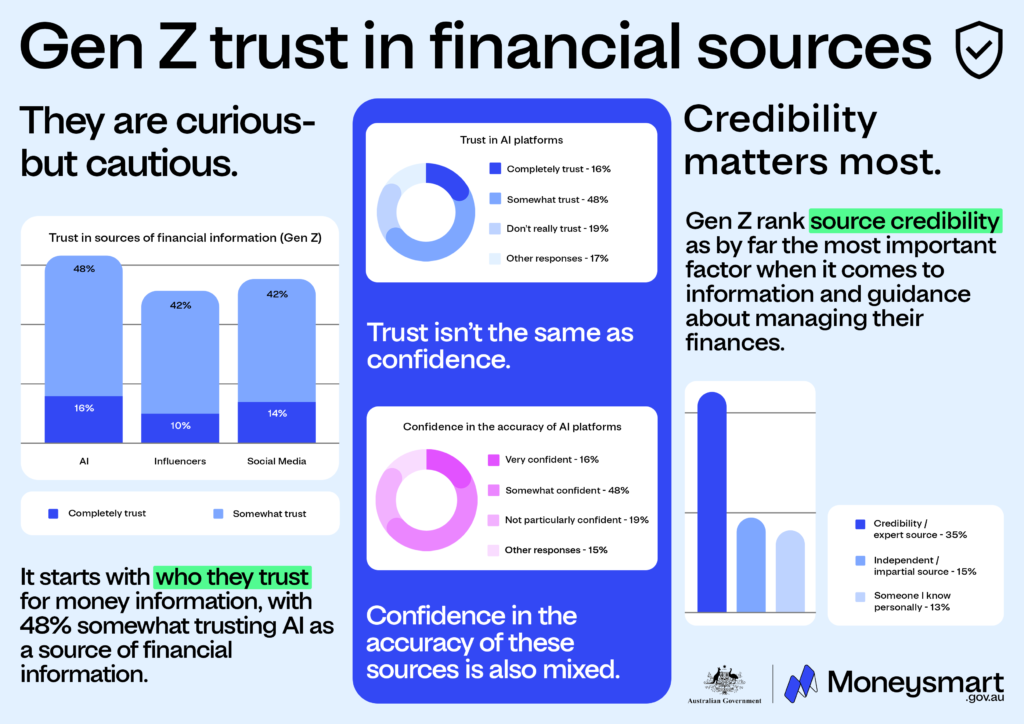
ASIC said depending too heavily on a narrow set of information sources, especially content that is unverified or promotional, can leave young people more exposed to poor decisions. That risk is amplified in fast-moving markets, where online trends shift quickly and broad advice may not match an individual’s financial circumstances.
High Crypto Exposure, Higher Speculative Risk
The regulator’s concerns were clearly visible in cryptocurrency, where the survey showed high participation and clear signs of speculative behavior.
Almost 1 in 4 Gen Z respondents said they owned crypto assets. Among that group, two-thirds said they take a short-term or speculative approach to at least part of their holdings, with nearly three in 10 saying they trade based on social media posts or influencer recommendations.
The research also showed that 24% of Gen Z crypto investors try to back the latest new coins in the hope of picking a winner, while 15% said they invest mainly for speculative trading.
Exposure to crypto marketing was also widespread. Nearly three-quarters (72%) of Gen Z respondents said they had seen social media advertising encouraging crypto investment over the past year, and 41% said someone had contacted them offering help to invest in crypto.
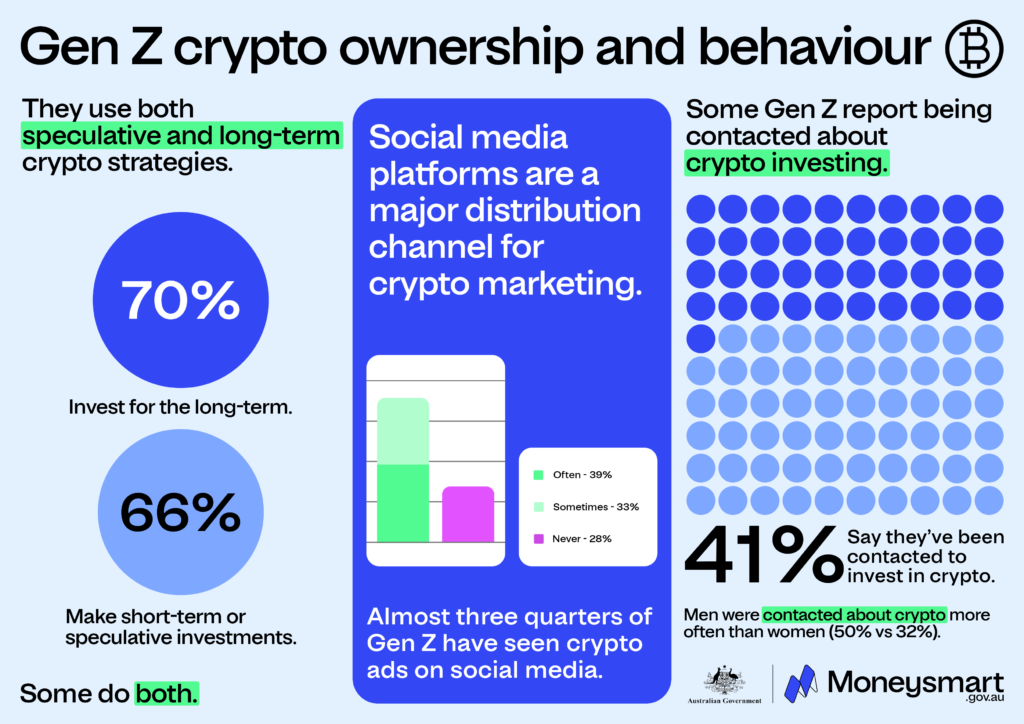
ASIC said crypto can create distorted expectations because it differs fundamentally from more traditional investments. That can lead some young investors to underestimate volatility, overestimate likely returns, and lose sight of the realities of long-term wealth building.
Algorithms Are Not Advisers
ASIC Commissioner Alan Kirkland said social media is deeply embedded in everyday life, but warned that its influence should be balanced with more credible and evidence-based sources.
He said people often place trust in content that is shaped by algorithms designed to maximize clicks and views, not to deliver accurate or complete financial guidance. He added that information found through social platforms or AI tools may be misleading, incomplete, or promotional, particularly when the person or platform distributing it stands to benefit commercially.
Pause, Check, Then Decide
ASIC is urging young Australians to pause before acting on online financial content and to test claims against independent sources.
The regulator said that means sense-checking what appears in a feed, doing further research, and comparing any recommendation with reliable guidance before committing money.
For ASIC, the message is straightforward: curiosity about money is a strength, but in a digital environment crowded with hype, speed, and salesmanship, caution matters just as much as curiosity.


