





Table of Contents
Colombia’s tax authority DIAN has ordered crypto asset platforms to report detailed information on their users and transactions, under a new transparency regime that aligns the country with global standards.
New Regime Mirrors OECD Crypto Reporting Standard
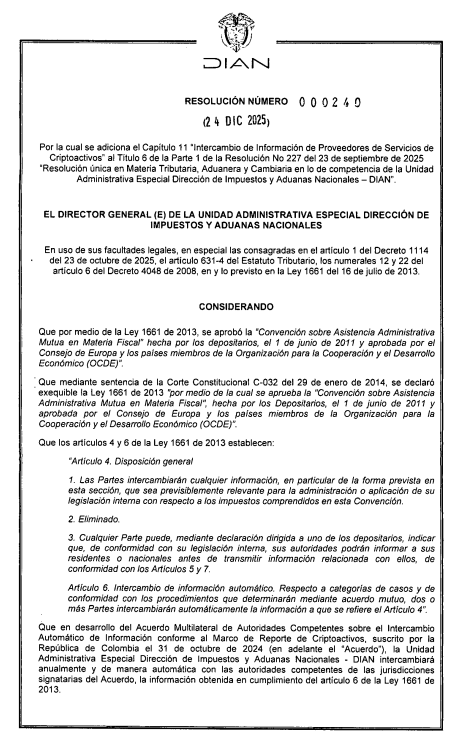
The measure, set out in Resolution 000240, aligns Colombia with the Organization for Economic Co-operation and Development’s (OECD) Crypto-Asset Reporting Framework (CARF) and its Common Reporting Standard, as well as recommendations from the Financial Action Task Force (FATF).
The new rules cover crypto-related transactions, including purchases, sales, exchanges, transfers, and certain retail payments settled in crypto assets, and apply to both domestic platforms and foreign providers that service Colombian tax residents.
Under the new framework, Crypto asset service providers that operate trading platforms, intermediate purchases and sales, or offer custody of assets or private keys will have to identify users and report their activity when they fall within the definition of reportable persons. That includes individuals and companies tax resident in Colombia and in other participating jurisdictions.
Reportable data will include the identity and tax residence of each user, the type of crypto asset, the number and type of relevant transactions, and the total values involved in both crypto and fiat currencies, as well as account ownership details and net balances. Providers must monitor activity and report transactions that exceed set value thresholds, including certain retail payments above 50,000 dollars.
Strict Data, Valuation and Filing duties
The framework sets rules for valuing crypto assets at fair market value, including specific methods for tokens that do not have an easily observable price.
Platforms must apply due diligence procedures to identify users and their tax residence, adapt their systems to capture the required data and transmit it in a DIAN-specified XML format linked to the OECD framework, file the information electronically, ensure the entity is correctly registered in the Single Tax Registry as subject to the new reporting obligation, and keep supporting records for several years.
Non-compliance, late filing, and inaccurate reports will be sanctioned under Colombia’s existing tax penalty regime, exposing crypto platforms to potentially significant fines if they fail to adapt their systems and procedures in time for the 2026 reporting cycle.

