


Key Takeaways
- The European Commission has proposed a wide-ranging reform package aimed at pulling together the EU’s fragmented financial markets into a unified system.
- Under the proposal, ESMA would move into a more prominent supervisory role, overseeing selected trading venues, clearing houses and securities depositories itself.
- The plan also brings all crypto-asset service providers under ESMA’s supervision and strengthens the agency’s role in coordinating rules for asset managers.
- Brussels argues that the reforms are needed to expand access to capital, improve competitiveness and offer savers more investment opportunities across the bloc.
The European Commission unveiled an extensive legislative package on Wednesday that seeks to pull Europe’s fragmented financial system into a more coherent single market, a move officials say is needed to strengthen the bloc’s economy and widen access to capital for households and companies.
Brussels framed the initiative as a core pillar of its Savings and Investments Union program (SIU), a long-term effort to give European savers broader investment choices while helping businesses tap funding across borders. The Commission argues that deeper and more efficient capital markets are vital for Europe’s competitiveness and for financing its digital ambitions, green transition and security needs.
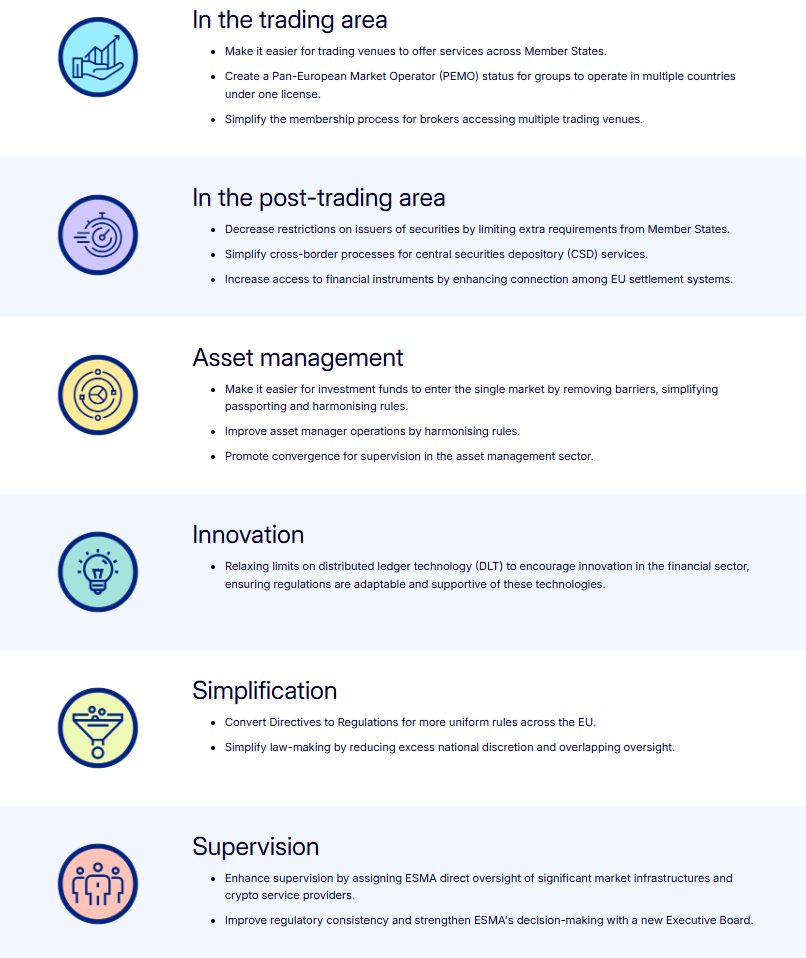
The plan presented in Brussels introduces a wide range of changes. It proposes giving trading venues and central securities depositories (CCPs) broader passporting rights so they can serve clients across the EU under a more unified framework. It also creates a new category for market operators that would allow firms running trading platforms in several countries to consolidate their operations under a single license.
The Commission is also seeking to open up cross-border distribution of investment funds by easing rules for UCITS and alternative managers, while also clearing obstacles that have limited the use of distributed ledger technology through planned adjustments to the DLT Pilot regime.
Alongside these steps, Brussels wants the European Securities and Markets Authority (ESMA) to take a stronger hand in market oversight, giving the regulator direct responsibility for selected trading venues, clearing houses and securities depositories, as well as authority over all crypto-asset service providers and a coordinating role across the asset management sector.
EU markets have expanded in recent years, yet remain far smaller and more fragmented than those in the United States. Stock market capitalization across the bloc stood at roughly three-quarters of GDP last year, compared with roughly three times GDP in the US. Regulators say uneven national rules and supervisory practices continue to raise costs for investors and firms operating in more than one country.
“For too long, Europe has tolerated a level of fragmentation that holds back our economy. Today we are making a deliberate choice to change course. By building a real Single Financial Market, we will give people better opportunities to grow their wealth, and we unlock stronger financing for Europe’s priorities. Market integration is not a technical exercise — it is a political imperative for Europe’s prosperity and global relevance,” said Maria Luís Albuquerque, Commissioner for Financial Services and the Savings and Investments Union, explaining why Brussels is pressing ahead with the overhaul.
Read More: Major Banks Quietly Test Crypto Pilots With Coinbase, Armstrong Says


