





Community bank leaders from across the United States have urged senators to close a perceived loophole in stablecoin rules under the GENIUS Act, citing concerns that interest-like rewards on stablecoins could drain deposits from local banks and weaken lending to households and small businesses.
In a joint message sent to members of the U.S. Senate on January 5, the bankers, who are part of the American Bankers Association’s Community Bankers Council, said that upcoming market structure legislation should make clear that the existing ban on interest on payment stablecoins also covers affiliates and business partners of the issuers, including digital asset platforms that share revenue with token holders.
Bankers warn of deposit flight and lost lending
The letter says community banks support innovation in payments and already offer instant transfer services, but warns that some crypto firms are using new structures to avoid the regulation and supervision that apply to banks, leaving consumers unprotected.
They point to the GENIUS Act, which created a federal framework for payment stablecoins and bans issuers from paying interest, yield, or other incentives. The bankers warn that some firms are trying to go around that restriction by funneling returns to stablecoin holders through exchanges and other affiliates and say that without this prohibition, Treasury has estimated that as much as $6.6 trillion of deposits could be at risk of moving into payment stablecoins.
State-by-state Analysis Highlights the Impact on Communities
An analysis attached to the letter shows how much each state could lose in community bank deposits and how much lending could shrink if large amounts of money move into interest-bearing stablecoin products.
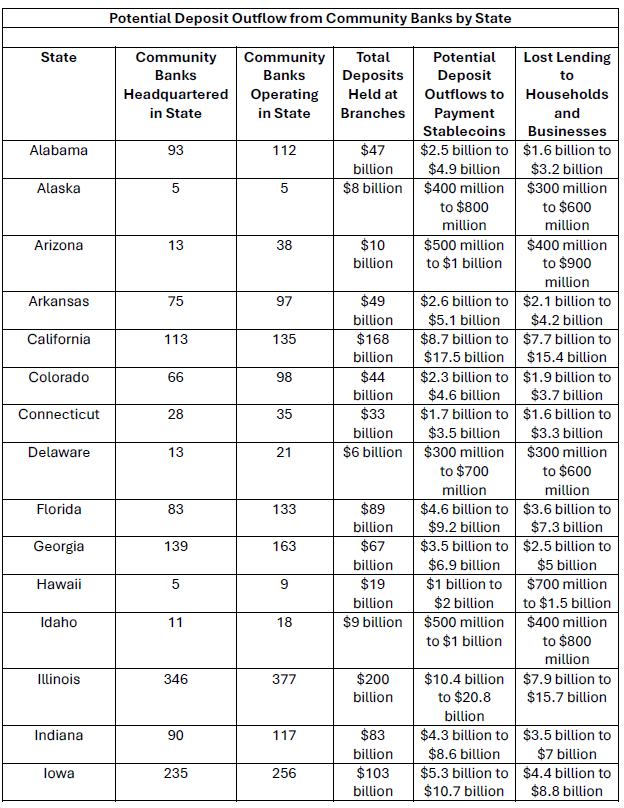
For Texas, it shows that as much as $29.3 billion of deposits at community banks could move to payment stablecoins, which the bankers say would translate into more than $21 billion less in loans to households and businesses, with similar patterns laid out for other states.
The executives say technology firms are free to compete in payments but should do so without pulling savings away from banks through yield-style products that the GENIUS Act was designed to restrict. They call on senators to stand up for community banks and small businesses by spelling out in market structure legislation that the interest ban applies not only to issuers but also to affiliates and partners, warning that otherwise local economies and future growth could be put at risk.
Read More: CLARITY Bill Headed to Senate Markup, Aims to “Democratize U.S. Economy”

