





Russia’s government approved a series of new laws to legalize crypto and digital rights within a tightly regulated foundation. The new legislation establishes a highly regulated market that requires all digital currency transactions to go through licensed intermediaries (i.e., exchanges, brokers, and digital asset custodians) and prohibits peer-to-peer (P2P) trading outside of regulated marketplaces.
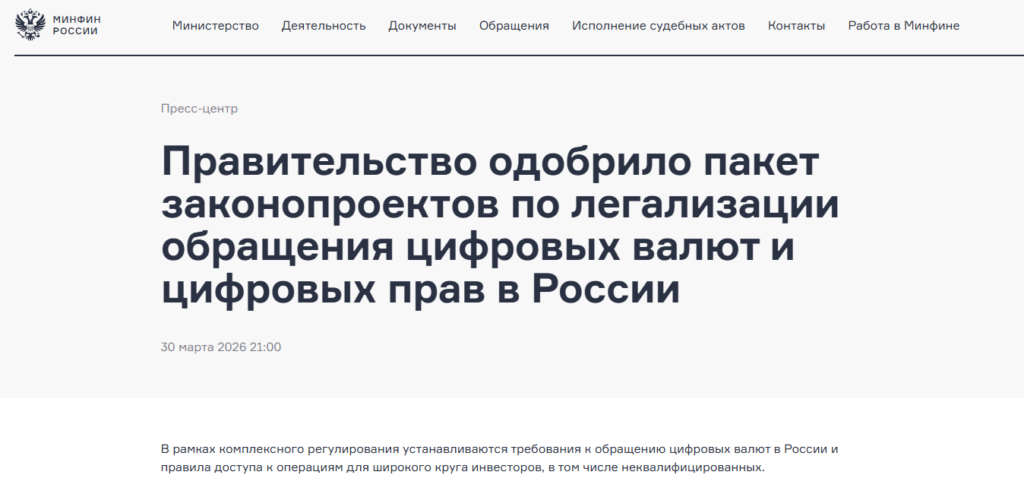
The New Rules to Legalize Crypto for Russian Investors
Additionally, there are two tiers of access for investors:
- Unqualified investors, representing a significant majority of all retail participants, can only acquire certain approved, highly liquid cryptocurrencies from the Bank of Russia’s list, after taking a ‘knowledge test,’ and are only allowed to transact using a single intermediary with an upper limit on aggregate transactions of 300,000 rubles (approximately USD 3,700) per year.
- Qualified investors can complete transactions through any number of intermediaries without restriction or annual limits.
Residents will be allowed to purchase crypto abroad through foreign bank accounts and transfer those assets from Russian intermediaries; however, the Federal Service for Taxation must be informed of such transfers. Furthermore, the new legislation also provides an updated regulatory framework for digital financial assets (DFA), utilitarian digital circumstances (UDR), and hybrid digital rights (HDR), allowing them to be created and traded on public blockchain networks rather than only on closed operator systems.
All licensed entities authorized under the new crypto exchange regulations will also need to follow special regulatory prudential requirements, and an administrative penalty will be imposed on any persons or entities violating the new regulations.
Crucial Information
It’s important to note that this package is an attempt by the Russian government to create an overarching framework of crypto regulations while maintaining tight state oversight. By requiring that all crypto transactions go through regulated financial institutions (e.g., banks), limiting retail and other forms of direct access to crypto, and imposing additional restrictions on its use, Moscow aims to capture tax revenue and control capital flows without endorsing crypto as a full substitute for the ruble. The push also adheres to international anti-money laundering (AML) regulations but maintains a window open for cross‑border crypto activity.


