





Table of Contents
U.S. Securities and Exchange Commission (SEC) Chairman Paul Atkins on Thursday unveiled a major reset of the agency’s rulebook, saying years of regulation-by-enforcement had pushed digital asset innovation overseas and left markets without clear rules.
Speaking at the “SEC Speaks” conference in Washington, Atkins said the agency’s work in the coming year would be guided by a three-part strategy aimed at updating outdated rules, clarifying overlapping jurisdictions, and trimming unnecessary requirements.
The framework, which he branded the SEC’s “A-C-T” strategy for “advance, clarify, transform,” offered one of the clearest signals yet of how the commission intends to depart from recent regulatory practice, particularly in crypto markets and corporate disclosure.
Atkins argued that too much of the SEC’s existing framework was built for an earlier era and has failed to keep up with the way markets now function. He pointed to paper-based default rules for shareholder communications as an example of how the agency’s framework has fallen behind modern markets shaped by algorithmic trading and artificial intelligence.
Instead of detailing each rulemaking planned for this year, Atkins said he wanted to explain the broader thinking behind them. He said the problem is not just that some rules are outdated, but that years of added requirements have made the system so complex that companies now need entire industries to help them navigate it.
He said the SEC should focus on raising the cost of fraud and manipulation, not the cost of compliance.
A New Direction on Crypto
Crypto was a major focus of Atkins’ remarks, highlighting how central digital asset policy is likely to be to the SEC’s broader reset.
Atkins said the SEC had relied too heavily on enforcement instead of writing rules tailored to new products, an approach he said pushed innovation overseas even as American entrepreneurs and investors stood ready to build at home.
He described the commission’s past message to crypto firms as forcing them to adapt to an outdated framework or face legal consequences. That approach, he said, neither produced clarity nor stopped the market from growing elsewhere.
The new direction, according to Atkins, will be to build rules that are clear enough to guide market participants, flexible enough to accommodate innovation and strong enough to safeguard investors.
Drawing Cleaner Lines with the CFTC
A second part of Atkins’ plan focuses on jurisdiction, an area that has long frustrated firms operating across securities and derivatives markets.
Atkins said overlapping oversight between the SEC and the Commodity Futures Trading Commission had often left companies caught between agencies without clear answers on which rules applied.
He noted that firms registered with both agencies can face multiple exam cycles, reporting systems, and supervisory regimes even when the underlying risks are largely the same.
Atkins argued that regulators should accept each other’s overlapping requirements when they achieve comparable outcomes, rather than forcing firms through duplicative processes.
As evidence of that shift, he pointed to a memorandum of understanding signed earlier this month between the SEC and CFTC, saying the agreement would support closer coordination, aligned definitions, and secure data sharing while helping deliver clearer regulatory boundaries for market participants.
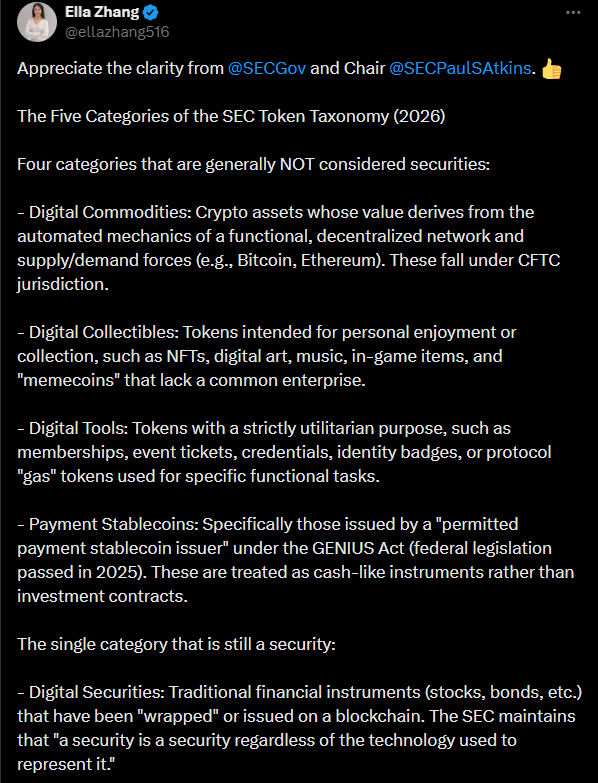
Among the first outcomes of that cooperation, Atkins said, was recently published token taxonomy and crypto interpretive guidance issued by the SEC with the CFTC’s participation.
A Push to Trim the Rulebook
The third part of Atkins’ agenda aims to scale back disclosure and compliance requirements he views as excessive.
Atkins said the SEC had drifted from the long-standing legal principle of materiality, replacing it in practice with a broader and more subjective standard shaped by whatever a particular investor might want to know. That, he argued, has contributed to disclosures that overwhelm rather than inform.
He said the Division of Corporation Finance is reviewing disclosure requirements from the ground up, with materiality as its guiding principle, in what he described as a broader regulatory cleanup.
Atkins noted that the effort would extend beyond disclosure, with the enforcement division being redirected toward fraud, market manipulation, and breaches of trust rather than technical violations where there was no clear investor harm.
He also said staff would review reporting rules tied to securities lending and short sales after a court remanded two related rulemakings, with a focus on balancing regulatory objectives and compliance costs.
Atkins concluded by urging market participants to challenge the agency’s thinking as it moves ahead.


