




Dan Romero, founder of Farcaster, stated that the rumors regarding the shutdown of the decentralized social protocol are false. He went on to clarify that although Farcaster will continue to operate, Merkle, a separate entity behind the social platform, has decided to return U$D 180 million worth of venture capital back to its investors.

The Two-Track Announcement: Protocol Continuity and Capital Return
Romero’s announcement covers two separate points, meaning the continuation of the protocol and the return of venture capital:
- First, Romero stated that Farcaster will remain operational and is sufficiently decentralized for the long term future. He also stated that Neynar, a start-up company backed by venture capitalists, that acquired both Farcaster’s client and its application Clanker, will act as the steward of the platform to ensure that it is built out to support builders (a more dev-centric path) as opposed to a more social media approach, and not winding it down.
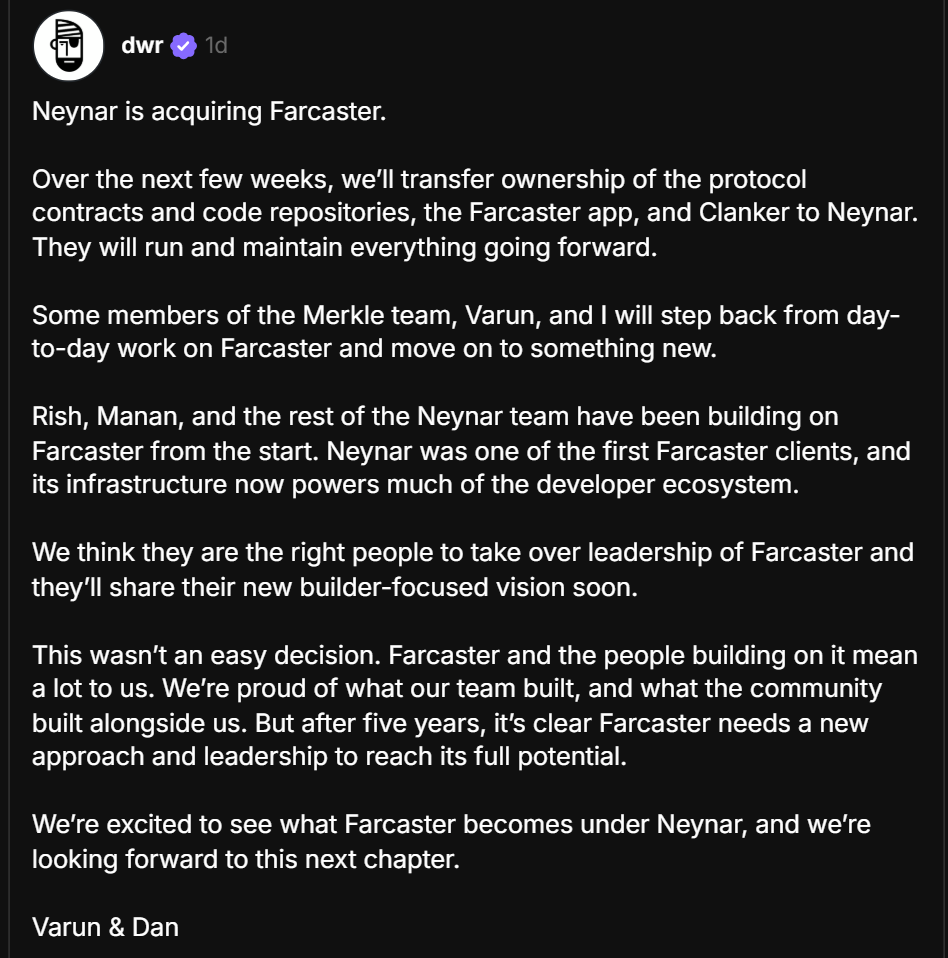
- Secondly, Romero announced that Merkle will indeed return all of its investors’ U$D 180 million that was previously raised from investors. He further stated that Merkle is committed to being responsible in their management of investors’ funds and stated that they funded Romero’s personal real estate purchases through proceeds from earlier sales of shares in Coinbase (to the investors of Merkle), not through venture capital.
Why This Clarification Was Necessary and What It Signals
This dual announcement was very likely created to reduce market confusion surrounding Farcaster’s operational future with Merkle’s financial decisions. With the two communications separated, Romero hopes to maintain investor confidence in the Farcaster Ecosystem (which currently has approximately 250,000 monthly active users) while being transparent about the way Merkle will return investors’ capital. This type of refund is rarely seen in the venture capital space due to the high-risk nature of the business. Merkle’s approach to this indicates the firm is no longer able to operate under its previous business model or adapt to current market conditions.

The Neynar acquisition sets a dedicated team working on Farcaster and will also expedite the development of Farcaster; however, it will introduce a much more centralized way of governing the development of a protocol that was originally built around decentralization principles.


