





Key Takeaways
- Mastercard Crypto Credential expands to self-custody wallets using Polygon blockchain.
- System replaces long wallet addresses with verified, username-style aliases.
- Mercuryo handles user verification while Polygon provides instant settlement infrastructure.
Table of Contents
Traditional Finance Meets Self-Custody Innovation
Mastercard Crypto Credential extends its reach into the self-custody wallet sector via a new partnership with Polygon Labs. The payment industry giant has selected Polygon as the first blockchain layer to support its new verified username system for non-custodial wallets, effectively eliminating the need for users to use their crypto address to send and receive digital currencies.
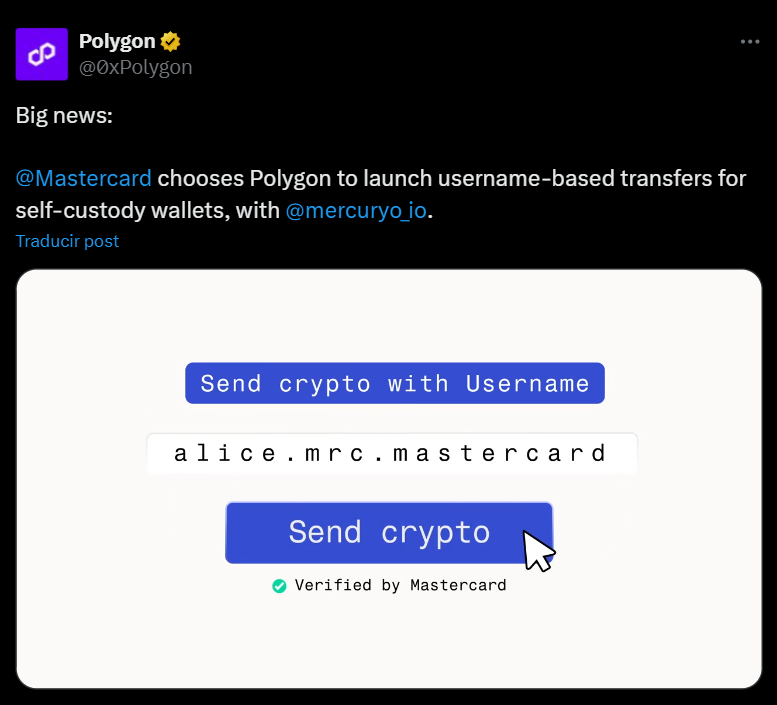
This expansion of Mastercard Crypto Credential represents a major step toward making self-custody intuitive for mainstream users, while also enabling them to maintain the independence and protection of their assets that come from a decentralized finance (DeFi) experience.
Read also: Goodbye CEXs: Mastercard’s 3.5B Cards Go Onchain with Chainlink’s Crypto Bridge
Simplified User Experience Through Verified Identities
The enhanced Mastercard Crypto Credential system replaces the complex hexadecimal wallet addresses (currently the standard for blockchain wallets) with human-friendly and comprehensible aliases tied to verified user identities.
Through partnership with verification provider Mercuryo, users undergo a one-time Know Your Customer (KYC) onboarding process and receive a portable credential that works across the Crypto Credential network.
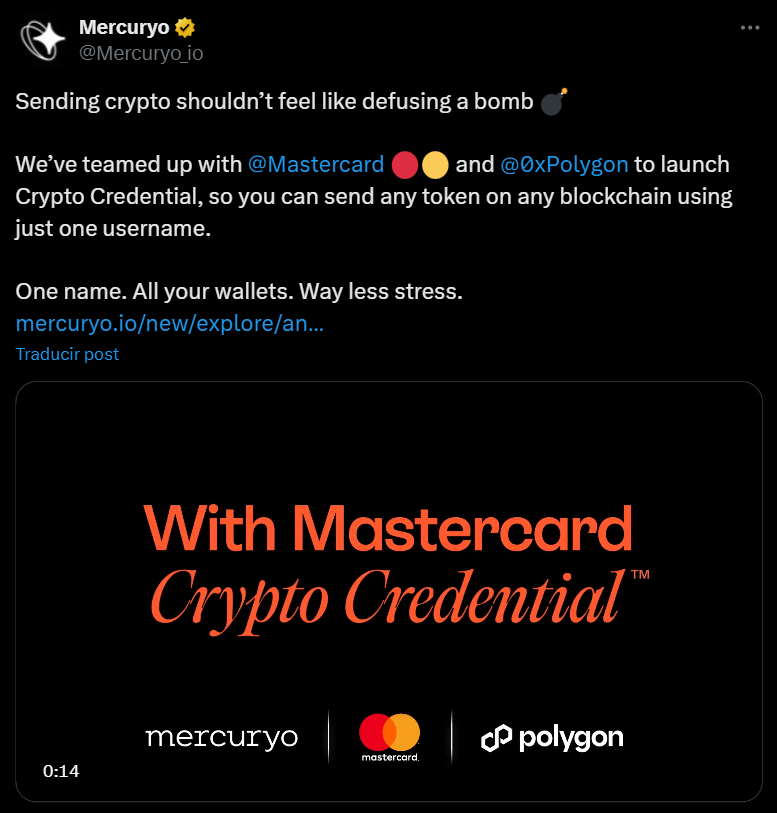
The overall vision for this program is to help maintain basic privacy for the user while ensuring the necessary level of trust and authentication to enable secure transactions, thereby bridging traditional financial verification standards and blockchain’s permissionless nature.
Read also: Polygon Rio Upgrade Revolutionizes Payments with 5,000 TPS and Instant Finality
Key Features and User Benefits
The interface offers several transformative enhancements to self-custody wallet user experience:
- Human-readable aliases instead of 42-character wallet addresses
- Portable verification credentials that work across platforms
- Optional soulbound tokens indicating verified status on Polygon
- Elimination of test transactions and address verification anxiety
- Maintained user control without sacrificing compliance requirements

Read also: Mastercard Zerohash Acquisition Nears $2B to Boost Stablecoin Infrastructure
Polygon’s Infrastructure Enables Global Scale
Mastercard selected Polygon because of its dependable history and proven reliability, sub-cent transaction fees, and enterprise-level infrastructure capable of handling global payment volumes. The recent upgrade to Rio eliminated the risk of reorganization and added stateless validation, providing the predictable settlement environment necessary for credential verification at scale.
With billions already moving across Polygon in stablecoin every month and 5,000 transactions per second (TPS) capacity coming soon, Mastercard is confident that Polygon will provide the infrastructure needed to launch the Mastercard Crypto Credential and drive mainstream adoption.
Read also: X Handle Marketplace Launches, Valuing Rare Usernames at Over $1 Million
The Future of Verified On-Chain Identity
This expansion of Mastercard Crypto Credential highlights an important moment in the growing willingness of legacy financial institutions to engage with blockchain tech.
Rather than attempting to recreate centralized models, Mastercard adopts this approach while layering necessary identity verification to make blockchain technology user-friendly.
As more institutions implement this template, verified on-chain identity may become an industry standard for both decentralized and traditional financial interactions.
FAQs
What is Mastercard Crypto Credential?
The Mastercard Crypto Credential is a verification system designed to replace complex crypto wallet addresses with human-readable usernames, allowing users to send and receive digital assets using simple aliases instead of long strings of characters.
How does Mastercard Crypto Credential work with self-custody wallets?
Mastercard Crypto Credential enables users to link their self-custodied wallets to verified usernames, maintaining full control of their assets while gaining the convenience of alias-based transactions through Polygon’s blockchain infrastructure.
Why did Mastercard choose Polygon for this expansion?
Mastercard selected Polygon for its proven reliability, low transaction costs, fast settlement times, and enterprise-ready infrastructure that can support global-scale payment and identity verification systems.
For more DeFi infrastructures stories, read: Yield-Bearing rcUSD+ Token Launches on Polygon, Bridging TradFi and DeFi


