




Key Takeaways
- A new ZKsync Proposal aims to introduce economic utility for $ZK token beyond governance.
- The model would use network revenue from fees and enterprise licensing to fund token buybacks.
- Value would be distributed through token burning, staking rewards, and ecosystem funding.
Table of Contents
From Governance to Economic Utility: The ZKsync Proposal
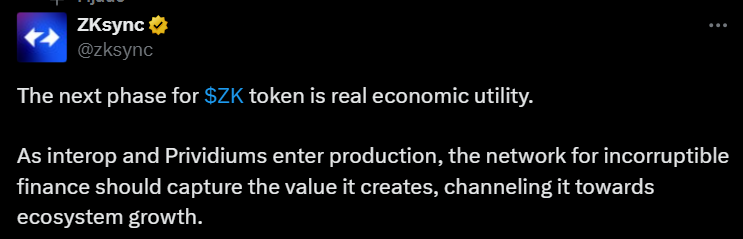
ZKsync’s founder, Alex Gluchowski, has introduced a major ZKsync Proposal aiming to radically change the $ZK token’s economic model. Specifically, the goal of the initiative is to transition the token from being a purely governance token to having some form of economic utility or activity that establishes a connection between the token’s value and development and revenue growth of the network.
This change also addresses the importance of sustainable and self-sourcing decentralization, ensuring the network can fund the ongoing and future maintenance/security without requiring central funding from a sponsor.
Read also: VeChain Hayabusa Upgrade: DPoS Shift and Tokenomiks Audit Set for December
Capturing Value Through Dual Revenue Streams
The ZKsync Proposal lays out two main revenue sources that would drive this new economic engine:
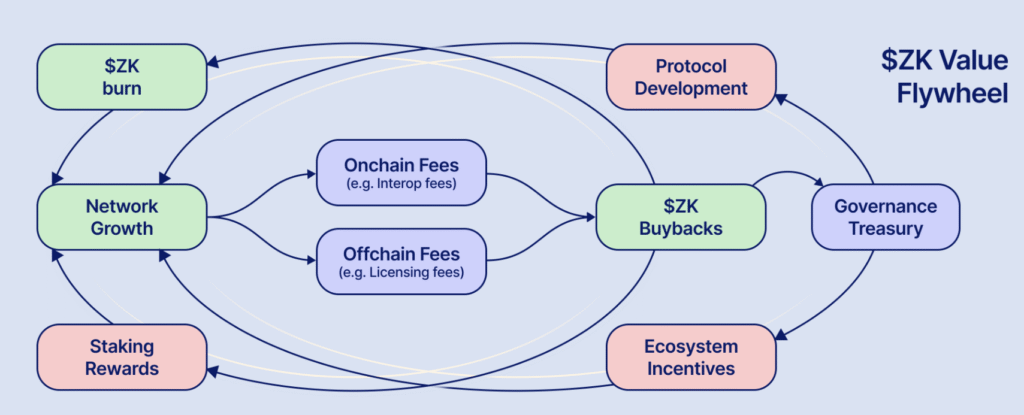
- On-chain value would be generated by interoperability fees to move assets across ZKsync and related private chains.
- Off-chain value would come from enterprise licensing of complex software modules designed specifically for financial institutions.
These affordable fees would provide a drastic change over expensive alternatives, such as SWIFT messaging, instead of adding friction.
Read also: Polygon Rio Upgrade Revolutionizes Payments with 5,000 TPS and Instant Finality
Core Features and Proposed Benefits
The architecture proposed creates a self-reinforcing economic flywheel:
- Revenue Aggregation: Every value flows into a treasury controlled by governance
- Token Buybacks: Ongoing acquisition of $ZK from open markets
- Value Distribution: Allocated between burning some tokens (to reduce supply) and funds for staking rewards to the network operator(s) and the ecosystem
- Sustainable Decentralization: Creates an economic incentive for value to flow to independent participants to preserve and secure the network
Read also: Solana Alpenglow Upgrade: 150ms Finality Could Make It Faster Than Stock Exchanges
Building a Self-Sustaining Cryptographic Economy
This ZkSync proposal signifies a progression of the network from experimental technology to economically stable technology infrastructure. In Gluchowski’s language, this could be thought of as “the heartbeat of an incorruptible economy”, aligning the value of a token with real-world usage and adoption by real world companies.
The model is now in the hands of the community for governance discussion and improvement. A potentially new way layer-2 networks can bring value to users, capture and distribute value.
FAQs
What is the main goal of the ZKsync Proposal?
The ZKsync Proposal aims to add concrete economic utility to the $ZK token by connecting its value to network revenue through buybacks, burns, and staking rewards.
How would the token gain value under this proposal?
Value would accrue through interoperability fees and enterprise licensing revenue, which would fund continuous token buybacks directly from the market, as well as reducing supply through burning.
What happens next for this proposal?
The ZKsync Proposal now enters a community discussion phase on governance forums, with detailed mechanics to follow once broad consensus is reached on the overall direction.
For more blockchain stories, read: Symbiosis Upgrades to Open Staking: SIS Holders Can Now Validate or Delegate Their Stake


