




The spread of artificial intelligence across the economy will force companies to rethink how digital payments work, and today only blockchain-based stablecoins are equipped to handle the volume and speed of machine-to-machine transactions, Circle CEO Jeremy Allaire said on Thursday.
AI Agents Seen as Next Big Users of Blockchain-Based Dollars
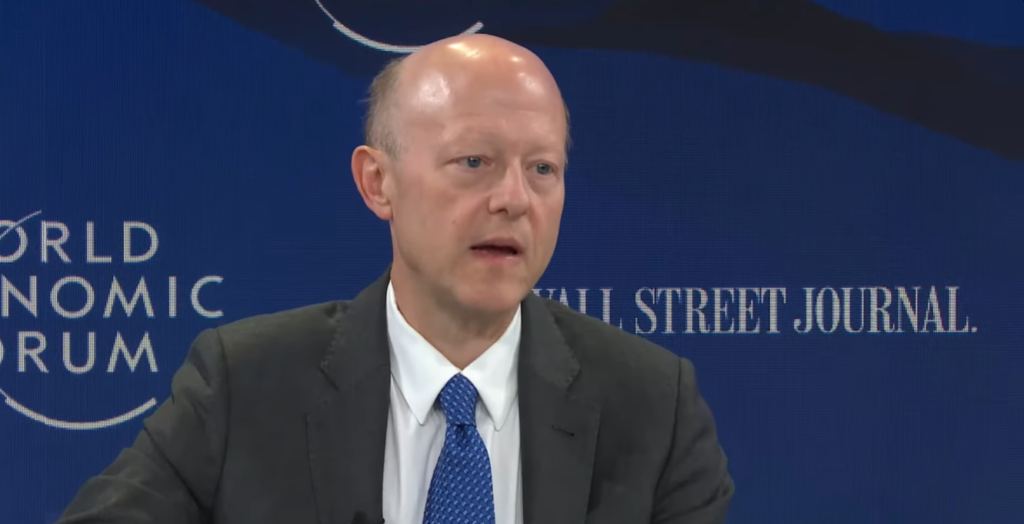
Speaking on a panel at the World Economic Forum in Davos, Allaire said the crypto industry has spent more than a decade trying to turn traditional money into simple digital objects that software can move and program, and that this work is now converging with the rise of autonomous AI systems.
Allaire added that smart-contract blockchains allow “digital dollars” to be embedded directly into software, enabling payments to be triggered and settled by code rather than banks or card processors, with these transactions verified on-chain, which is an important aspect when software agents are trading or buying services with little human involvement.
“What we’re really seeing is the next generation of blockchain networks … being designed specifically for agentic compute,” Allaire said, referring to systems built with AI-driven economic activity in mind.
Stablecoins Can be Used as Rails for AI Microtransactions
Allaire said he expects that kind of activity to expand rapidly. “Three years, five years from now, one can reasonably expect that there will be billions, literally billions, of AI agents conducting economic activity in the world on a continuous basis,” he said.
As those agents expand, they will need a way to pay for data, computing power, and online services in very small, frequent increments, he said. “They need an economic system. They need a financial system. They need a payment system. There is no other alternative, in my view, other than stablecoins to do that right now,” Allaire told the panel.
He said most emerging payment protocols aimed at AI agents are already using stablecoins as the settlement asset because the tokens can move at internet speed, work across borders, and support amounts down to fractions of a cent. By contrast, card networks and bank transfers are built around higher fees, slower settlement, and closed account systems, making them ill-suited to high-volume microtransactions, he argued.
Blockchain Records Seen Vital to Trust in AI Agents
Allaire also linked the use of blockchains to concerns about trust in AI. Beyond worries over incorrect or “hallucinated” outputs, he said organizations will need clearer ways to see which company or individual an AI agent represents and to audit the work it has paid for and delivered. Public ledgers, he added, can help by recording which entity controls an agent and by providing an auditable trail of its economic activity.
Big Tech Already Moving to Build Payment Rails for AI Agents
Allaire’s remarks come as large technology firms are already laying out payment infrastructure for AI systems.
In September last year, Google rolled out an open-source payments protocol designed to let AI applications move money on their own, using a mix of traditional payment methods and stablecoins.
The framework is meant to allow software “agents” to settle transactions with each other over existing rails, such as credit and debit cards, while also supporting stablecoins.
To build in stablecoin support, Google teamed up with cryptocurrency exchange Coinbase, which contributed its own AI-and-crypto payments architecture. The Ethereum Foundation and more than 60 other organizations, including Salesforce, American Express and Etsy, were also involved, showing that machine-to-machine payment protocols Allaire described in Davos are already being tested, with stablecoins positioned alongside legacy systems as a core settlement option.


