





The $15.96 billion figure attached to Friday’s combined Bitcoin and Ethereum options expiry on Deribit will likely dominate the headlines, but the number that actually matters is the distance between where spot prices are trading today and where the options structure says they should be. Bitcoin sits $4,235 below its max pain level of $75,000. Ethereum is trading $151 below its max pain level of $2,300. Those gaps, combined with diverging put/call ratios and a geopolitical deadline landing on the exact same day as expiry, make March 27 a session where the derivatives market and the news cycle are pulling on the same rope simultaneously.
The BTC Setup: 197,007 Contracts, Max Pain at $75,000
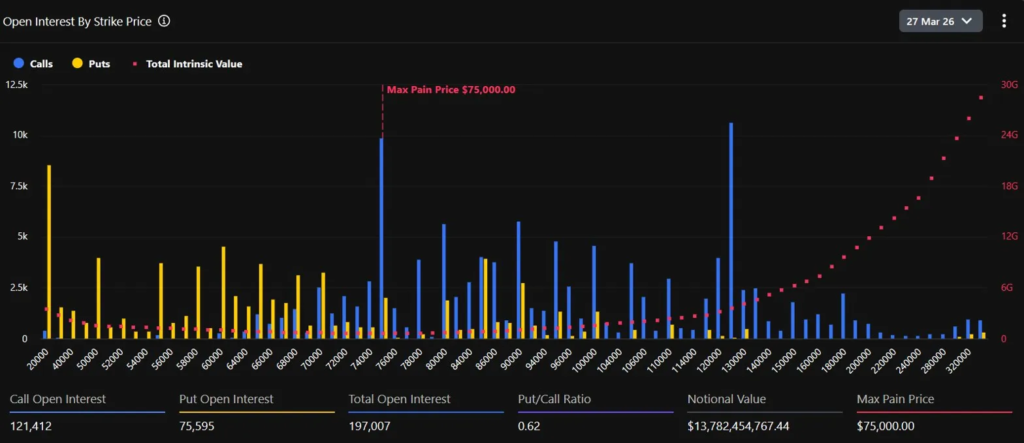
Bitcoin’s options chain heading into expiry shows 197,007 total contracts outstanding, carrying a notional value of $13.78 billion. Of those, 121,412 are calls and 75,595 are puts, producing a put/call ratio of 0.62. On the surface, that ratio reads as bullish positioning. The call side outweighs puts by roughly 61%.
But the max pain price tells a more nuanced story: $75,000. With Bitcoin trading near $70,765 at the time of writing, the spot sits roughly $4,235 below the level at which the maximum number of option holders lose the most money on expiration. For max pain theory to play out, Bitcoin would need to push higher into the settlement window. That is not a guarantee, but it identifies where market maker incentives are concentrated and where dealer hedging flows are likely to point.
The strike distribution sharpens the picture considerably. The single largest call cluster sits precisely at $75,000, with approximately 9,800 contracts, making it the most heavily contested strike on the entire board. A secondary call concentration appears at the $120,000 to $130,000 range, accumulating over 10,000 contracts combined, but those are deep out-of-the-money positions with negligible delta exposure for Friday’s print. They represent aspiration, not near-term price pressure.
On the put side, the $20,000 strike holds roughly 8,500 contracts. That is either tail-risk hedging placed during last year’s drawdown cycle or structural portfolio protection for large holders. At current prices, every one of those puts will expire worthless on Friday, resulting in a clean loss for whoever holds them. The more relevant put concentration sits between $60,000 and $68,000, where a cluster of shorter-dated protection has been accumulating. Those strikes are within range and carry real gamma exposure heading into the final 24 hours.
The practical implication for Friday’s price action is this: with 61.6% of open interest sitting on the call side and max pain sitting above spot, dealers are likely net short gamma in the $70,000 to $80,000 corridor. That creates conditions where upward price moves get amplified rather than dampened, as dealers are forced to buy into strength to hedge their delta exposure. It also means downside moves can accelerate if spot breaks below key support, as the same dealers reduce hedges on the way down. The market is not in a neutral zone. It is coiled.
The ETH Setup: 1,025,890 Contracts, Max Pain at $2,300
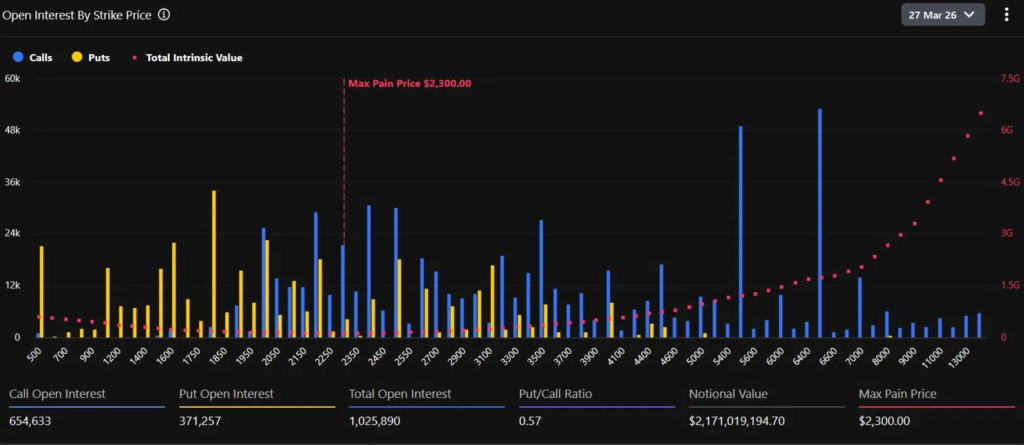
Ethereum’s expiry is structurally different in ways that are worth examining independently. Total open interest reaches 1,025,890 contracts, with a notional value of $2.17 billion. Calls account for 654,633 contracts versus 371,257 puts, yielding a put/call ratio of 0.57. That is meaningfully more put-heavy than Bitcoin on a relative basis, and it is the first signal that ETH options traders have been buying more downside protection proportionally heading into this event.
Ethereum was changing hands at $2,149 at time of writing, placing it spot $151 below its max pain level of $2,300. The gap is tighter in percentage terms than Bitcoin’s when measured against spot price, but that tighter gap combined with a lower put/call ratio creates a different risk profile. ETH needs a smaller absolute price move to reach max pain, but its options structure is less supportive of that move happening organically.
The strike structure confirms the more cautious positioning. Put open interest clusters heavily at the $1,750 to $1,850 range, with the $1,850 strike holding the largest single put concentration at approximately 34,000 contracts. That is substantial downside hedging for a level 14% below current spot. It tells you that a meaningful segment of the ETH options market has been positioning for a scenario where Ethereum revisits those levels, not as a speculative bet but as a hedge against a position they are already carrying.
On the call side, the $5,400 and $6,500 strikes hold the two largest concentrations, at approximately 50,000 and 49,000 contracts, respectively. Those strikes sit 151% to 202% above the current price. They are set to expire worthless on Friday and represent the residual optimism from earlier in the cycle that the market never validated.
Supply Context: Exchange BTC at a 7-Year Low
Layered underneath the options structure is a supply dynamic that adds further texture. Bitcoin held on exchanges has dropped to a seven-year low, a data point that tightens the available float for large options-related spot transactions. When dealers need to hedge delta exposure by purchasing spot Bitcoin, a thinner exchange supply means that buying hits the order book harder. It is a multiplier on the gamma dynamics described above. It does not change the direction, but it can exaggerate the magnitude of moves in either direction around the expiry window.
This also means that any post-expiry repositioning, where traders roll contracts or establish new positions based on the outcome, happens in a market with structurally less available supply than at any point in the past seven years. That context makes the $70,000 to $75,000 range more significant as a technical zone. It is a spot market inflection point with constrained liquidity on both sides.
The Technical Side to Focus
Three price levels are most relevant heading into the expiry window. For Bitcoin, $75,000 is the gravitational center from a max pain standpoint. A sustained hold above $72,000 through Thursday night would put that level in play with real momentum. Below $70,000, the put hedging between $60,000 and $68,000 starts gaining delta, and dealer selling pressure compounds the move.
For Ethereum, $2,300 is the equivalent max pain target, but the 0.57 put/call ratio and thin call wall between $2,300 and $5,000 suggest the market is less structurally supported in reaching it. The $2,100 level functions as the near-term floor where put protection starts becoming meaningful. A break below $2,000, in a geopolitical shock scenario, brings the $1,850 put cluster into focus.
Post-expiry, once the $15.96 billion in notional clears on Friday, the market will likely see a repositioning period where new directional bets are established with less structural friction. Historically, large options expiries have preceded sharp directional moves rather than resolving cleanly at max pain. With the geopolitical variable still live as of this writing, the direction of that post-expiry move may be determined by news flow rather than technical levels.


