





Markets rarely bottom cleanly; they bottom when two opposing forces stop pulling against each other, when the structural case for accumulation finally overpowers the macro conditions suppressing price. Right now, both forces are active and visible in Bitcoin’s data. One says the asset is entering a historically significant accumulation zone. The other says the global liquidity environment is not done tightening.
A 50% Drawdown and What It Actually Means
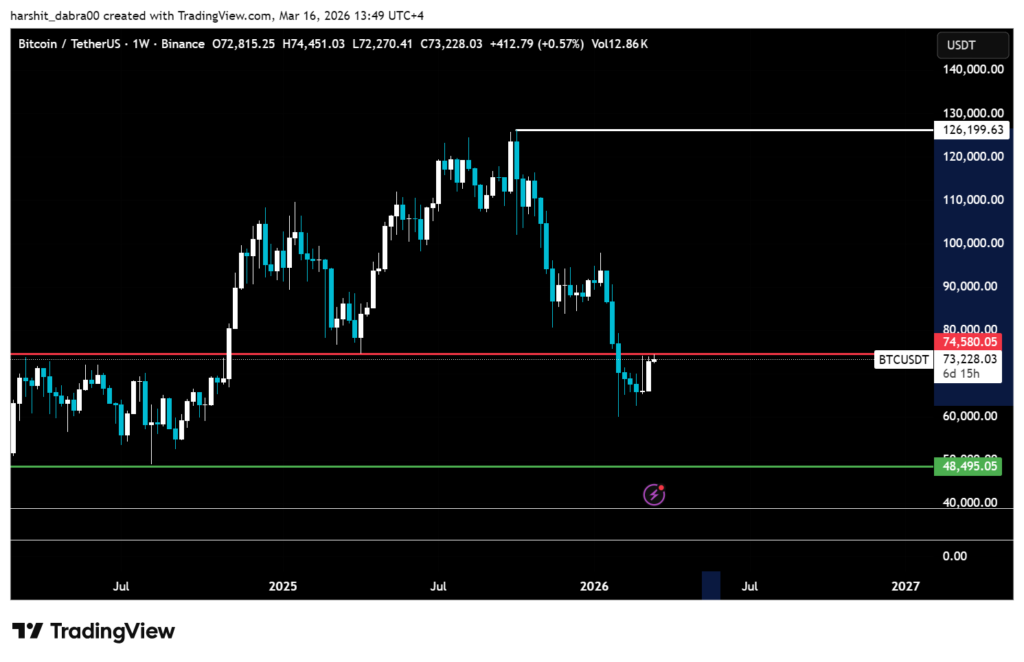
Bitcoin experienced a decline of nearly 50% from its October peak above $126,000 and dropped close to to $62,000 in late Feb 2026. That decline is not just a number. It is a valuation reset that historically compresses the market into territory where the composition of sellers begins to change. Speculative capital, the kind that entered late in the prior cycle chasing momentum, has largely been flushed out at this depth. What remains are longer-term holders whose cost basis sits well below current prices and new buyers entering deliberately rather than reactively.
Short-term momentum is currently positive, with the largest cryptocurrency being up 3.14% over 24 hours and 9.14% over seven days. But the medium-term structure tells the fuller story: down 23.43% over 60 days, down 14.42% over 90 days, and down 16.82% year-to-date. The bounce is real. The broader downtrend has not yet confirmed a reversal. Both are true and neither should be dismissed to make the narrative cleaner.
What the Onchain Data Is Actually Showing
Price is a lagging signal. On-chain flows move earlier, and right now they are building a specific picture.
Lacie Zhang, research analyst at Bitget Wallet, identifies the structural shift directly. Pointing to the convergence of realized price and MVRV metrics, Zhang states that these indicators “suggest Bitcoin may be entering the late stage of a typical bear cycle, a phase historically associated with long-term accumulation rather than continued capitulation.”
MVRV measures the ratio of Bitcoin’s current market value to its realized value, the aggregate cost basis of all coins based on the price at which they last moved. When that ratio compresses toward 1, the market is trading close to what the average holder paid. Historically, that zone does not produce further breakdown. It produces consolidation and the structural base that precedes the next directional move.
Exchange balance data reinforces the same thesis. Coins moving off exchanges signal holders are not preparing to sell. Zhang notes that “declining exchange balances and increasing whale accumulation reinforce this interpretation, indicating that longer-term investors may already be positioning ahead of the next cycle while BTC ETF inflows and expanding stablecoin liquidity continue to anchor the broader market.”
Whale wallet activity aligns with that reading. Larger holders are adding at current levels rather than reducing. BTC ETF inflows and expanding stablecoin liquidity extend the structural floor further, representing durable institutional demand and deployable capital that did not exist in prior cycles. These change the calculus of how deep a sustained drawdown can realistically go before structural buying overwhelms available supply.
Where the Macro Environment Is Complicating the Setup
Identifying an accumulation zone is not the same as identifying a recovery. The on-chain structure can locate where value is concentrating. It cannot determine how long macro forces keep the price suppressed within that zone.
Zhang is direct: “Macro dynamics could still delay a definitive bottom. Geopolitical tensions, along with the strong relationship between oil prices and the U.S. dollar index, are tightening global liquidity conditions and weighing on risk assets in the near term.”
The transmission mechanism is specific. Elevated oil prices feed into dollar strength through energy trade flows and inflation expectations. A stronger dollar reduces dollar-denominated liquidity available globally. Bitcoin, which appreciated from under $20,000 to above $126,000 during a period of historically loose monetary conditions, sits near the top of that sensitivity list when liquidity contracts.
This trend is visible in the data. The same period during which global liquidity tightened is the same period during which Bitcoin absorbed its sharpest medium-term drawdowns. The current short-term bounce does not erase that correlation. It raises the question of whether the macro environment has shifted enough to allow the on-chain accumulation signal to translate into sustained price appreciation, or whether the current move is another rally within a structure that has not yet found its definitive floor.
Geopolitical tension adds a layer that is harder to quantify but impossible to ignore. It historically drives dollar demand as a safe haven, tightening global liquidity further and introducing unpredictable risk-off events that can override technical and on-chain constructive setups regardless of how strong the underlying data appears.
The Range and What It Reflects
Zhang projects Bitcoin trading between $68,000 and $84,000 in the near term as markets search for equilibrium. Those boundaries directly reflect the tension that has been building.
The lower bound at $68,000 is where structural on-chain support metrics concentrate most densely. A move to that level would not represent failure. It would represent the macro headwinds winning the near-term timing battle while the structural case remains intact underneath.
The $84,000 ceiling is not a technical resistance level. It is a macro permission level. Price does not sustain above it until global liquidity conditions loosen, geopolitical pressure eases, or both deliver a simultaneous relief. Until that happens, every push toward the upper bound hands shorter-term holders a convenient exit, and the range resets.
What This Phase Demands From Investors
Zhang calls this period a “strategic accumulation phase rather than a clear recovery,” and that distinction is doing more work than it appears. Recovery phases have visible catalysts. The next move higher is not dependent on a Bitcoin-specific development. It is waiting on global liquidity to stop tightening, and that is a timeline nobody in the market controls. Price stays range-bound not because the thesis is wrong but because the trigger is external.
The on-chain data already shows who is navigating the market correctly: long-term holders and whale wallets building positions quietly, without leverage and excluding demands for immediate price confirmation. Leverage is the wrong instrument here and a range between $68,000 and $84,000, with macro uncertainty capping the upper end, creates the volatility that liquidates leveraged positions before the structural move materializes.
Until the 60-day and 90-day return figures begin turning positive, the medium-term structure has not confirmed what the short-term momentum is suggesting. The seven-day gain of 9.14% confirms buying pressure exists. It does not confirm the macro environment has shifted enough to sustain a breakout.


