



Bitcoin spot exchange-traded funds (ETFs) recorded their first net inflow after the five consecutive days of outflows. Yesterday, the metric experienced an inflow of $6.84M. The minor inflow, which brought a 0.67% Bitcoin price increase, prompted the price change to go back since it followed the pattern of institutional selling.
BlackRock’s IBIT received most of the inflows, while the outflows affected only one product, which was Bitwise’s BITB. The current total spot exchange-traded fund assets under management reach $113.54 billion, which represents 6.48% of Bitcoin’s total market value and shows that investors have made $56.50 billion in net inflows since the beginning of the product.
Spot ETF Flow Dynamics
BlackRock IBIT generated the net flow of $15.93 million, which increased its total historical investments to $62.92 billion. Grayscale’s Bitcoin Mini Trust ($BTC) provided additional support, recording $7.75 million in inflows and currently holding $1.96 billion in cumulative net subscriptions. The $10.97 million outflow from Bitwise BITB reduced the total financial gains, but the company still maintains a positive net financial entry of $2.16 billion.
Notably, the majority of other spot ETF products saw minimal or zero flows. This trend shows that institutional investors are more focused on the biggest and least costly options instead of spreading their investments across different providers.
ETF Market Structure Overview

At the time of writing, total spot Bitcoin ETF AUM stands at $113.54 billion, reinforcing the structural importance of ETFs within the broader Bitcoin market. The 6.48% ETF AUM to market cap ratio remains elevated relative to other newly financialized asset classes, underscoring sustained institutional participation despite recent volatility. Historical cumulative net inflows of $56.50 billion suggest that longer-term allocation trends remain intact, even as short-term flows fluctuate.
Bitcoin Technical Context
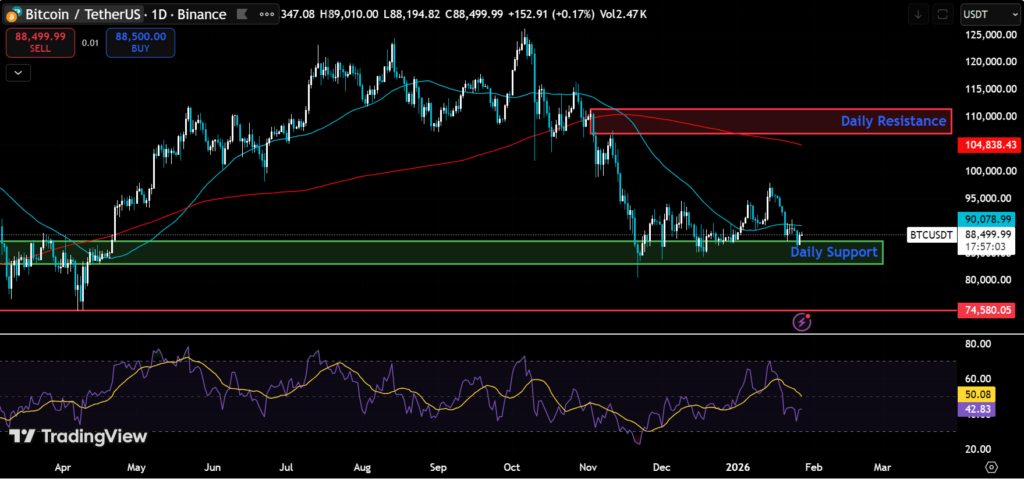
Bitcoin is trading near $88,300, based on ETF implied market capitalization, representing a 0.67% gain over the past 24 hours. On the daily timeframe, price action keeps on being constructive within a consolidation range. The largest cryptocurrency holds below both the 50-day SMA near $90,100 and the 200-day SMA near $104,800. The price is now holding above its daily support zone of $87,200 to $84,500. A sustained daily close below this region may weaken short-term momentum.
On the upside, resistance remains clustered around the level of $104,000, where psychological levels intersect with prior all-time high supply. The price needs to reclaim and create a strong market reversal through its high point of $91,500, which requires substantially higher volume to confirm. The market structure will change because the price move will break through the previous resistance point, which subsequent leads to the following daily resistance area where both supply and psychological barriers meet. The situation requires volume confirmation because a breakout with low liquidity increases the chances of false movements, which could result in the price returning to its previous range.
From the momentum indicators perspective, Bitcoin’s RSI (relative strength index), remains within normal limits. The metric currently stands at 43, indicating neutral market conditions; however, there might be a slight bullish tendency since selling pressure has cooled, although the asset must rise further to reach overbought status. If the bulls regain control above $91,500, then sentiment is expected to surge, which will help the market maintain its upward trend throughout the upcoming period.
Higher Timeframe and Risk Considerations
The weekly chart displays Bitcoin’s price range-bound movement below its all-time highs since the cryptocurrency experienced a strong upward movement that persists through 2025. Volume profile analysis shows that the market participants carried out most of their transactions between $80,000 and $85,000, which creates a high liquidity support zone in this price range. The recent ETF outflow period produced declining volume, but on-balance volume has now reached a stable level, which corresponds to the increase in ETF flows that have returned to slightly positive territory.
Macro liquidity conditions and the potential for renewed ETF outflows continue to pose downside risks. A deterioration in either could trigger a retest of the $80,000 region, particularly if risk assets broadly come under pressure.
Outlook
The $6.84 million net inflow shows no significant impact on total ETF assets under management, while the subsequent development of the trend after multiple days of outflows demonstrates important market indications. The Grayscale Mini Trust, together with IBIT, shows that investors prefer to invest in liquidity solutions that provide lower-cost access to financial markets. Bitcoin’s technical strength shows essential trend levels while market participants maintain neutral sentiment.
Consistent ETF inflows throughout the coming months will likely contribute to supporting the increased chances for the $90,000 range again. The price may get back to the $80,000 to $85,000 support level when investors initiate a sell-off of their assets. The risk-reward profile remains advantageous since Bitcoin stays above the daily support zone, which serves as the main indication for ETF flow patterns and trading volume.


