





Bitcoin is trading at $66,533, sitting 47.28% below its all-time high of $126,198, while the broader crypto market has shed roughly $2.29 trillion in total value over the same stretch. By conventional measures, those numbers describe a market in meaningful distress, yet the flow data tells a story that runs counter to what the price chart suggests, with institutional capital continuing to move into the asset class rather than away from it.
The Inflow Signal That Challenges the Price Action
Over the four weeks ending March 27, 2026, Bitcoin ETFs absorbed $2.3 billion in net inflows. This happened while the asset itself fell 4.06% in a single 24-hour window, 5.58% across seven days, and 23.90% over the past 90 days. The cumulative ETF base now sits at $96.32 billion in assets under management, a figure that reflects structural demand rather than speculative positioning.
This divergence between price and institutional flows is not accidental. It reflects a deliberate behavior pattern: institutional investors treat drawdowns as entry points, not exit signals. While $1.6 billion was pulled from Bitcoin ETFs between October and late February, the subsequent four-week reversal of $2.3 billion suggests that capital is returning faster than it departed.
The backdrop is a geopolitically charged environment. The joint U.S.-Israeli strike on Iran sent risk assets lower broadly, yet Bitcoin has outperformed both equities and gold in the same window, a comparison that fund managers are actively making when pitching allocations to new clients.
What the Technical Data Actually Shows
Over the 24 hours ending March 27 at 12:20 PM UTC, Bitcoin shed 3.9%, moving from $69,319 to $66,638. What the price series reveals is not a sharp break but a slow, controlled descent across multiple hourly intervals. Such price behavior has a distinct character: it points to systematic position reduction rather than forced exits.
The largest cryptocurrency is trading below every major moving average on the daily chart. The 7-day SMA sits at $69,802, the 30-day at $69,619, and the 200-day at $91,767; each one has a ceiling that the current price of $66,513 has yet to challenge. That stacking pattern, where short and medium-term averages cluster below the long-term baseline, tells technical traders the path of least resistance remains downward until price reclaims the $69,000 zone at minimum.
The MACD reading reinforces that the MACD line is at -24.17 against a signal line of 71, producing a histogram of -95.17. RSI sits at 46.14 on the 14-period measure, neutral but leaning toward weakness. The daily pivot is at $69,440, and reclaiming that level is the minimum requirement for any constructive technical shift.
None of this activity is disastrous; instead,; it reflects a market working through distribution pressure from large holders who accumulated near the cycle peak, combined with macro uncertainty. The RSI remains above oversold territory, indicating that forced selling has not yet occurred at scale.
The Derivatives Picture: Leverage, Liquidations, and What They Mean
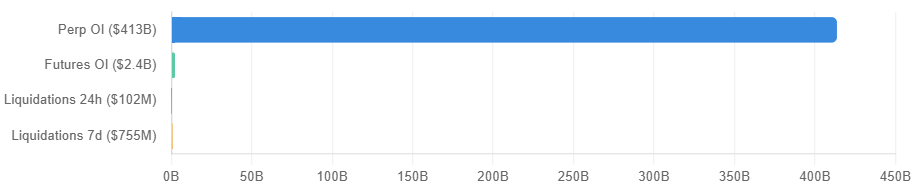
The derivatives market is where the short-term stress is most visible. Total open interest across BTC derivatives stands at $422.66 billion, a 1.4% rise in 24 hours. Perpetual open interest, which at $413.62 billion dominates the derivatives landscape, dropped 10.45% in the same period. Futures open interest fell even harder, down 24.43% to $2.36 billion.
The funding rate is currently negative at -0.0063361, a 293.16% move in the metric over 24 hours. Negative funding means short positions are paying longs to hold their positions, a structural signal that bearish bets have become crowded. Historically, crowded shorts in Bitcoin become fuel for sharp upside moves when sentiment shifts.
Liquidations totaled $102.31 million in the past 24 hours, up 51.43% day-over-day, with $754.74 million wiped out over seven days and $3.9 billion over the past month. These are meaningful numbers, but they have not cascaded into a systemic flush. The market is under pressure, not breaking.
The 24-hour correlation between Bitcoin and the Nasdaq (QQQ) stands at 0.845, which is high. This means that near-term Bitcoin price action is largely a function of macro risk sentiment, particularly around rate expectations and geopolitical developments. Institutional buyers who understand the situation are treating the current episode as a macro-driven entry window rather than a crypto-specific problem.
Why the $13 Trillion Projection Changes the Frame
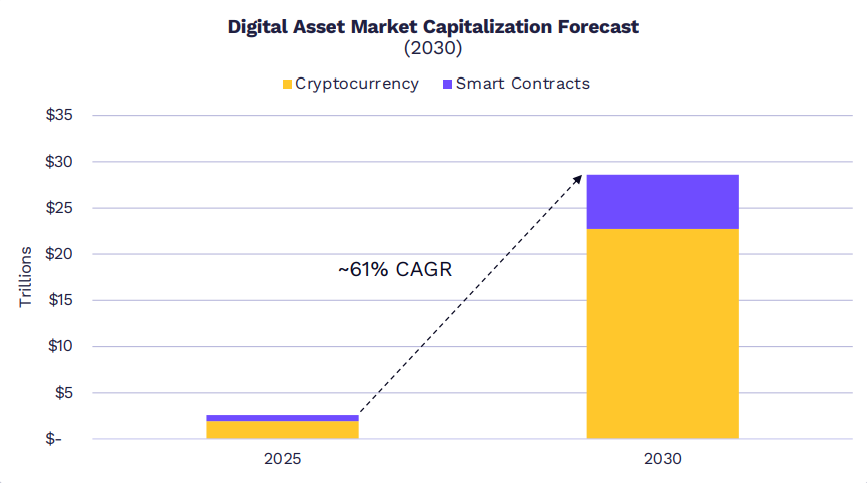
Ark Invest has forecast up to $13 trillion in institutional Bitcoin investment by 2030. That figure is worth examining not as a guarantee, but as a framing device. If even a fraction of that capital follows through, the demand architecture around Bitcoin changes fundamentally. ETF AUM of $96.32 billion against the asset’s total market cap of $1.33 trillion already represents a meaningful institutionalization of the asset. The four-week inflow pattern suggests that the capital formation process is ongoing, not paused.
The regulatory environment is a material tailwind. The SEC has classified Ether, Solana, and XRP as commodities, reducing legal uncertainty across the digital asset space. A stablecoin bill has been signed into law and the Clarity Act is in motion. Morgan Stanley launched a Bitcoin ETF this week, competing directly with BlackRock and Fidelity. JPMorgan now allows institutional clients to use crypto holdings as loan collateral. Fannie Mae is reportedly moving toward accepting crypto-backed mortgages. These are not marginal developments.
The Forward Picture
Bitcoin’s circulating supply is 20 million BTC against a maximum of 21 million. The supply constraint is fixed. The demand variable is not. Social sentiment currently sits at 4.62 out of 10, mildly bearish, consistent with a market that has been grinding lower for weeks. Bearish sentiment at these levels often precedes the slowdown in sell-side pressure rather than acceleration.
The selling wave attributed to large holders following the four-year halving cycle narrative appears to be losing momentum. If that pressure eases through April as indicated, Bitcoin faces a setup where supply-side headwinds diminish at the same time institutional inflows are re-establishing. The $69,440 pivot level on the daily chart is the near-term line to watch. A close above it resets the technical picture but until then, the data supports caution on short timeframes and a more constructive view for those with longer horizons. The $96.32 billion already sitting in Bitcoin ETFs does not evaporate with a 4% down day.


