





The global cryptocurrency market holds at $3.06 trillion. In the past 24 hours, the parameter has experienced a 1.4% drop. This slight drop can be attributed to profit-taking by traders who want to secure their short-term gains after a long period of bullishness, and selling in the spot market is the main reason for the price drop. The volumes for trading have stayed almost the same, which means that the price drop is not caused by panic selling or liquidation of the accounts due to leverage, but by a change in investors’ preference to more stable ecosystems. On the other hand, the measure of volatility has increased a bit, which is an indication of the short-term uncertainty being more pronounced as the market players are re-evaluating their positions in light of the cautious stance.
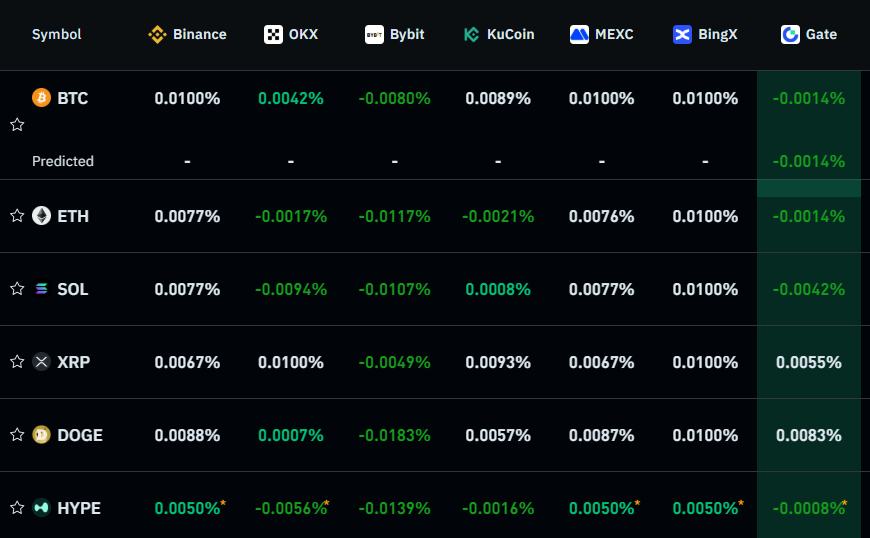
The fundamental indicators point to the current decline being more of a range-bound or consolidation phase than the starting point of a broad trend reversal. According to data sources like Coinglass, the funding rates across major perpetual futures contracts remain in positive territory, indicating sustained bullish bias among the market participants. Leverage ratios are also under control, with no instances of excessive optimism that could trigger downside risks. The current scenario points to a healthy retracement of recent rallies and sets the stage for the bullish side once the selling pressure takes a pause.
Bitcoin (BTC)
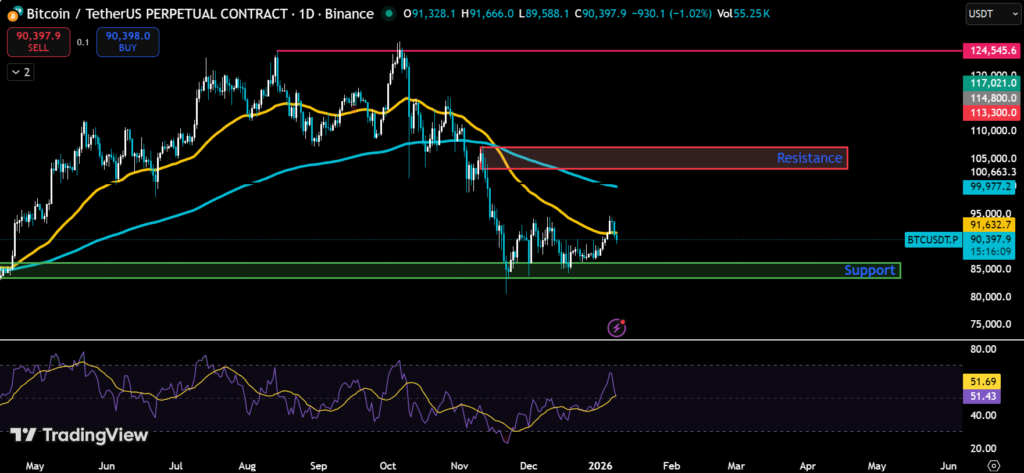
Bitcoin fell under $90,000, accompanied by a minor upside retracement around $90,400. The largest crypto asset experienced a 1.37% decline in the last 24 hours. The above chart reveals a clear downtrend from the all-time high zone around $124,545 (major resistance level), with price forming lower highs and being unable to reclaim the overhead resistance levels in the mid-$100,000s.
The asset’s key support sits at roughly $85,000-$90,000 (green zone), where price has found buyers multiple times that aligns with a long-term rising 200EMA (blue). The 50 EMA reflects the weakness, which is the dynamic resistance, while the volume stays at a moderate level without any strong conviction. For a bullish scenario, the price must break the resistance of about $91,500, and a continuous breakout can alter the current downward market structure.
Following the case, the next move can be a prior high of around $100,500. However, inability to hold the current daily support zone around $86,000 could signal a deeper pullback toward $74,000 that extends the broader distribution phase seen since late 2025. The short-term viewpoint for the asset ranges from neutral to bearish unless buyers start to scale up positions.
Ethereum (ETH)
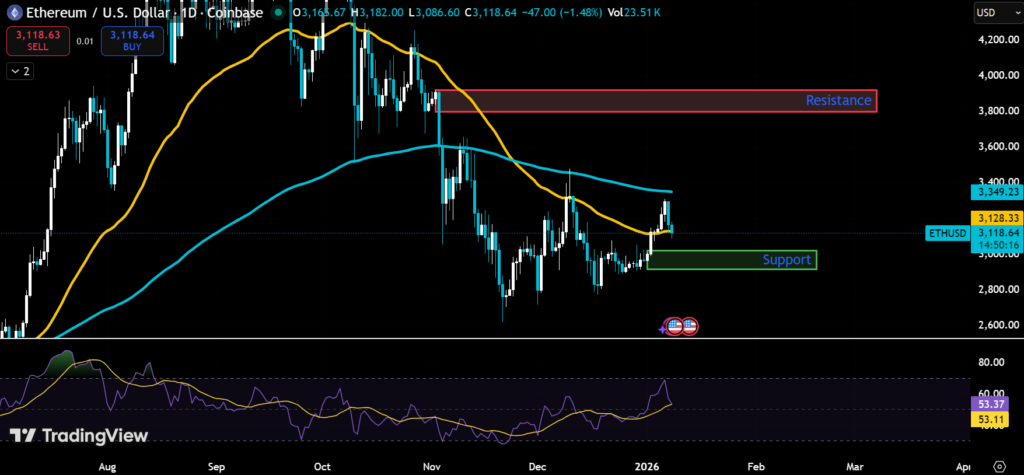
Ethereum has seen a drop of 3.5% in the past 24 hours, trading around $3,120. The daily chart displays a clear downtrend from the all-time high zone above $4,200, with prices forming lower highs and repeatedly failing to break the overhead resistance in the $3,800–$3,920 area.
Key support lies in the $3,000-$3,100 zone (green area), where buyers have stepped in multiple times. The daily RSI for the asset stands at 53.37. The blue moving average (200 EMA) is declining and providing dynamic resistance, while the 50 EMA (yellow) is acting as support for the price’s sustainability.
A significant move above the descending resistance (close to $3,500) can lead to a bullish trend, with the price aiming for the previous peaks of about $4,000 plus. On the other hand, if the asset doesn’t sustain the above-stated support levels, the price might drop to $2,750, thus extending the correction into early 2026. Short-term bias remains neutral to bearish pending a stronger buyer defense.
Broader Market Outlook
The current trend indicates a market sell off and it shows a tactical pause rather than a structural weakness. The positive funding rates accompanied by the controlled leverage significantly diminish the chance of a flash crash taking place, while the greater volatility might create favorable conditions for mean-reversion trades. The primary factors to keep an eye on would be the forthcoming U.S. economic data (e.g., inflation numbers) and the actions taken by the regulators, which can either make people more cautious or trigger a relief rally for the market.
Traders are now focusing on the volatile environment and favor selective exposure to ecosystems with strong fundamentals. It turns out to be crucial to decide on high-throughput chains or projects that carry real-world utility over broad beta plays. Risk management stays the crucial factor. The market participant should decide on the position sizing, which needs to account for potential tests of lower supports, with stop-losses below key levels like BTC’s $88,900. Overall, even though short-term headwinds persist, the absence of systemic breakdowns keeps the midterm uptrend in place, establishing crypto for a potential rebound of gains once the profit-taking trend exhausts.


